







Question: Read problem 2.6 of Beckers Optimization book (image attached below.) You dont have to solve this problem, just answer the following questions: What is the
Read problem 2.6 of Beckers Optimization book (image attached below.) You dont have to solve this problem, just answer the following questions:
What is the criterion for this problem? What are the choice variables and the constraints? What functions would you need to calculate to solve this problem? What are the parameters of this problem?
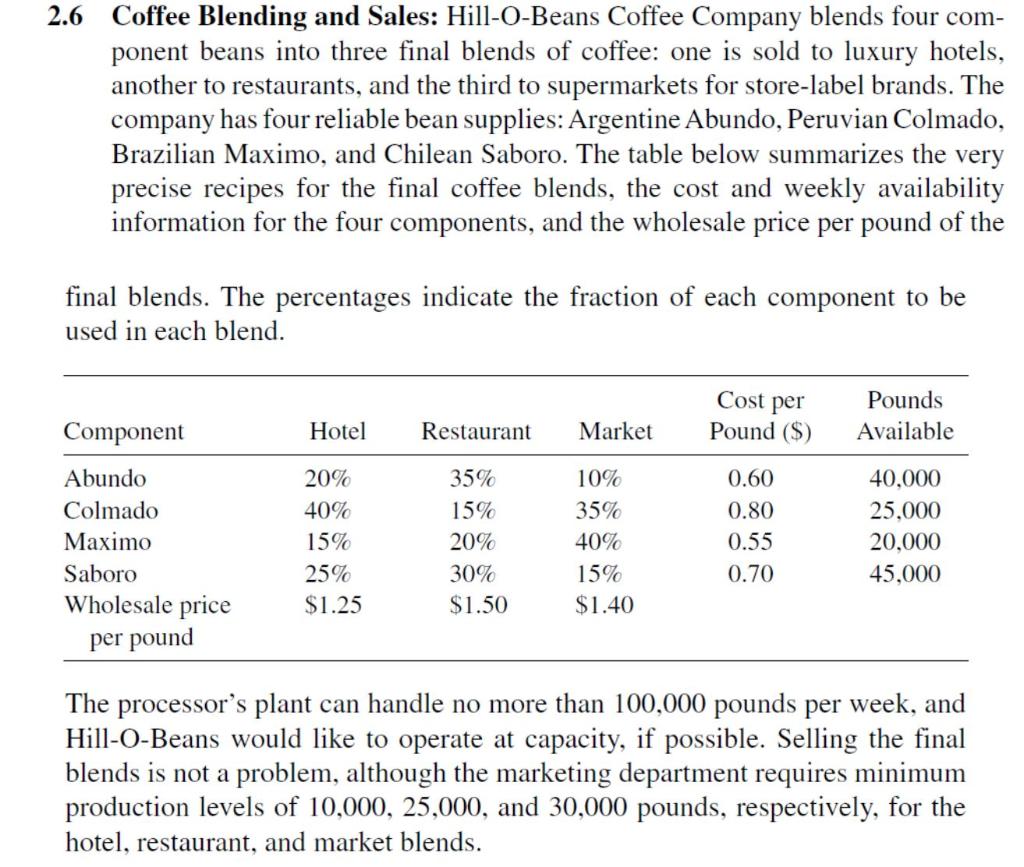
2.6 Coffee Blending and Sales: Hill-O-Beans Coffee Company blends four com- ponent beans into three final blends of coffee: one is sold to luxury hotels, another to restaurants, and the third to supermarkets for store-label brands. The company has four reliable bean supplies: Argentine Abundo, Peruvian Colmado, Brazilian Maximo, and Chilean Saboro. The table below summarizes the very precise recipes for the final coffee blends, the cost and weekly availability information for the four components, and the wholesale price per pound of the final blends. The percentages indicate the fraction of each component to be used in each blend. Cost per Pounds Available Component Hotel Restaurant Market Pound ($) Abundo Colmado Maximo Saboro Wholesale price per pound 20% 40% 15% 25% $1.25 35% 15% 20% 30% $1.50 10% 35% 40% 15% $1.40 0.60 0.80 0.55 0.70 40,000 25,000 20,000 45,000 The processor's plant can handle no more than 100,000 pounds per week, and Hill-O-Beans would like to operate at capacity, if possible. Selling the final blends is not a problem, although the marketing department requires minimum production levels of 10,000, 25,000, and 30,000 pounds, respectively, for the hotel, restaurant, and market blends. 2.6 Coffee Blending and Sales: Hill-O-Beans Coffee Company blends four com- ponent beans into three final blends of coffee: one is sold to luxury hotels, another to restaurants, and the third to supermarkets for store-label brands. The company has four reliable bean supplies: Argentine Abundo, Peruvian Colmado, Brazilian Maximo, and Chilean Saboro. The table below summarizes the very precise recipes for the final coffee blends, the cost and weekly availability information for the four components, and the wholesale price per pound of the final blends. The percentages indicate the fraction of each component to be used in each blend. Cost per Pounds Available Component Hotel Restaurant Market Pound ($) Abundo Colmado Maximo Saboro Wholesale price per pound 20% 40% 15% 25% $1.25 35% 15% 20% 30% $1.50 10% 35% 40% 15% $1.40 0.60 0.80 0.55 0.70 40,000 25,000 20,000 45,000 The processor's plant can handle no more than 100,000 pounds per week, and Hill-O-Beans would like to operate at capacity, if possible. Selling the final blends is not a problem, although the marketing department requires minimum production levels of 10,000, 25,000, and 30,000 pounds, respectively, for the hotel, restaurant, and market blends
Step by Step Solution
There are 3 Steps involved in it

Get step-by-step solutions from verified subject matter experts
 Study Help