Question: read question and answer number 10(only!), plz write cleary or u can type it. thank you A Lean Six Sigma DMAIC approach was taken to
read question and answer number 10(only!), plz write cleary or u can type it. thank you
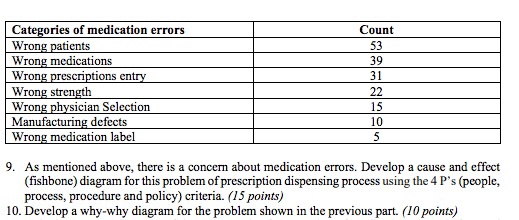
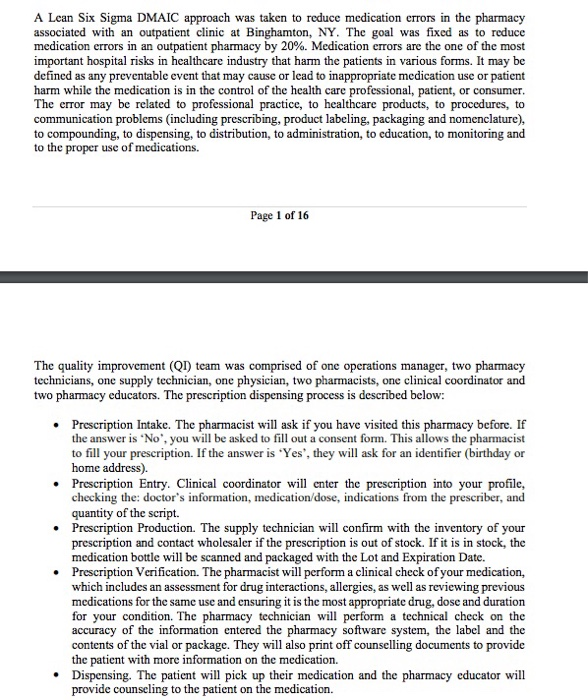
A Lean Six Sigma DMAIC approach was taken to reduce medication errors in the pharmacy associated with an outpatient clinic at Binghamton, NY. The goal was fixed as to reduce medication errors in an outpatient pharmacy by 20%. Medication errors are the one of the most important hospital risks in healthcare industry that harm the patients in various forms. It may be defined as any preventable event that may cause or lead to inappropriate medication use or patient harm while the medication is in the control of the health care professional, patient, or consumer. The error may be related to professional practice, to healthcare products, to procedures, to communication problems (including prescribing, product labeling, packaging and nomenclature), to compounding, to dispensing, to distribution, to administration, to education, to monitoring and to the proper use of medications. Page 1 of 16 The quality improvement (Q1) team was comprised of one operations manager, two pharmacy technicians, one supply technician, one physician, two pharmacists, one clinical coordinator and two pharmacy educators. The prescription dispensing process is described below: Prescription Intake. The pharmacist will ask if you have visited this pharmacy before. If the answer is 'No', you will be asked to fill out a consent form. This allows the pharmacist to fill your prescription. If the answer is "Yes", they will ask for an identifier (birthday or home address). Prescription Entry. Clinical coordinator will enter the prescription into your profile, checking the doctor's information, medication/dose, indications from the prescriber, and quantity of the script Prescription Production. The supply technician will confirm with the inventory of your prescription and contact wholesaler if the prescription is out of stock. If it is in stock, the medication bottle will be scanned and packaged with the Lot and Expiration Date. Prescription Verification. The pharmacist will perform a clinical check of your medication, which includes an assessment for drug interactions, allergies, as well as reviewing previous medications for the same use and ensuring it is the most appropriate drug, dose and duration for your condition. The pharmacy technician will perform a technical check on the accuracy of the information entered the pharmacy software system, the label and the contents of the vial or package. They will also print off counselling documents to provide the patient with more information on the medication. Dispensing. The patient will pick up their medication and the pharmacy educator will provide counseling to the patient on the medication. Categories of medication errors Wrong patients Wrong medications Wrong prescriptions entry Wrong strength Wrong physician Selection Manufacturing defects Wrong medication label Count 53 39 31 22 15 10 5 9. As mentioned above, there is a concem about medication errors. Develop a cause and effect (fishbone) diagram for this problem of prescription dispensing process using the 4 P's (people, process, procedure and policy) criteria. (15 points) 10. Develop a why-why diagram for the problem shown in the previous part. (10 points)









 Study Help