Question: Read the Analytics in Action, Procter & Gamble Uses Business Analytics to Redesign its supply chain then describes how analytics was used to drive efficiency
Read the Analytics in Action, Procter & Gamble Uses Business Analytics to Redesign its supply chain then describes how analytics was used to drive efficiency in Procter & Gambles North American supply chain. Which part of the article showed the Descriptive analytics? Predictive analytics? Prescriptive analytics?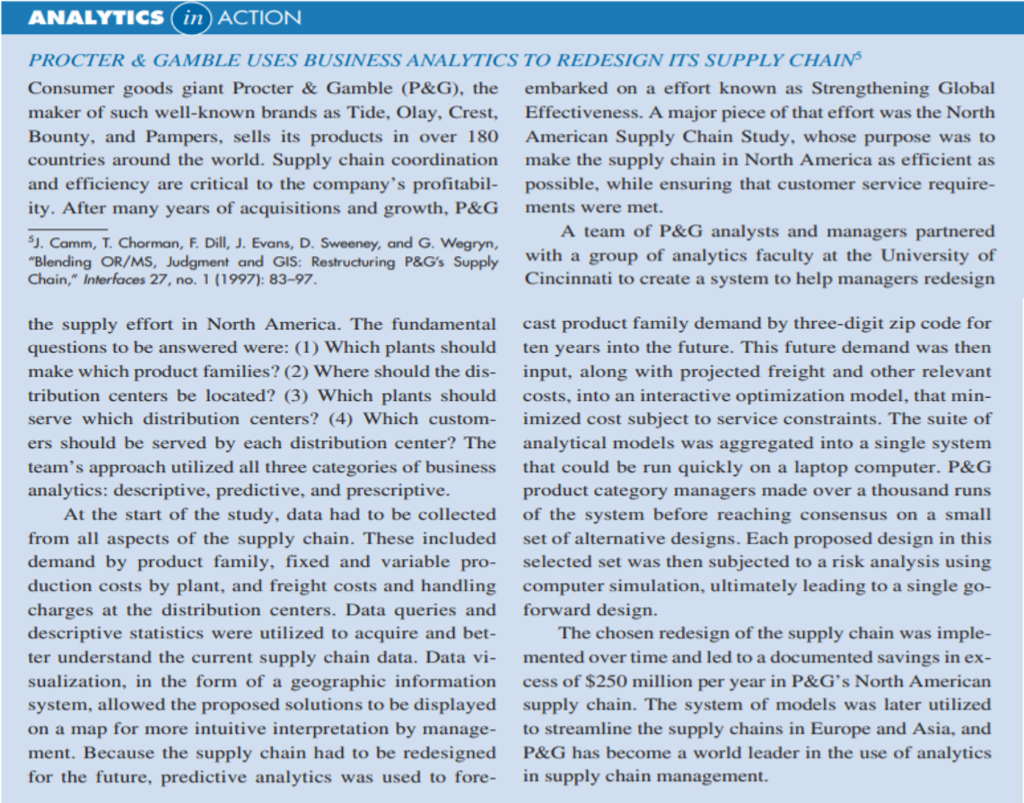
ANALYTICS in ACTION PROCTER & GAMBLE USES BUSINESS ANALYTICS TO REDESIGN ITS SUPPLY CHAINS Consumer goods giant Procter & Gamble (P&G), the embarked on a effort known as Strengthening Global maker of such well-known brands as Tide, Olay, Crest, Effectiveness. A major piece of that effort was the North Bounty, and Pampers, sells its products in over 180 American Supply Chain Study, whose purpose was to countries around the world. Supply chain coordination make the supply chain in North America as efficient as and efficiency are critical to the company's profitabil- possible, while ensuring that customer service require- ity. After many years of acquisitions and growth, P&G ments were met. A team of P&G analysts and managers partnered SJ. Camm, T. Chorman, F. Dill, J. Evans, D. Sweeney, and G. Wegryn, "Blending OR/MS, Judgment and GIS: Restructuring P&G's Supply with a group of analytics faculty at the University of Chain," Interfaces 27, no. 1 (1997): 83-97. Cincinnati to create a system to help managers redesign the supply effort in North America. The fundamental cast product family demand by three-digit zip code for questions to be answered were: (1) Which plants should ten years into the future. This future demand was then make which product families? (2) Where should the dis- input, along with projected freight and other relevant tribution centers be located? (3) Which plants should costs, into an interactive optimization model, that min- serve which distribution centers? (4) Which custom- imized cost subject to service constraints. The suite of ers should be served by each distribution center? The analytical models was aggregated into a single system team's approach utilized all three categories of business that could be run quickly on a laptop computer. P&G analytics: descriptive, predictive, and prescriptive. product category managers made over a thousand runs At the start of the study, data had to be collected of the system before reaching consensus on a small from all aspects of the supply chain. These included set of alternative designs. Each proposed design in this demand by product family, fixed and variable pro- selected set was then subjected to a risk analysis using duction costs by plant, and freight costs and handling computer simulation, ultimately leading to a single go- charges at the distribution centers. Data queries and forward design. descriptive statistics were utilized to acquire and bet- The chosen redesign of the supply chain was imple- ter understand the current supply chain data. Data vi- mented over time and led to a documented savings in ex- sualization, in the form of a geographic information cess of $250 million per year in P&G's North American system, allowed the proposed solutions to be displayed supply chain. The system of models was later utilized on a map for more intuitive interpretation by manage- to streamline the supply chains in Europe and Asia, and ment. Because the supply chain had to be redesigned P&G has become a world leader in the use of analytics for the future, predictive analytics was used to fore- in supply chain management









 Study Help