







Question: Read the article below and answer ALL the questions that follow. The New Barriers to Entry: Why Strategy Assumptions Need to Change in the Era
Read the article below and answer ALL the questions that follow.
The New Barriers to Entry: Why Strategy Assumptions Need to Change in the Era of Ecosystems
by Rita Gunther McGrath
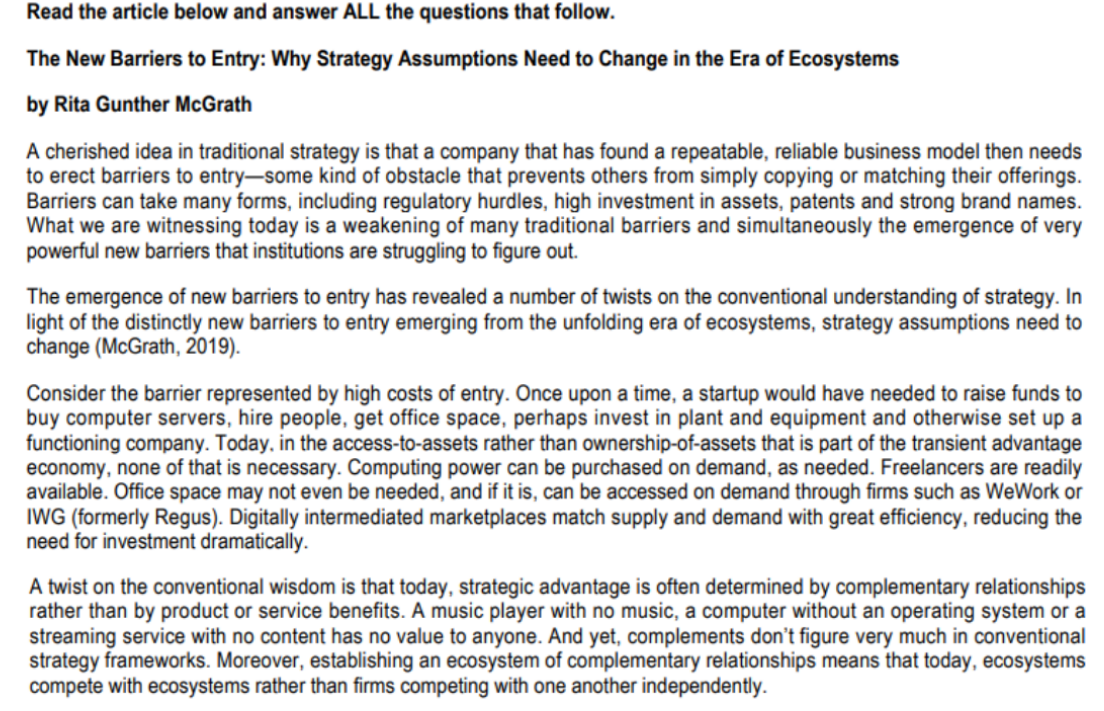
A cherished idea in traditional strategy is that a company that has found a repeatable, reliable business model then needs
to erect barriers to entrysome kind of obstacle that prevents others from simply copying or matching their offerings.
Barriers can take many forms, including regulatory hurdles, high investment in assets, patents and strong brand names.
What we are witnessing today is a weakening of many traditional barriers and simultaneously the emergence of very
powerful new barriers that institutions are struggling to figure out.
The emergence of new barriers to entry has revealed a number of twists on the conventional understanding of strategy. In
light of the distinctly new barriers to entry emerging from the unfolding era of ecosystems, strategy assumptions need to
change McGrath
Consider the barrier represented by high costs of entry. Once upon a time, a startup would have needed to raise funds to
buy computer servers, hire people, get office space, perhaps invest in plant and equipment and otherwise set up a
functioning company. Today, in the accesstoassets rather than ownershipofassets that is part of the transient advantage
economy, none of that is necessary. Computing power can be purchased on demand, as needed. Freelancers are readily
available. Office space may not even be needed, and if it is can be accessed on demand through firms such as WeWork or
IWG formerly Regus Digitally intermediated marketplaces match supply and demand with great efficiency, reducing the
need for investment dramatically.
A twist on the conventional wisdom is that today, strategic advantage is often determined by complementary relationships
rather than by product or service benefits. A music player with no music, a computer without an operating system or a
streaming service with no content has no value to anyone. And yet, complements don't figure very much in conventional
strategy frameworks. Moreover, establishing an ecosystem of complementary relationships means that today, ecosystems
compete with ecosystems rather than firms competing with one another independently.
Step by Step Solution
There are 3 Steps involved in it
1 Expert Approved Answer
Step: 1 Unlock

Question Has Been Solved by an Expert!
Get step-by-step solutions from verified subject matter experts
Step: 2 Unlock
Step: 3 Unlock
 Study Help