







Question: Read the attached case study about the 1996 class-action lawsuit against Mitsubishi Motors for gross sexual harassment. Then discuss the following questions. You should write
Read the attached case study about the 1996 class-action lawsuit against Mitsubishi Motors for gross sexual harassment. Then discuss the following questions. You should write one or two paragraphs (75-150 words).
 How could the company have prevented these problems in the first place?
Think critically: what values were violated by Mitsubishi managers in allowing these things to happen?
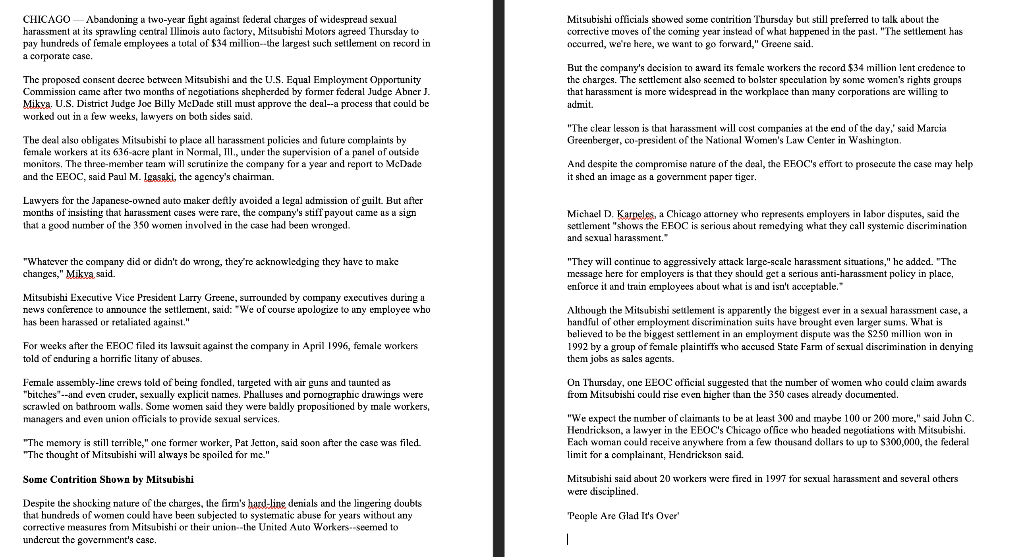
CHICAGO Abandoning a two-year fight against federal charges of widespread sexual harassment at its sprawling central Illinois auto factory, Mitsubishi Motors agreed Thursday to pay hundreds of female employees a total of $34 million--the largest such settlement on record in a corporate case. Mitsubishi officials showed some contrition Thursday but still preferred to talk about the corrective moves of the coming year instead of what happened in the past. "The settlement has occurred, we're here, we want to go forward," Greene said. But the company's decision to award its female workers the record $34 million lent credence to the charges. The settlement also seemed to bolster speculation by some women's rights groups that harassinent is more widespread in the workplace than many corporations are willing to admit. The proposed consent decree between Mitsubishi and the U.S. Equal Employment Opportunity Commission came after two months of negotiations shepherded by former federal Judge Abner J. Mikva. U.S. District Judge Joe Billy McDade still must approve the deal-a process that could be worked out in a few weeks, lawyers on both sides said. The deal also obligates Mitsubishi to place all harassitient policies and future complaints by female workers at its 636-acre plant in Normal, III., under the supervision of a panel of outside monitors. The three-member team will scrutinize the company for a year and report to McDade and the EEOC, said Paul M. Igasaki, the agency's chairman. Lawyers for the Japanese-owned auto maker deftly avoided a legal admission of guilt. But after months of insisting that burussment cuses were rare, the company's stiff payout came us a sign that a good number of the 350 women involved in the case had been wronged. "The clear lesson is that harassment will cost companies at the end of the day,' said Marcia Greenberger, co-president of the National Women's Law Center in Washington, And despite the compromise nature of the deal, the EEOC's effort to prosecute the case may help it shed an image as a government paper tiger. Michael D. Karneles, a Chicago attorney who represents employers in labor disputes, said the settlement "shows the EFOC is serious ahout remedying what they call systemic discrimination and sexual harassment." "Whatever the company did or didn't do wrong, they're acknowledging they have make changes," Mikya said. Mitsubishi Executive Vice President Larry Greene, surrounded by company executives during a news conference to announce the settlement, said: "We of course upologize to any employee who has been harassed or retaliated against." 18 For weeks after the EFOC filed its lawsuit against the company in April 1996, female workers told of enduring a horrific litany of abuses. "They will continue to aggressively attack large-scale harassment situations," he added. "The message here for employers is that they should get a scrious anti-harassment policy in place, enforce it und train employees about what is and isn't acceptable." handful of other employment discrimination suits have brought even larger sums, What i Although the Mitsubishi settlement is apparently the biggest ever in a sexual harassment case, a believed to be the biggest settlement in an employment dispute was the $250 million won in 1992 by a group of female plaintiffs who accused State Farm of sexual discrimination in denying them jobs as sales agents. On Thursday, one EEOC official suggested that the number of women who could claim awards from Mitsubishi could rise even higher than the 350 cases already documented. "We expect the number of claimants to be at least 300 and maybe 100 or 200 more," said John C. Hendrickson, a lawyer in the EEOC's Chicago office who headed negotiations with Mitsubishi, Each woman could receive anywhere from a few thousand dollars to up to $300,000, the federal limit for a complainant, Hendrickson said. Female assembly-line crews told of being fonciled, turgeted with air guns and taunted as "bitches"--and even cruder, sexually explicit names. Phalluses and pornogruphic druwings were Scrawled on bathroom walls. Some women said they were baldly propositioned by male workers, managers and even union officials to provide sexual services. "The memory is still terrible," one former worker, Pat Jetton, said soon after the case was filed. "The thought of Mitsubishi will always be spoiled for me." Some Contrition Shown by Mitsubishi Despite the shocking nature of the charges, the firm's hard-line denials and the lingering doubts that hundreds of women could have been subjected to systematic abuse for years without any corrective measures from Mitsubishi or their union--the United Auto Workers--seemed to undercut the government's casc. Mitsubishi said about 20 workers were fired in 1997 for sexual harassment and several others were disciplined. People Are Glad It's OverStep by Step Solution
There are 3 Steps involved in it
1 Expert Approved Answer
Step: 1 Unlock

Question Has Been Solved by an Expert!
Get step-by-step solutions from verified subject matter experts
Step: 2 Unlock
Step: 3 Unlock
 Study Help