Question: Read the attached case study about the Tuskegee Syphilis Experiment. Then discuss the following questions. You should write one or two paragraphs (75-150 words). Why
Read the attached case study about the Tuskegee Syphilis Experiment. Then discuss the following questions. You should write one or two paragraphs (75-150 words).
Why did the State Department carry out this experiment? Was there moral reason to do so?
Does the case uphold or violate the principles related to autonomy and respect for persons? In what way?
What was the eventual result of the experiment? Can you infer how it affects medical ethics today?
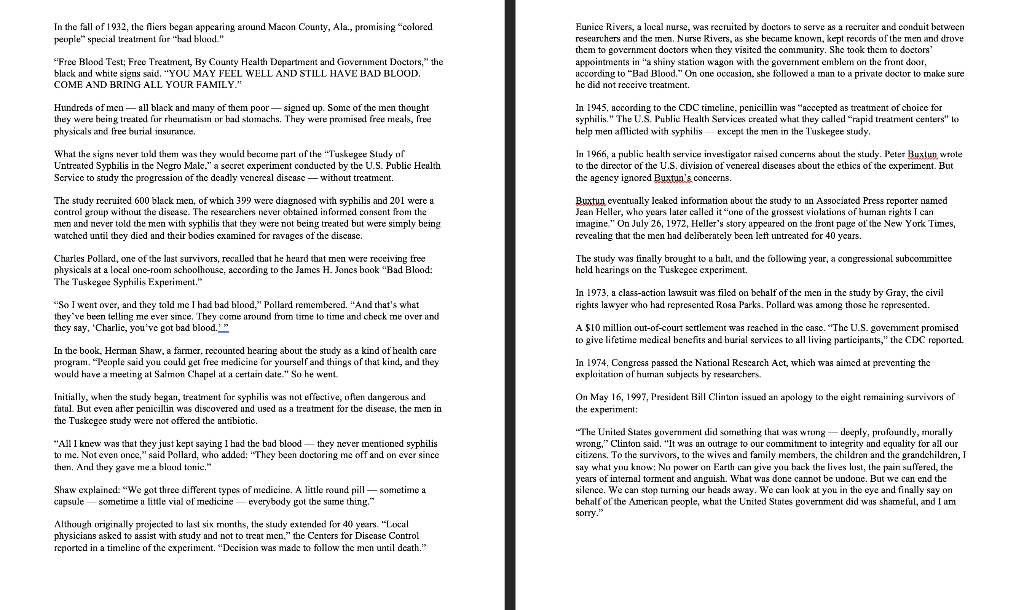
In the fall of 1932, the fliers began appearing around Macon County, Ala., promising "colored people special treatment for "bad blood." Free Blood Test; Free Treatment, By County Health Department and Government Doctors," the black and white signs said. "YOU MAY FEEL WELL AND STILL HAVE BAD BLOOD COME AND BRING ALL YOUR FAMILY." Funice Rivers, a local nurse, was recruited by doctors to serve as a recruiter and conduit between researchers and the men. Nurse Rivers, as she became known, kept records of the men and drove them to government doctors when they visited the community. She took them to doctors appointments in a shiny station wagon with the government emblem on the front door, according to "Bad Blood." On one occusion, she followed u min to a private doctor to make sure he did not receive treatment. In 1945, according to the CDC timeline, penicillin was "accepted as treatment of choice for syphilis." The U.S. Public Health Services created what they called rapid treatment centers" to help men alllicted with syphilis except the men in the Tuskegee study, In 1966, a public health service investigator raised concerns about the study, Peter Buxtun wrote to the director of the U.S. division of venercal diseases about the ethics of the experiment. But the agency ignored Buxtun's concerns, Buxtun eventually leaked information about the study to an Associated Press reporter named Jean Heller, who years later called it one of the grossest violations of human rights I can imagine." On July 26, 1972, Heller's story uppeared on the front page of the New York Times, revealing that the men bad deliberately been left untreated for 40 years. The study was tinally brought to u bult, and the following year, a congressional subcommittee held hearings on the Tuskegee experiment. Hundreds of meu all black and many of them poor signed up. Some of the men thought they were being treated for rheumatism or bad stomachs. They were promised free meals, Tree physicals and free burial insurance, What the signs never told them was they would become part of the "Tuskegee Study of Untreated Syphilis in the Negro Male," a secret experiment conducted by the U.S. Public Health Service to study the progression of the deadly vencrcal discasc - without treatment, The study recruited 600 black men, of which 399 were diagnosed with syphilis and 201 were a control group without the disease. The researchers never obtained informed consent from the men und never told the men with syphilis that they were not being treated but were simply being watched until they died and their bodics cxamined for ravages of the discasc. Charles Pollard, one of the last survivors, recalled that he heard that men were receiving free physicals at a local onc-room schoolhouse, according to the James H. Jones book "Bad Blood: The Tuskegee Syphilis Experiment." "So I went over, and they told me I had bad blood," Pollard remembered. "And that's what they've been telling me ever since. They come around from time to time and check me over and they say, 'Charlic, you've got bad blood. In the book. Herman Shaw, a farmer, recounted hearing about the study as a kind of health care program. "People said you could get free medicine for yourself and things of that kind, and they would have a meeting at Salmon Chapel at a certain date." So he went. Initially, when the study began, treatment for syphilis was not effective, often dangerous and fotal. But even after penicillin was discovered and used as a treatment for the discuse, the men in the Tuskegee study were not offered the antibiotic. "All I knew was that they just kept saying I had the bad blood - they never mentioned syphilis to me. Not even once," said Pollard, who added: "They been doctoring me off and on ever since then. And they gave me a blood tonic." Shaw explained: "We got three different types of medicine. A little round pill sometime a capsule - sometime little vial of medicine - everybody got the same thing." Although originally projected to last six months, the study extended for 40 years. "Local physicians asked to assist with study and not to treat men." the Centers for Discasc Control reported in a timeline of the experiment. "Decision was made to follow the men until death." In 1973. a class-action lawsuit was filed on behalf of the mea in the study by Gray, the civil rights lawyer who had represented Rosa Parks. Pollard was among those he represented. A $10 million out-of-court settlement was reached in the case. "The U.S. govemment promised to give lifetime medical benefits and burial services to all living participants," the CDC reported. In 1974. Congress passed the National Research Act, which was aimed at preventing the exploitation of human subjects by researchers. On May 16, 1997, President Bill Clinton issued an apology to the eight remaining survivors of the experiment: "The United States government did something that was wrong - deeply, profoundly, murally wrong." Clinton said. "It was un outrage to our commitment to integrity and equality for all ou citizens. To the survivors, to the wives and family members, the children and the grandchildren, I say what you know: No power on Earth can give you back the lives lust, the pain suffered, the years of internal torment and anguish. What was done cannot be undone. But we can end the silence. We can stop turning our heads away. We can look at you in the eye and finally say on behalf of the American people, what the United States government did was shameful, and I am sorry









 Study Help