Question: Read the attached case study and answer the following questions: 1. Summarize the case study in your own words. What factors enabled Nokia to establish
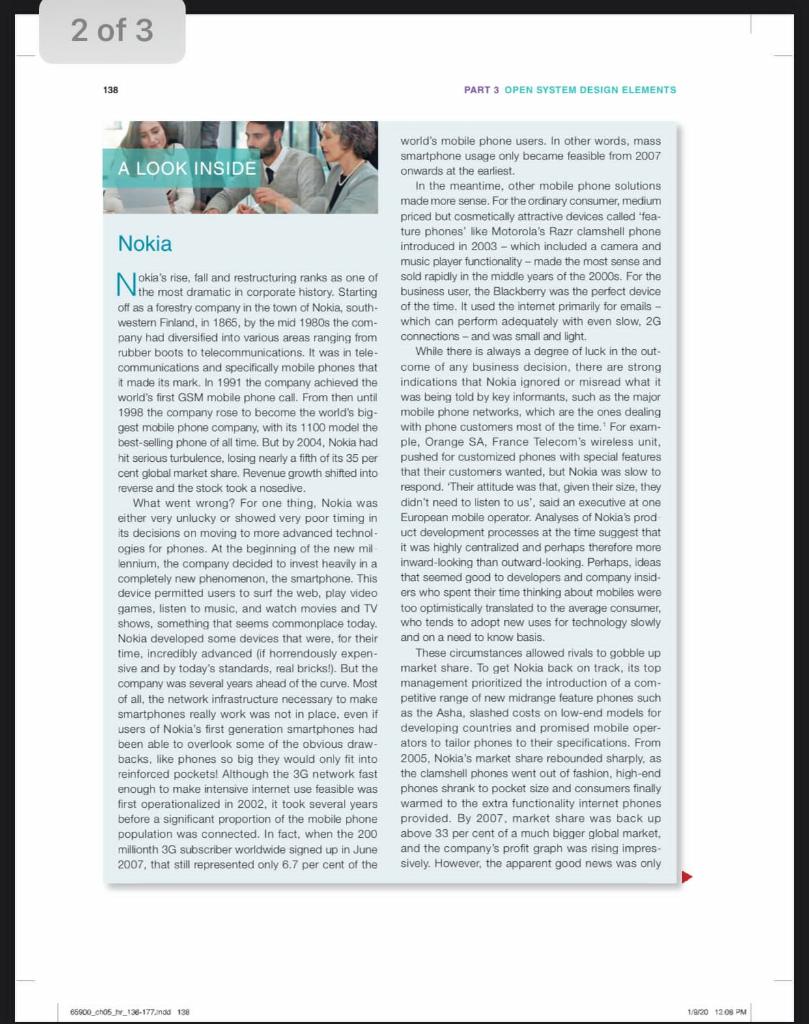
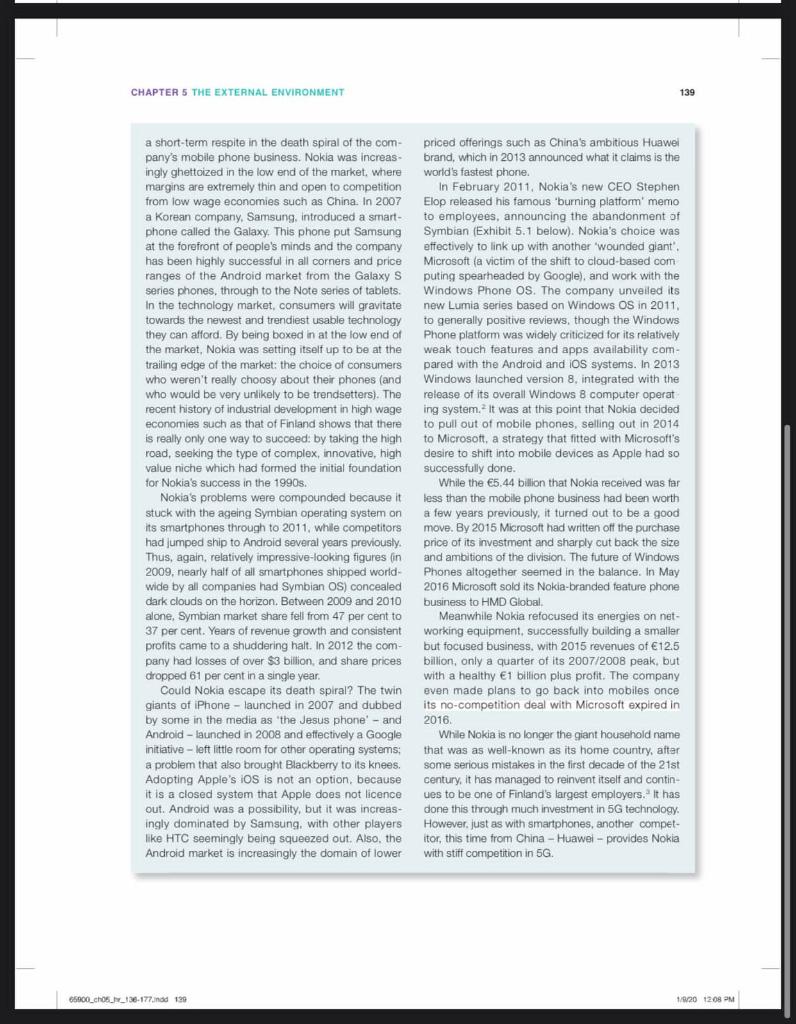
Read the attached case study and answer the following questions: 1. Summarize the case study in your own words. What factors enabled Nokia to establish leadership in mobile phone business in 1990s and early 2000s (150 Words) (2 Marks) 2. In your opinion shy did Nokia lose it mobile phone market share by and after 2004. If you where the CEO of the Nokia Company what strategies would you have implemented to save the company's mobile phone business. (2.0 Marks) 3. From the case study identify and quote/list the statements that show that Nokia could not adapt well to the changing environment which became the reason for the loss of its mobile phone business. (1 Marks) 2 of 3 138 PART 3 OPEN SYSTEM DESIGN ELEMENTS A LOOK INSIDE Nokia okia's rise, fall and restructuring ranks as one of off as a forestry company in the town of Nokia, south- westem Finland, in 1865, by the mid 1980s the com- pany had diversified into various areas ranging from rubber boots to telecommunications. It was in tele- communications and specifically mobile phones that it made its mark. In 1991 the company achieved the world's first GSM mobile phone call. From then until 1998 the company rose to become the world's big- gest mobile phone company, with its 1100 model the best-selling phone of all time. But by 2004. Nokia had hit serious turbulence, losing nearly a fifth of its 35 per cent global market share. Revenue growth shifted into reverse and the stock took a nosedive. What went wrong? For one thing, Nokia was either very unlucky or showed very poor timing in its decisions on moving to more advanced technol- ogies for phones. At the beginning of the new mil lennium, the company decided invest heavily in a completely new phenomenon, the smartphone. This device permitted users to surf the web, play video games, listen to music, and watch movies and TV shows, something that seems commonplace today. Nokia developed some devices that were, for their time, incredibly advanced (if horrendously expen- sive and by today's standards, real bricks!). But the company was several years ahead of the curve. Most of all, the network infrastructure necessary to make smartphones really work was not in place, even if users of Nokia's first generation smartphones had been able to overlook some of the obvious draw- backs, like phones so big they would only fit into reinforced pockets Although the 3G network fast enough to make intensive internet use feasible was first operationalized in 2002. it took several years before a significant proportion of the mobile phone population was connected. In fact, when the 200 millionth 3G subscriber worldwide signed up in June 2007, that still represented only 6.7 per cent of the world's mobile phone users. In other words, mass smartphone usage only became feasible from 2007 onwards at the earliest. In the meantime, other mobile phone solutions made more sense. For the ordinary consumer, medium priced but cosmetically attractive devices called "fea- ture phones' like Motorola's Razr clamshell phone introduced in 2003 - which included a camera and music player functionality-made the most sense and sold rapidly in the middle years of the 2000s. For the business user, the Blackberry was the perfect device of the time. It used the intemet primarily for emails which can perform adequately with even slow. 2G connections - and was and light While there is always a degree of luck in the out- come of any business decision, there are strong indications that Nokia ignored or misread what it was being told by key informants, such as the major mobile phone networks, which are the ones dealing with phone customers most of the time. For exam- ple, Orange SA, France Telecom's wireless unit, pushed for customized phones with special features that their customers wanted, but Nokia was slow to respond. Their attitude was that, given their size, they didn't need to listen to us', said an executive at one European mobile operator. Analyses of Nokia's prod uct development processes at the time suggest that it was highly centralized and perhaps therefore more inward-looking than outward-looking. Perhaps, Ideas that seemed good to developers and company insid- ers who spent their time thinking about mobiles were too optimistically translated to the average consumer, who tends to adopt new uses for technology slowly na need to know basis. These circumstances allowed rivals to gobble up market share. To get Nokia back on track, its top management prioritized the introduction of a com- petitive range of new midrange feature phones such as the Asha, slashed costs on low-end models for developing countries and promised mobile oper- ators to tailor phones to their specifications. From 2005. Nokia's market share rebounded sharply, as the clamshell phones went out of fashion, high-end phones shrank to pocket size and consumers finally warmed to the extra functionality internet phones provided. By 2007. market share was back up above 33 per cent of a much bigger global market. and the company's profit graph was rising impres- sively. However, the apparent good news was only and on 85900_Ch05_136-177d 138 1/9/201208 PM CHAPTER 5 THE EXTERNAL ENVIRONMENT 139 a short-term respite in the death spiral of the com- pany's mobile phone business. Nokia was increas- ingly ghettoized in the low end of the market, where margins are extremely thin and open to competition from low wage economies such as China. In 2007 a Korean company, Samsung, introduced a smart- phone called the Galaxy, This phone put Samsung at the forefront of people's minds and the company has been highly successful in all corners and price ranges of the Android market from the Galaxy S series phones, through to the Note series of tablets. In the technology market, consumers will gravitate towards the newest and trendiest usable technology they can afford. By being boxed in at the low end of the market, Nokia was setting itself up to be at the trailing edge of the market: the choice of consumers who weren't really choosy about their phones (and who would be very unlikely to be trendsetters). The recent history of industrial development in high wage economies such as that of Finland shows that there is really only one way to succeed: by taking the high road, seeking the type of complex, innovative, high value niche which had formed the initial foundation for Nokia's success in the 1990s. Nokia's problems were compounded because it stuck with the ageing Symbian operating system on its smartphones through to 2011, while competitors had jumped ship to Android several years previously Thus, again, relatively impressive-looking figures in 2009, nearly half of all smartphones shipped world- wide by all companies had Symbian OS) concealed dark clouds on the horizon. Between 2009 and 2010 alone, Symbian market share fell from 47 per cent to 37 per cent. Years of revenue growth and consistent profits came to a shuddering halt. In 2012 the com- pany had losses of over $3 billion, and share prices dropped 61 per cent in a single year. Could Nokia escape its death spiral? The twin giants of iPhone - launched in 2007 and dubbed by some in the media as 'the Jesus phone' - and Android - launched in 2008 and effectively a Google initiative - left little room for other operating systems: a problem that also brought Blackberry to its knees. Adopting Apple's iOS is not an option, because it is a closed system that Apple does not licence out. Android was a possibility, but it was increas- ingly dominated by Samsung, with other players like HTC seemingly being squeezed out. Also, the Android market is increasingly the domain of lower priced offerings such as China's ambitious Huawei brand, which in 2013 announced what it claims is the world's fastest phone. In February 2011, Nokia's new CEO Stephen Elop released his famous 'burning platform memo to employees, announcing the abandonment of Symbian (Exhibit 5.1 below). Nokia's choice was effectively to link up with another wounded giant'. Microsoft (a victim of the shift to cloud-based com puting spearheaded by Google), and work with the Windows Phone OS. The company unveiled its new Lumia series based on Windows OS in 2011, to generally positive reviews, though the Windows Phone platform was widely criticized for its relatively weak touch features and apps availability com- pared with the Android and iOS systems. In 2013 Windows launched version 8. integrated with the release of its overall Windows 8 computer operat ing system. It was at this point that Nokia decided to pull out of mobile phones, selling out in 2014 to Microsoft, a strategy that fitted with Microsoft's desire to shift into mobile devices as Apple had so successfully done. While the 5.44 billion that Nokia received was far less than the mobile phone business had been worth a few years previously, it turned out to be a good move. By 2015 Microsoft had written off the purchase price of its investment and sharply cut back the size and ambitions of the division. The future of Windows Phones altogether seemed in the balance. In May 2016 Microsoft sold its Nokia-branded feature phone business to HMD Global Meanwhile Nokia refocused its energies on net working equipment, successfully building a smaller but focused business, with 2015 revenues of 12.5 billion, only a quarter of its 2007/2008 peak, but with a healthy 61 billion plus profit. The company even made plans to go back into mobiles once its no-competition deal with Microsoft expired in 2016 While Nokia is no longer the giant household name that was as well-known as its home country, after some serious mistakes in the first decade of the 21st century, it has managed to reinvent itself and contin- ues to be one of Finland's largest employers. It has done this through much investment in 5G technology However, just as with smartphones, another compet- itor, this time from China - Huawei - provides Nokia with stiff competition in 5G. GIAO_CHO__ 1 1 /9/201208 PM









 Study Help