







Question: Read the case above and answer the questions below. Each answer must be ATLEAST 150-200 words. 1) In what ways has digitization affected Zara's business?
Read the case above and answer the questions below. Each answer must be ATLEAST 150-200 words.
1) In what ways has digitization affected Zara's business?
2) In what ways has the business model been able to adjust to the challenges of the online retailers?
3) How would you assess Zara from a sustainability perspective?
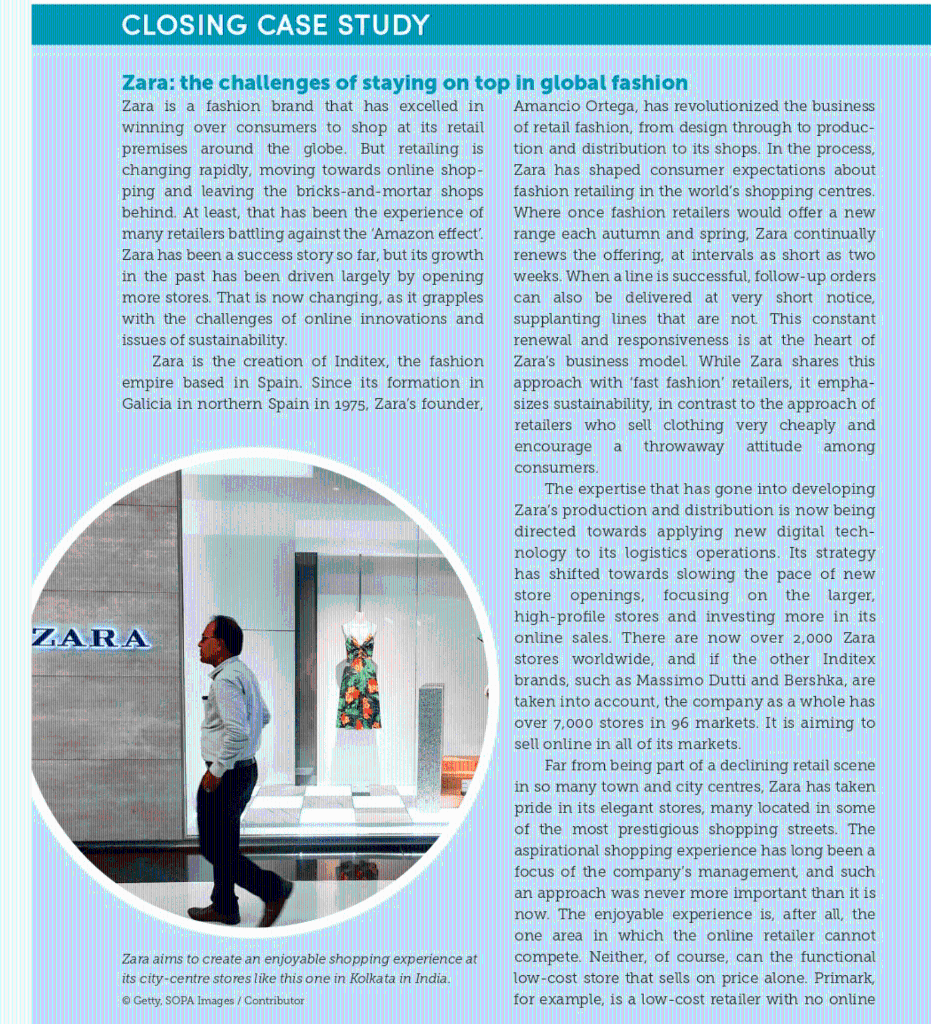
CLOSING CASE STUDY a Zara: the challenges of staying on top in global fashion Zara is a fashion brand that has excelled in Amancio Ortega, has revolutionized the business winning over consumers to shop at its retail of retail fashion, from design through to produc- premises around the globe. But retailing is tion and distribution to its shops. In the process, changing rapidly, moving towards online shop- Zara has shaped consumer expectations about ping and leaving the bricks-and-mortar shops fashion retailing in the world's shopping centres behind. At least, that has been the experience of Where once fashion retailers would offer a new many retailers battling against the 'Amazon effect. range each autumn and spring, Zara continually Zara has been a success story so far, but its growth renews the offering, at intervals as short as two in the past has been driven largely by opening weeks. When a line is successful, follow-up orders more stores. That is now changing, as it grapples can also be delivered at very short notice, with the challenges of online innovations and supplanting lines that are not. This constant issues of sustainability. renewal and responsiveness is at the heart of Zara is the creation of Inditex, the fashion Zara's business model. While Zara shares this empire based in Spain. Since its formation in approach with 'fast fashion' retailers, it empha- Galicia in northern Spain in 1975, Zara's founder, sizes sustainability, in contrast to the approach of retailers who sell clothing very cheaply and encourage throwaway attitude among consumers. The expertise that has gone into developing Zara's production and distribution is now being directed towards applying new digital tech- nology to its logistics operations. Its strategy has shifted towards slowing the pace of new store openings, focusing on the larger high-profile stores and investing more in its ZARA online sales. There are now over 2,000 Zara stores worldwide, and if the other Inditex brands, such as Massimo Dutti and Bershka, are taken into account, the company as a whole has over 7.000 stores in 96 markets. It is aiming to sell online in all of its markets. Far from being part of a declining retail scene in so many town and city centres, Zara has taken pride in its elegant stores, many located in some of the most prestigious shopping streets. The aspirational shopping experience has long been a focus of the company's management and such an approach was never more important than it is now. The enjoyable experience is, after allthe one area in which the online retailer cannot Zara aims to create an enjoyable shopping experience at compete. Neither, of course, can the functional its city centre stores like this one in Kolkata in India. low-cost store that sells on price alone. Primark, Getty, SOPA Images / Contributor for example, is a low-cost retailer with no online be 2 Globalization and the Business Environment 69 presence. Zara, by contrast, seeks to attract the consumer at an aesthetic level, with attractively displayed stock in a pleasant environment. The opening of its new flagship store in Milan in 2018 was indicative of this approach, inviting the shopper to take part in the celebration. Digital innovations in the shops themselves add a new dimension to the experience. One of these is augmented reality (AR), which are interactive experiences that add a whole new dimension for the customer Zara store managers see firsthand what lines are popular and which are not. They are given considerable scope to take decisions on orders, and they are in frequent contact with the company's headquarters in Spain, where the commercial managers and designers can respond immediately. The responsiveness of the manufacturing process owes much of its efficiency to the fact that Inditex relies heavily on factories in relatively close proximity to its HQ. Over 50% of its products are made in Spain, Portugal, Morocco and Turkey. Morocco and Turkey offer relatively low-cost labour. Labour in these countries is not as cheap as in Asia, but the lower transport costs and speed of fulfilling orders make these closer manufacturing loca- tions advantageous. On the other hand, much manufacturing for the Zara brand does take place in Asia, where much of the world's garment manufacturing is now concentrated. These are low-wage economies where poor working conditions, and safety doubts have come to taint any company involved in fast fashion. Inditex has been involved in Bangla- desh, where the collapse of the Rana Plaza factory, in which over a thousand people died, brought to the world's attention the dangerous conditions suffered by garment workers. Inditex has been part of the Accord on fire and building safety, along with other western companies (see the case study in Chapter 12). The Inditex approach to global fashion retailing has been highly profitable. Surging sales in emerging markets are now helping to ensure future growth, as its online platform is launching in countries such as India and Turkey. Inditex saw a rise of 41% in online sales in 2017, and online sales now account for 10% of the total (BBC, 2018). Profits were up 7% and revenues reached over 25 billion for the year. Inditex has taken pride in its investment in tech- nology and logistics, and also its sustainability initiatives. It announced in 2019 that all Zara clothes would be made from sustainable fabrics by 2025, with other Inditex brands to follow Since 2015, it has operated schemes to collect used stock for recycling Consumers are increasingly concerned over issues of ethics in the entire supply chain, including production, human rights issues and recycling of used clothing. Zara has been among the leaders in its approaches to sustainability. . Questions What are the aspects of the Inditex business model that have proved crucial to its success? In what ways has digitalization affected Zara's business? In what ways has the business model been able to adjust to the challenges of online retailers? How would you assess Zara from a sustainability perspective? . . 0 Further reading See the article by Scarlett Conlon, Zara clothes to be made from 100% sustainable fabrics by 2025. in The Guardian, 17 July 2019Step by Step Solution
There are 3 Steps involved in it
1 Expert Approved Answer
Step: 1 Unlock

Question Has Been Solved by an Expert!
Get step-by-step solutions from verified subject matter experts
Step: 2 Unlock
Step: 3 Unlock
 Study Help