



Question: Read the case above Directed Reading What it takes to be a good project manager to answer: 1/ What are the three most critical skills


 Read the case above Directed Reading "What it takes to be a good project manager" to answer:
1/ What are the three most critical skills for project management according to a study in "What it takes to be a good project manager"?
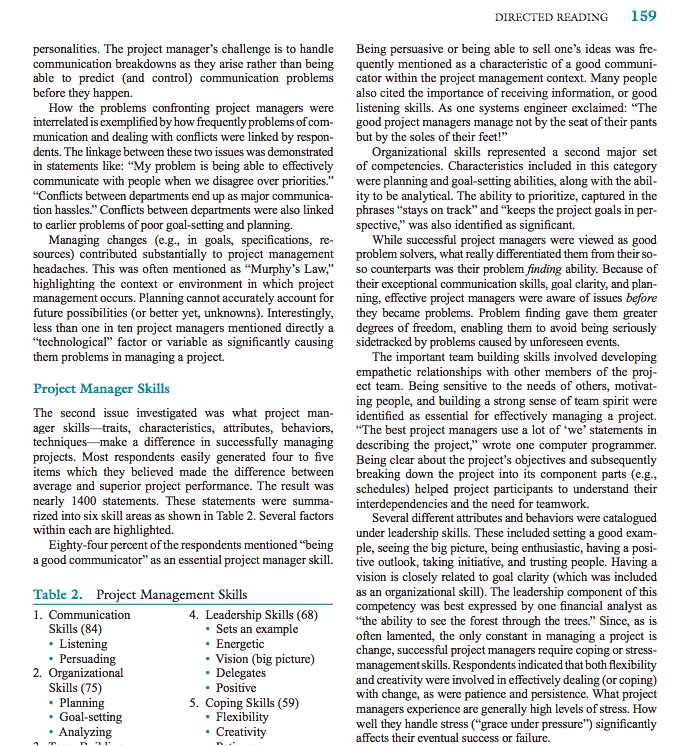
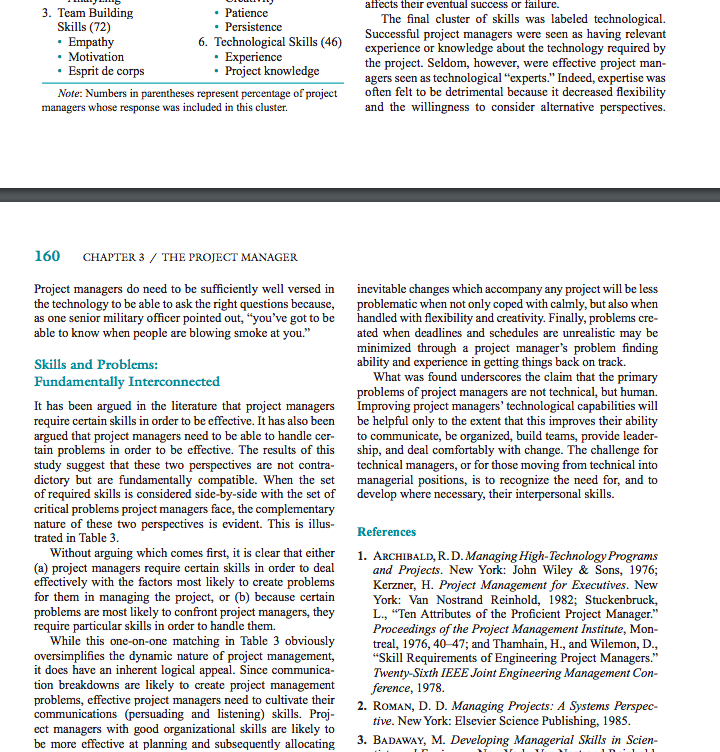
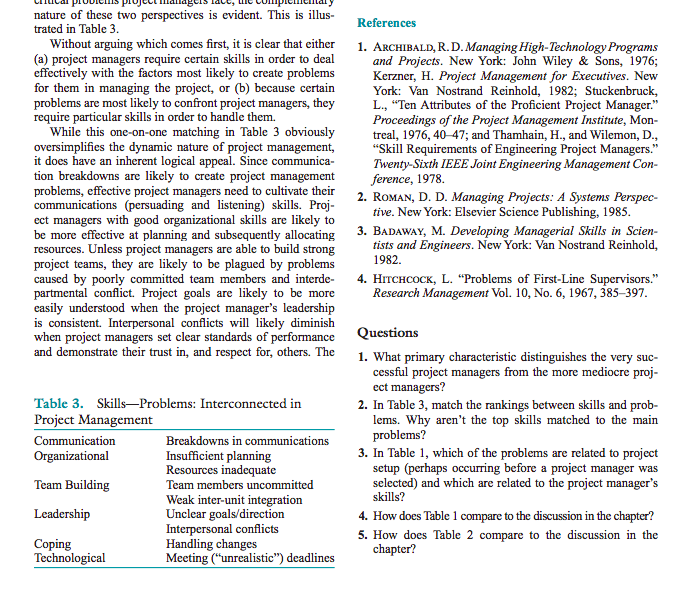
DIRECTED READING WHAT IT TAKES TO BE A GOOD PROJECT MANAGER B. Z. Posner Selecting a good project manager is not a simple task. However, Daniel Roman (2) maintains that it would Being an effective project manager is an ongoing challenge. take an extraordinary individual to have all of these criti- The complex nature and multifaceted range of activities cal personal characteristics. A more practical solution, he involved in managing projects precludes easily identifying suggests, would be to determine the critical problems faced managerial talent and continually stretches the capabilities by project managers and to select a person who can handle of talented project managers. Two seemingly contradictory such difficulties. The shortcoming with this second per- viewpoints have been advanced about what is required to be spective, argue those like Michael Badaway [3], is that the a good project manager. primary problems of project managers are really not techni- One perspective prescribes a set of personal charac- cal ones. The reason managers fail at managing projects, teristics necessary to manage a project [1]. Such personal he contends, is because they lack critical organization and attributes include aggressiveness, confidence, poise, deci- management skills. siveness, resolution, entrepreneurship, toughness, integrity, Scholars like Roman and Badaway as well as versatility, multidisciplinarity, and quick thinking. practitioners may actually be raising different issues. On the one hand, good project managers understand the critical problems which face them and are prepared to deal with them. On the other hand, managing projects well requires "What It Takes to Be A Good Project Manager." Project Manage- a set of particular attributes and skills. But, are these two ment Journal, March 1987. C1987 by the Project Management Insti- viewpoints really at odds with one another? In this study tute. Reprinted by permission. they were discovered to be two sides of the same coin! Study of Project Manager Problems and skills about as often as the general inadequate resource lament. Questionnaires were completed by project managers during meet unrealistic deadlines." Typically, the problem of time was expressed as "having to a nationwide series of project management seminars. Proj- ect managers attending these seminars came from a variety not the least of which being that resources are generally lim- That resources are inadequate is caused by many factors, of technology-oriented organizations. Responses to the sur- ited and costly. Before this hue is dismissed by veteran proj- vey instrument were both voluntary and confidential. ect managers as just so much bellyaching-"after all, there Information about the respondents and the nature of their are never enough resources to go around"-it is impor- projects was collected. The typical project manager was a tant to examine the cause(s) of this problem. Respondents 37-year-old male, had nine people reporting to him, and was responsible for a small to moderate size project within pointed out that resource allocation problems were usually created by senior management's failure to be clear about a matrix organization structure. More specifically, there project objectives, which in turn resulted in poor planning were 189 men and 98 women in the sample (N = 287) and their ages ranged from 22 to 60 years of age (X = 37.4, tive planning were specifically mentioned by more than efforts. These two problems lack of clear goals and effec- S.D. = 8.3). Fifty-six percent indicated that they were the for- 60 percent of the respondents. It is painfully obvious that mal manager of the project. The size of their immediate proj- vague goals and insufficient planning lead to mistakes in ect group ranged from 2 to over 100 people (median = 8.9). allocating the resources needed by project managers. Fifty-nine percent reported that they worked primarily on small projects (involving few people or functions, with a short time horizon) as compared to large projects (involving Table 1. Project Management Problems many people or functions, with a long time horizon). More 1. Resources inadequate (69) than 63 percent indicated they were working within a matrix 2. Meeting ("unrealistic") deadlines (67) organization structure. No information was collected about 3. Unclear goals/direction (63) the specific nature (e.g., new product development, R&D, 4. Team members uncommitted (59) MIS) of their projects. 5. Insufficient planning (56) Two open-ended questions were asked their order was 6. Breakdown of communications (54) randomized). The first asked about the skills necessary 7. Changes in goals and resources (42) to be a successful project manager. The second question 8. Conflicts between departments or functions (35) investigated the most likely problems encountered in man- aging projects. Responses to these questions were content Note: Numbers in parentheses represent percentage of project analyzed. Content analysis is a systematic approach to managers whose response was included in this cluster. data analysis, resulting in both qualitative assessments and The three most significant problems reported by first- quantitative information. Each respondent comment was line research, development, and engineering supervisors first coded and then recoded several times as patterns of in Lauren Hitchcock's [4] study parallels those identified responses became apparent. The two questions were: by project managers. He found "insufficient definition of policy from top downward, how to define the goal of a prob- 1. What factors or variables are most likely to cause you lem, and budgeting and manpower assignments" to be the problems in managing a project? major problems confronting supervisors. It remains true 2. What personal characteristics, traits, or skills make for that senior management needs to articulate clearly where "above average" project managers? What specific behav- the project should be going, why, and what it expects from iors, techniques, or strategies do "above average" project project personnel. managers use (or use better than their peers)? When project goals are not clear, it is difficult (if not impossible) to plan the project efficiently. The lack of plan- Problems in Managing Projects. There were nearly ning contributes directly to unrealistic resource allocations 900 statements about what factors or variables created and schedules. People assigned to the project are unlikely, "problems" in managing a project. Most of these state- therefore, to commit energetically to the endeavor. The lack ments could be clustered into eisht categories as shown in of commitment (and noor motivation among nmiect derson- "above average" project managers? What specific behav- the project should be going, why, and what it expects from iors, techniques, or strategies do "above average" project project personnel. managers use (or use better than their peers)? When project goals are not clear, it is difficult (if not impossible) to plan the project efficiently. The lack of plan- Problems in Managing Projects. There were nearly ning contributes directly to unrealistic resource allocations 900 statements about what factors or variables created and schedules. People assigned to the project are unlikely, "problems" in managing a project. Most of these state- therefore, to commit energetically to the endeavor. The lack ments could be clustered into eight categories as shown in of commitment and poor motivation among project person- Table 1. Inadequate resources was the issue most frequently nel was reported as emerging more from the problems already mentioned as causing problems in managing a project. "No mentioned than from issues associated with the project's tech- matter what the type or scope of your project," wrote one nology or organizational structure (e.g., matrix form). engineering manager, "if insufficient resources are allocated The communication breakdowns (problems which occur to the project, you have to be a magician to be successful." during the life of a project) were often referred to as "inevi- Not having the necessary budget or personnel for the project table." These breakdowns occur as a result of the ambigu- was a frequent complaint. However, the specific resource of ity surrounding the project, but also result from difficulties time and generally the lack thereof-was mentioned just in coordinating and integrating diverse perspectives and DIRECTED READING 159 personalities. The project manager's challenge is to handle Being persuasive or being able to sell one's ideas was fre- communication breakdowns as they arise rather than being quently mentioned as a characteristic of a good communi- able to predict (and control) communication problems cator within the project management context. Many people before they happen. also cited the importance of receiving information, or good How the problems confronting project managers were listening skills. As one systems engineer exclaimed: "The interrelated is exemplified by how frequently problems of com- good project managers manage not by the seat of their pants munication and dealing with conflicts were linked by respon- but by the soles of their feet!" dents. The linkage between these two issues was demonstrated Organizational skills represented a second major set in statements like: "My problem is being able to effectively of competencies. Characteristics included in this category communicate with people when we disagree over priorities." were planning and goal-setting abilities, along with the abil- "Conflicts between departments end up as major communica- ity to be analytical. The ability to prioritize, captured in the tion hassles." Conflicts between departments were also linked phrases "stays on track" and "keeps the project goals in per- to earlier problems of poor goal-setting and planning. spective," was also identified as significant. Managing changes (e.g., in goals, specifications, re- While successful project managers were viewed as good sources) contributed substantially to project management problem solvers, what really differentiated them from their so- headaches. This was often mentioned as Murphy's Law," so counterparts was their problem finding ability. Because of highlighting the context or environment in which project their exceptional communication skills, goal clarity, and plan- management occurs. Planning cannot accurately account for ning, effective project managers were aware of issues before future possibilities (or better yet, unknowns). Interestingly, they became problems. Problem finding gave them greater less than one in ten project managers mentioned directly a degrees of freedom, enabling them to avoid being seriously "technological factor or variable as significantly causing sidetracked by problems caused by unforeseen events. them problems in managing a project. The important team building skills involved developing empathetic relationships with other members of the proj- Project Manager Skills ect team. Being sensitive to the needs of others, motivat- ing people, and building a strong sense of team spirit were The second issue investigated was what project man- identified as essential for effectively managing a project. ager skills-traits, characteristics, attributes, behaviors, **The best project managers use a lot of 'we' statements in techniques make a difference in successfully managing describing the project," wrote one computer programmer. projects. Most respondents easily generated four to five Being clear about the project's objectives and subsequently items which they believed made the difference between breaking down the project into its component parts (e.g., average and superior project performance. The result was schedules) helped project participants to understand their nearly 1400 statements. These statements were summa- interdependencies and the need for teamwork. rized into six skill areas as shown in Table 2. Several factors Several different attributes and behaviors were catalogued within each are highlighted. under leadership skills. These included setting a good exam- Eighty-four percent of the respondents mentioned "being ple, seeing the big picture, being enthusiastic, having a posi- a good communicator" as an essential project manager skill. tive outlook, taking initiative, and trusting people. Having a vision is closely related to goal clarity (which was included Table 2. Project Management Skills as an organizational skill). The leadership component of this 1. Communication 4. Leadership Skills (68) competency was best expressed by one financial analyst as Skills (84) "the ability to see the forest through the trees." Since, as is Sets an example Listening Energetic often lamented, the only constant in managing a project is Persuading Vision (big picture) change, successful project managers require coping or stress- 2. Organizational Delegates management skills. Respondents indicated that both flexibility Skills (75) Positive and creativity were involved in effectively dealing (or coping) Planning 5. Coping Skills (59) with change, as were patience and persistence. What project Goal-setting Flexibility managers experience are generally high levels of stress. How Analyzing Creativity well they handle stress ("grace under pressure") significantly affects their eventual success or failure. . . . 3. Team Building Patience Skills (72) Persistence . Empathy 6. Technological Skills (46) Motivation Experience Esprit de corps Project knowledge Note: Numbers in parentheses represent percentage of project managers whose response was included in this cluster. affects their eventual success or failure. The final cluster of skills was labeled technological. Successful project managers were seen as having relevant experience or knowledge about the technology required by the project. Seldom, however, were effective project man- agers seen as technological "experts." Indeed, expertise was often felt to be detrimental because it decreased flexibility and the willingness to consider alternative perspectives. 160 CHAPTER 3 / THE PROJECT MANAGER Project managers do need to be sufficiently well versed in inevitable changes which accompany any project will be less the technology to be able to ask the right questions because, problematic when not only coped with calmly, but also when as one senior military officer pointed out, "you've got to be handled with flexibility and creativity. Finally, problems cre- able to know when people are blowing smoke at you." ated when deadlines and schedules are unrealistic may be minimized through a project manager's problem finding Skills and Problems: ability and experience in getting things back on track. Fundamentally Interconnected What was found underscores the claim that the primary problems of project managers are not technical, but human. It has been argued in the literature that project managers Improving project managers' technological capabilities will require certain skills in order to be effective. It has also been be helpful only to the extent that this improves their ability argued that project managers need to be able to handle cer- to communicate, be organized, build teams, provide leader- tain problems in order to be effective. The results of this ship, and deal comfortably with change. The challenge for study suggest that these two perspectives are not contra- technical managers, or for those moving from technical into dictory but are fundamentally compatible. When the set managerial positions, is to recognize the need for, and to of required skills is considered side-by-side with the set of develop where necessary, their interpersonal skills. critical problems project managers face, the complementary nature of these two perspectives is evident. This is illus- trated in Table 3. References Without arguing which comes first, it is clear that either 1. ARCHIBALD, R. D. Managing High-Technology Programs (a) project managers require certain skills in order to deal and Projects. New York: John Wiley & Sons, 1976; effectively with the factors most likely to create problems Kerzner, H. Project Management for Executives. New for them in managing the project, or (b) because certain York: Van Nostrand Reinhold, 1982; Stuckenbruck, problems are most likely to confront project managers, they L., "Ten Attributes of the Proficient Project Manager." require particular skills in order to handle them. Proceedings of the Project Management Institute, Mon- While this one-on-one matching in Table 3 obviously treal, 1976, 40-47; and Thamhain, H., and Wilemon, D., oversimplifies the dynamic nature of project management, "Skill Requirements of Engineering Project Managers. it does have an inherent logical appeal. Since communica- Twenty-Sixth IEEE Joint Engineering Management Con- tion breakdowns are likely to create project management ference, 1978 problems, effective project managers need to cultivate their communications (persuading and listening) skills. Proj- 2. ROMAN, D. D. Managing Projects: A Systems Perspec- ect managers with good organizational skills are likely to tive. New York: Elsevier Science Publishing, 1985. be more effective at planning and subsequently allocating 3. BADAWAY, M. Developing Managerial Skills in Scien- nature of these two perspectives is evident. This is illus- trated in Table 3. References Without arguing which comes first, it is clear that either 1. ARCHIBALD, R.D. Managing High-Technology Programs (a) project managers require certain skills in order to deal and Projects. New York: John Wiley & Sons, 1976; effectively with the factors most likely to create problems Kerzner, H. Project Management for Executives. New for them in managing the project, or (b) because certain York: Van Nostrand Reinhold, 1982: Stuckenbruck, problems are most likely to confront project managers, they L., "Ten Attributes of the Proficient Project Manager." require particular skills in order to handle them. Proceedings of the Project Management Institute, Mon- While this one-on-one matching in Table 3 obviously treal, 1976, 40-47; and Thamhain, H., and Wilemon, D., oversimplifies the dynamic nature of project management, "Skill Requirements of Engineering Project Managers." it does have an inherent logical appeal. Since communica- Twenty-Sixth IEEE Joint Engineering Management Con- tion breakdowns are likely to create project management ference, 1978. problems, effective project managers need to cultivate their 2. ROMAN, D.D. Managing Projects: A Systems Perspec- communications (persuading and listening) skills. Proj- ect managers with good organizational skills are likely to tive. New York: Elsevier Science Publishing, 1985. be more effective at planning and subsequently allocating 3. BADAWAY, M. Developing Ma erial Skills in Scien- resources. Unless project managers are able to build strong tists and Engineers. New York: Van Nostrand Reinhold, project teams, they are likely to be plagued by problems 1982. caused by poorly committed team members and interde- 4. HITCHCOCK, L. "Problems of First-Line Supervisors." partmental conflict. Project goals are likely to be more Research Management Vol. 10, No. 6, 1967, 385-397. easily understood when the project manager's leadership is consistent. Interpersonal conflicts will likely diminish when project managers set clear standards of performance Questions and demonstrate their trust in, and respect for, others. The 1. What primary characteristic distinguishes the very suc- cessful project managers from the more mediocre proj- ect managers? Table 3. Skills Problems: Interconnected in 2. In Table 3, match the rankings between skills and prob- Project Management lems. Why aren't the top skills matched to the main Communication Breakdowns in communications problems? Organizational Insufficient planning 3. In Table 1, which of the problems are related to project Resources inadequate setup (perhaps occurring before a project manager was Team Building Team members uncommitted selected) and which are related to the project manager's Weak inter-unit integration skills? Leadership Unclear goals/direction 4. How does Table 1 compare to the discussion in the chapter? Interpersonal conflicts 5. How does Table 2 compare to the discussion in the Coping Handling changes chapter? Technological Meeting ("unrealistic") deadlinesStep by Step Solution
There are 3 Steps involved in it
1 Expert Approved Answer
Step: 1 Unlock

Question Has Been Solved by an Expert!
Get step-by-step solutions from verified subject matter experts
Step: 2 Unlock
Step: 3 Unlock