







Question: Read the case and answer the question The Minimum Wage and Productivity: A Case Study of California Strawberry Pickers California accounts for roughly 90% of
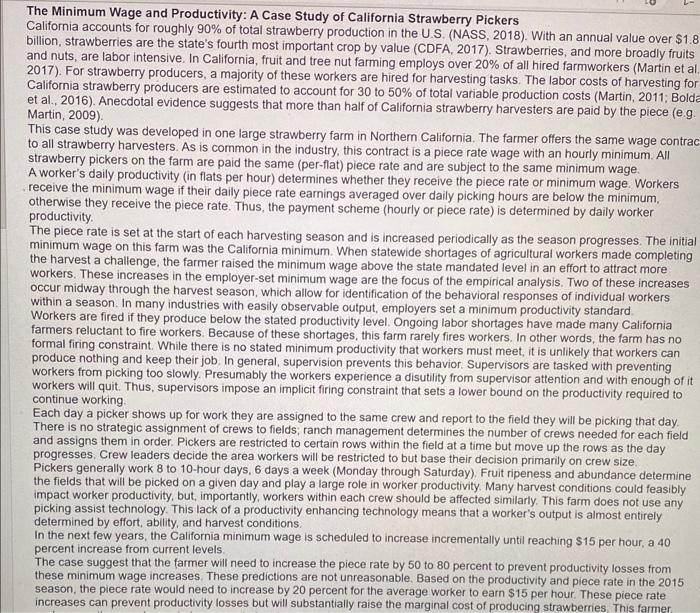
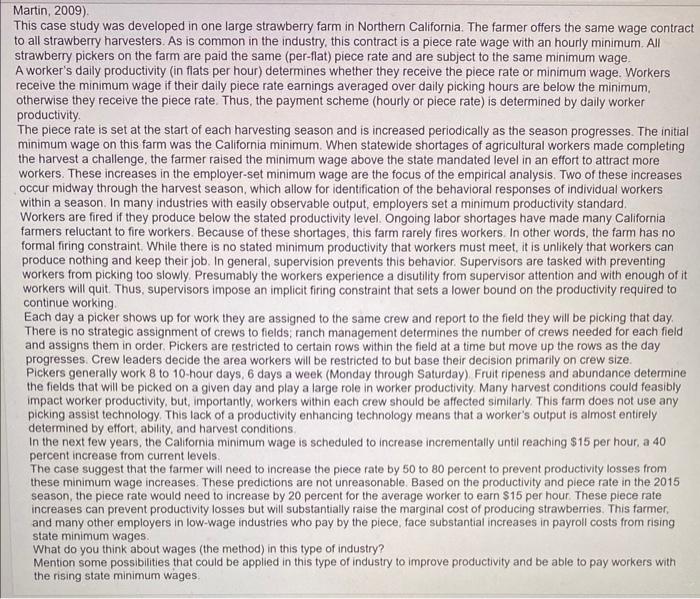
The Minimum Wage and Productivity: A Case Study of California Strawberry Pickers California accounts for roughly 90% of total strawberry production in the U.S. (NASS, 2018). With an annual value over $1.8 billion, strawberries are the state's fourth most important crop by value (CDFA, 2017). Strawberries, and more broadly fruits and nuts, are labor intensive. In California, fruit and tree nut farming employs over 20% of all hired farmworkers (Martin et al 2017). For strawberry producers, a majority of these workers are hired for harvesting tasks. The labor costs of harvesting for California strawberry producers are estimated to account for 30 to 50% of total variable production costs (Martin, 2011; Bold: et al., 2016). Anecdotal evidence suggests that more than half of California strawberry harvesters are paid by the piece (e.g. Martin, 2009). This case study was developed in one large strawberry farm in Northern California. The farmer offers the same wage contrac to all strawberry harvesters. As is common in the industry, this contract is a piece rate wage with an hourly minimum. All strawberry pickers on the farm are paid the same (per-flat) piece rate and are subject to the same minimum wage. A worker's daily productivity (in flats per hour) determines whether they receive the piece rate or minimum wage. Workers receive the minimum wage if their daily piece rate earnings averaged over daily picking hours are below the minimum. otherwise they receive the piece rate. Thus, the payment scheme (hourly or piece rate) is determined by daily worker productivity. The piece rate is set at the start of each harvesting season and is increased periodically as the season progresses. The initial minimum wage on this farm was the California minimum. When statewide shortages of agricultural workers made completing the harvest a challenge, the farmer raised the minimum wage above the state mandated level in an effort to attract more workers. These increases in the employer-set minimum wage are the focus of the empirical analysis. Two of these increases occur midway through the harvest season, which allow for identification of the behavioral responses of individual workers within a season. In many industries with easily observable output, employers set a minimum productivity standard. Workers are fired if they produce below the stated productivity level. Ongoing labor shortages have made many California farmers reluctant to fire workers. Because of these shortages, this farm rarely fires workers. In other words, the farm has no formal firing constraint. While there is no stated minimum productivity that workers must meet, it is unlikely that workers can produce nothing and keep their job. In general, supervision prevents this behavior. Supervisors are tasked with preventing workers from picking too slowly. Presumably the workers experience a disutility from supervisor attention and with enough of it workers will quit. Thus, supervisors impose an implicit firing constraint that sets a lower bound on the productivity required to continue working. Each day a picker shows up for work they are assigned to the same crew and report to the field they will be picking that day. There is no strategic assignment of crews to fields; ranch management determines the number of crews needed for each field and assigns them in order. Pickers are restricted to certain rows within the field at a time but move up the rows as the day progresses. Crew leaders decide the area workers will be restricted to but base their decision primarily on crew size. Pickers generally work 8 to 10-hour days, 6 days a week (Monday through Saturday). Fruit ripeness and abundance determine the fields that will be picked on a given day and play a large role in worker productivity. Many harvest conditions could feasibly impact worker productivity, but, importantly, workers within each crew should be affected similarly. This farm does not use any picking assist technology. This lack of a productivity enhancing technology means that a worker's output is almost entirely determined by effort, ability, and harvest conditions: In the next few years, the California minimum wage is scheduled to increase incrementally until reaching $15 per hour, a 40 percent increase from current levels. The case suggest that the farmer will need to increase the piece rate by 50 to 80 percent to prevent productivity losses from these minimum wage increases. These predictions are not unreasonable. Based on the productivity and piece rate in the 2015 season, the piece rate would need to increase by 20 percent for the average worker to earn $15 per hour. These piece rate increases can prevent productivity losses but will substantially raise the marginal cost of producing strawberries. This farmer. Martin, 2009). This case study was developed in one large strawberry farm in Northern California. The farmer offers the same wage contract to all strawberry harvesters. As is common in the industry, this contract is a piece rate wage with an hourly minimum. All strawberry pickers on the farm are paid the same (per-flat) piece rate and are subject to the same minimum wage. A worker's daily productivity (in flats per hour) determines whether they receive the piece rate or minimum wage. Workers receive the minimum wage if their daily piece rate earnings averaged over daily picking hours are below the minimum, otherwise they receive the piece rate. Thus, the payment scheme (hourly or piece rate) is determined by daily worker productivity. The piece rate is set at the start of each harvesting season and is increased periodically as the season progresses. The initial minimum wage on this farm was the California minimum. When statewide shortages of agricultural workers made completing the harvest a challenge, the farmer raised the minimum wage above the state mandated level in an effort to attract more workers. These increases in the employer-set minimum wage are the focus of the empirical analysis. Two of these increases occur midway through the harvest season, which allow for identification of the behavioral responses of individual workers within a season. In many industries with easily observable output, employers set a minimum productivity standard. Workers are fired if they produce below the stated productivity level. Ongoing labor shortages have made many California farmers reluctant to fire workers. Because of these shortages, this farm rarely fires workers. In other words, the farm has no formal firing constraint. While there is no stated minimum productivity that workers must meet, it is unlikely that workers can produce nothing and keep their job. In general, supervision prevents this behavior. Supervisors are tasked with preventing workers from picking too slowly. Presumably the workers experience a disutility from supervisor attention and with enough of it workers will quit. Thus, supervisors impose an implicit firing constraint that sets a lower bound on the productivity required to continue working. Each day a picker shows up for work they are assigned to the same crew and report to the field they will be picking that day. There is no strategic assignment of crews to fields; ranch management determines the number of crews needed for each field and assigns them in order. Pickers are restricted to certain rows within the field at a time but move up the rows as the day progresses. Crew leaders decide the area workers will be restricted to but base their decision primarily on crew size. Pickers generally work 8 to 10-hour days, 6 days a week (Monday through Saturday). Fruit ripeness and abundance determine the fields that will be picked on a given day and play a large role in worker productivity. Many harvest conditions could feasibly impact worker productivity, but, importantly, workers within each crew should be affected similarly. This farm does not use any picking assist technology. This lack of a productivity enhancing technology means that a worker's output is almost entirely determined by effort, ability, and harvest conditions; In the next few years, the Califomia minimum wage is scheduled to increase incrementally until reaching $15 per hour, a 40 percent increase from current levels: The case suggest that the farmer will need to increase the piece rate by 50 to 80 percent to prevent productivity losses from these minimum wage increases. These predictions are not unreasonable. Based on the productivity and piece rate in the 2015 season, the piece rate would need to increase by 20 percent for the average worker to earn $15 per hour. These piece rate increases can prevent productivity losses but will substantially raise the marginal cost of producing strawberries. This farmer, and many other employers in low-wage industries who pay by the piece, face substantial increases in payroll costs from rising state minimum wages. What do you think about wages (the method) in this type of industry? Mention some possibilities that could be applied in this type of industry to improve productivity and be able to pay workers with the rising state minimum wages
Step by Step Solution
There are 3 Steps involved in it

Get step-by-step solutions from verified subject matter experts
 Study Help