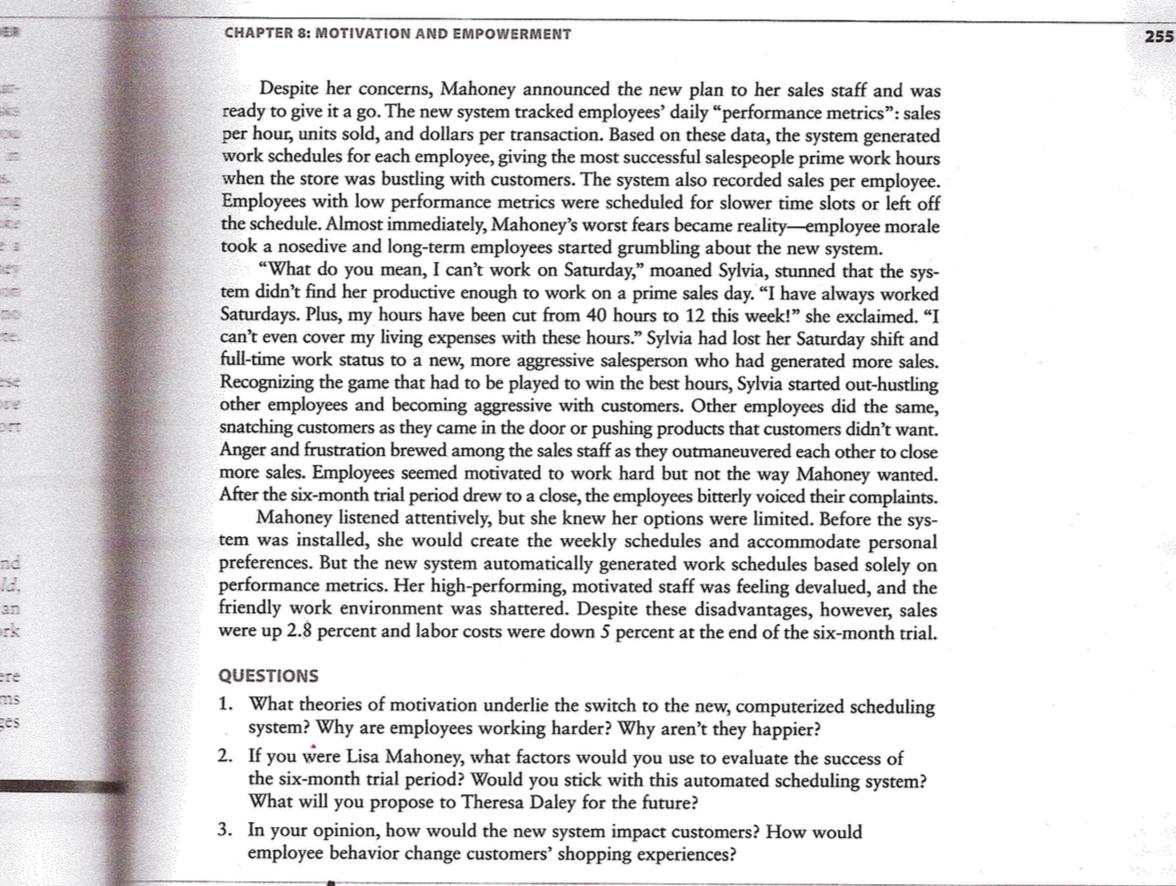
Question: Read the Case for Chapter 8 (Attached) ....Answer the following questions: 1. From the Corporate perspective....is any new system of tracking employees' productivity warranted or
Read the Case for Chapter 8 (Attached) ....Answer the following questions:
1. From the Corporate perspective....is any new system of tracking employees' productivity warranted or unwarranted ??
2. Explain why you either agree or disagree with the new system described in the Case. As a Manager how would you increase productivity (holding sales costs down) AND what Motivational tools would you use to increase EACH employee's sales ?
3. How would the new system explained in the Case affect the Customers ?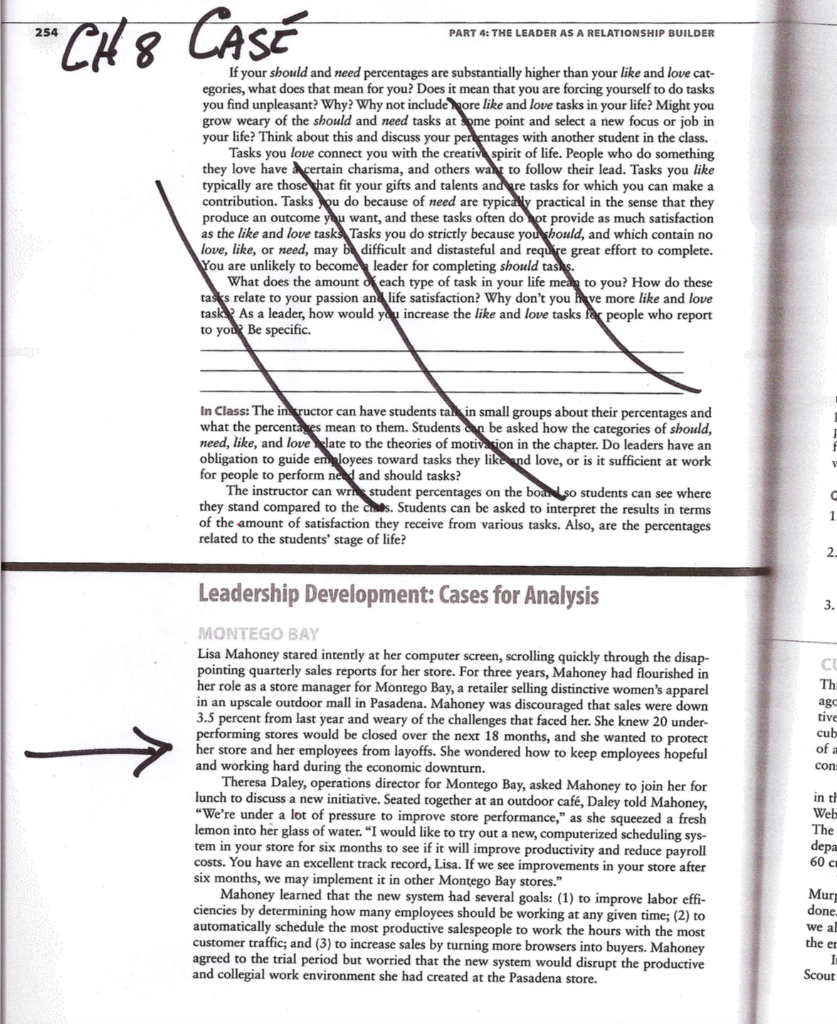
*** CH 8 CASE a like, or or need, may be difficult costs. You have an excellent track record, Lisa. If we schements in your store after 254 PART 4: THE LEADER AS A RELATIONSHIP BUILDER If your should and need percentages are substantially higher than your like and love cat- egories, what does that mean for you? Does it mean that you are forcing yourself to do tasks you find unpleasant? Why? Why not include more like and love tasks in your life? Might you grow weary of the should and need tasks at some point and select a new focus or job in your life? Think about this and discuss your perbentages with another student in the class. Tasks you love connect you with the creativ spirit of life. People who do something they love have certain charisma, and others want to follow their lead. Tasks you like typically are those that fit your gifts and talents and are tasks for which you can' contribution. Tasks bu do because are typically practical in the sense that they produce an outcome you want, and these tasks often do ot provide as much satisfaction as the like and love tasks Tasks you do strictly because you should, and which contain no love, and distasteful and requires great effort to complete. You are unlikely to become leader for completing should tasks What does the amount each type of task in your life mean to you? How do these tasks relate to your passion and life satisfaction? Why don't you have more like and love task As a leader, how would you increase the like and love tasks for people who report to yod Be specific In Class: The instructor can have students tal in small groups about their percentages and what the percentages mean to them. Students can be asked how the categories of should, need, like, and love late to the theories of motivation in the chapter. Do leaders have an obligation to guide emloyees toward tasks they like and love, or is it sufficient at work for people to perform need and should tasks? The instructor can wrh student percentages on the boa so students can see where they stand compared to the class. Students can be asked to interpret the results in terms of the amount of satisfaction they receive from various tasks. Also, are the percentages related to the students' stage of life? Leadership Development: Cases for Analysis MONTEGO BAY Lisa Mahoney stared intently at her computer screen, scrolling quickly through the disap- pointing quarterly sales reports for her store. For three years, Mahoney had flourished in her role as a store manager for Montego Bay, a retailer selling distinctive women's apparel 3.5 percent from last year and weary of the challenges that faced her. She knew 20 under- performing stores would be closed over the challen over the next 18 months, and she wanted to protect her store and I her employees from layoffs. She wondered how to keep employees hopeful and working hard aring the economic downturn. Theresa Daley, operations director for Montego Bay, asked Mahoney to join her for lunch to discuss a new initiative. Seated together at an outdoor caf, Daley told Mahoney, e're under a lot of pressure to improve store performance," as she squeezed a fresh lemon into her glass of water. "I would like to try out a new, computerized scheduling sys- tem in your store for six months to see if it will improve productivity and reduce payroll it in Bay Mahoney learned that the new system had several goals: (1) to improve labor effi- ciencies by determining how many employees should be working at any given time; (2) to automatically schedule the most productive salespeople to work the hours with the most customer traffic; and (3) to increase sales by turning more browsers into buyers. Mahoney agreed to the trial period but worried that the new system would disrupt the productive and collegial work environment she had created at the Pasadena store. d 1 2. 3. an Th ago tive cub of a con in t! Web The depa 60 CE Mur done we al the er T Scout CHAPTER 8: MOTIVATION AND EMPOWERMENT 255 06 Despite her concerns, Mahoney announced the new plan to her sales staff and was ready to give it a go. The new system tracked employees' daily performance metrics": sales per hour, units sold, and dollars per transaction. Based on these data, the system generated work schedules for each employee, giving the most successful salespeople prime work hours when the store was bustling with customers. The system also recorded sales per employee. Employees with low performance metrics were scheduled for slower time slots or left off the schedule. Almost immediately, Mahoney's worst fears became reality-employee morale took a nosedive and long-term employees started grumbling about the new system. "What do you mean, I can't work on Saturday, moaned Sylvia, stunned that the sys- tem didn't find her productive enough to work on a prime sales day. I have always worked Saturdays. Plus, my hours have been cut from 40 hours to 12 this week! she exclaimed. I can't even cover my living expenses with these hours. Sylvia had lost her Saturday shift and full-time work status to a new, more aggressive salesperson who had generated more sales. Recognizing the game that had to be played to win the best hours, Sylvia started out-hustling other employees and becoming aggressive with customers. Other employees did the same, snatching customers as they came in the door or pushing products that customers didn't want. Anger and frustration brewed among the sales staff as they outmaneuvered each other to close more sales. Employees seemed motivated to work hard but not the way Mahoney wanted. After the six-month trial period drew to a close, the employees bitterly voiced their complaints. Mahoney listened attentively, but she knew her options were limited. Before the sys- tem was installed, she would create the weekly schedules and accommodate personal preferences. But the new system automatically generated work schedules based solely on performance metrics. Her high-performing, motivated staff was feeling devalued, and the friendly work environment was shattered. Despite these disadvantages, however, sales were up 2.8 percent and labor costs were down 5 percent at the end of the six-month trial. nd an ere ms ges QUESTIONS 1. What theories of motivation underlie the switch to the new, computerized scheduling system? Why are employees working harder? Why aren't they happier? 2. If you were Lisa Mahoney, what factors would you use to evaluate the success of the six-month trial period? Would you stick with this automated scheduling system? What will you propose to Theresa Daley for the future? 3. In your opinion, how would the new system impact customers? How would employee behavior change customers' shopping experiences









 Study Help