







Question: Read the case given below and answer the following questions 346 CHAPTER 8 STRENGTHENING BUSINESS-TO-BUSINESS RELATIONSHIPS VIA SUPPLY CHAIN AND CUSTOMER RELATIONSHIP MANAGEMENT CASE 2
Read the case given below and answer the following questions
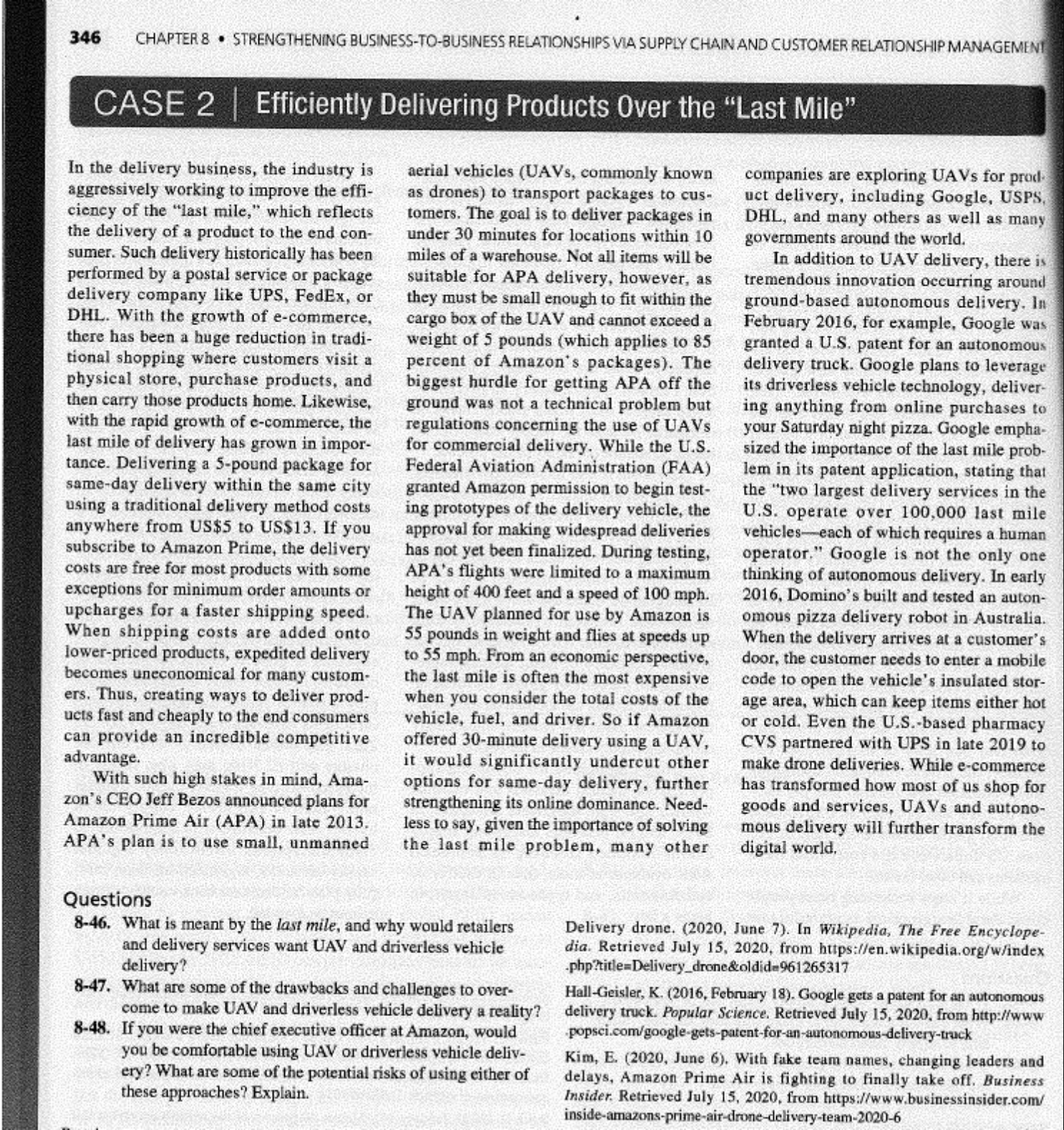
346 CHAPTER 8 STRENGTHENING BUSINESS-TO-BUSINESS RELATIONSHIPS VIA SUPPLY CHAIN AND CUSTOMER RELATIONSHIP MANAGEMENT CASE 2 Efficiently Delivering Products Over the "Last Mile" In the delivery business, the industry is aggressively working to improve the effi- ciency of the "last mile," which reflects the delivery of a product to the end con- sumer. Such delivery historically has been performed by a postal service or package delivery company like UPS, FedEx, or DHL. With the growth of e-commerce, there has been a huge reduction in tradi- tional shopping where customers visit a physical store, purchase products, and then carry those products home. Likewise, with the rapid growth of e-commerce, the last mile of delivery has grown in impor- tance. Delivering a 5-pound package for same-day delivery within the same city using a traditional delivery method costs anywhere from US$5 to US$13. If you subscribe to Amazon Prime, the delivery costs are free for most products with some exceptions for minimum order amounts or upcharges for a faster shipping speed. When shipping costs are added onto lower-priced products, expedited delivery becomes uneconomical for many custom- ers. Thus, creating ways to deliver prod- ucts fast and cheaply to the end consumers can provide an incredible competitive advantage. aerial vehicles (UAVs, commonly known as drones) to transport packages to cus- tomers. The goal is to deliver packages in under 30 minutes for locations within 10 miles of a warehouse. Not all items will be suitable for APA delivery, however, as they must be small enough to fit within the cargo box of the UAV and cannot exceed a weight of 5 pounds (which applies to 85 percent of Amazon's packages). The biggest hurdle for getting APA off the ground was not a technical problem but regulations concerning the use of UAVs for commercial delivery. While the U.S. Federal Aviation Administration (FAA) granted Amazon permission to begin test- ing prototypes of the delivery vehicle, the approval for making widespread deliveries has not yet been finalized. During testing, APA's flights were limited to a maximum height of 400 feet and a speed of 100 mph. The UAV planned for use by Amazon is 55 pounds in weight and flies at speeds up to 55 mph. From an economic perspective, the last mile is often the most expensive when you consider the total costs of the vehicle, fuel, and driver. So if Amazon offered 30-minute delivery using a UAV, it would significantly undercut other options for same-day delivery, further strengthening its online dominance. Need- less to say, given the importance of solving the last mile problem, many other With such high stakes in mind, Ama- zon's CEO Jeff Bezos announced plans for Amazon Prime Air (APA) in late 2013. APA's plan is to use small, unmanned Questions 8-46. What is meant by the last mile, and why would retailers and delivery services want UAV and driverless vehicle delivery? 8-47. What are some of the drawbacks and challenges to over- come to make UAV and driverless vehicle delivery a reality? 8-48. If you were the chief executive officer at Amazon, would you be comfortable using UAV or driverless vehicle deliv- ery? What are some of the potential risks of using either of these approaches? Explain. companies are exploring UAVs for prod uct delivery, including Google, USPS, DHL, and many others as well as many governments around the world. In addition to UAV delivery, there is tremendous innovation occurring around ground-based autonomous delivery. In February 2016, for example, Google was granted a U.S. patent for an autonomous delivery truck. Google plans to leverage its driverless vehicle technology, deliver- ing anything from online purchases to your Saturday night pizza. Google empha- sized the importance of the last mile prob- lem in its patent application, stating that the "two largest delivery services in the U.S. operate over 100,000 last mile vehicles each of which requires a human operator." Google is not the only one thinking of autonomous delivery. In early 2016, Domino's built and tested an auton- omous pizza delivery robot in Australia. When the delivery arrives at a customer's door, the customer needs to enter a mobile code to open the vehicle's insulated stor- age area, which can keep items either hot or cold. Even the U.S.-based pharmacy CVS partnered with UPS in late 2019 to make drone deliveries. While e-commerce has transformed how most of us shop for goods and services, UAVs and autono- mous delivery will further transform the digital world. Delivery drone. (2020, June 7). In Wikipedia, The Free Encyclope- dia. Retrieved July 15, 2020, from https://en.wikipedia.org/w/index .php?title=Delivery drone&oldid-961265317 Hall-Geisler, K. (2016, February 18). Google gets a patent for an autonomous delivery truck. Popular Science. Retrieved July 15, 2020, from http://www popsci.com/google-gets-patent-for-an-autonomous-delivery-truck Kim, E. (2020, June 6). With fake team names, changing leaders and delays, Amazon Prime Air is fighting to finally take off. Business Insider. Retrieved July 15, 2020, from https://www.businessinsider.com/ inside-amazons-prime-air-drone-delivery-team-2020-6
Step by Step Solution
There are 3 Steps involved in it
Answer 846 What is meant by the last mile and why would retailers and delivery services want UAV and driverless vehicle delivery The last mile refers to the final leg of the delivery process where pro... View full answer

Get step-by-step solutions from verified subject matter experts
 Study Help