Question: read the case study and answer case study questions - + | A Read aloud | Draw NORTHCUTT BIKES: THE FORECASTING PROBLEM Jan Northcuti, owner
read the case study and answer case study questions
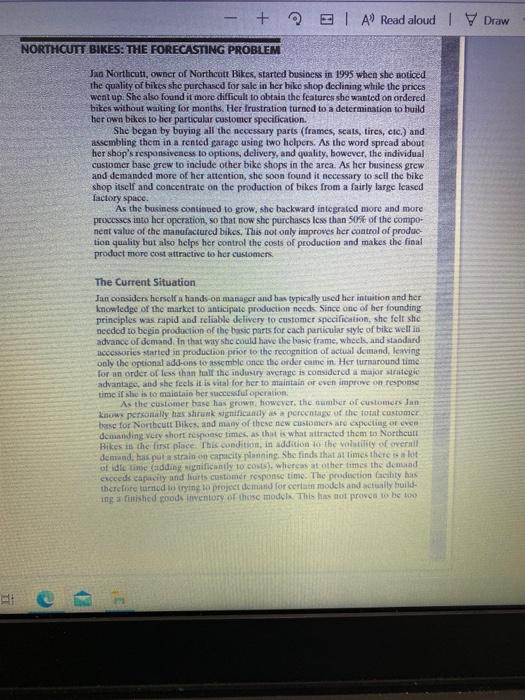
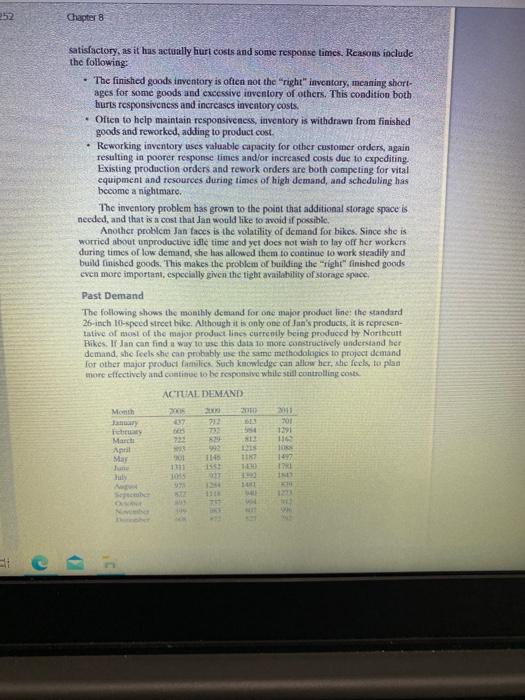
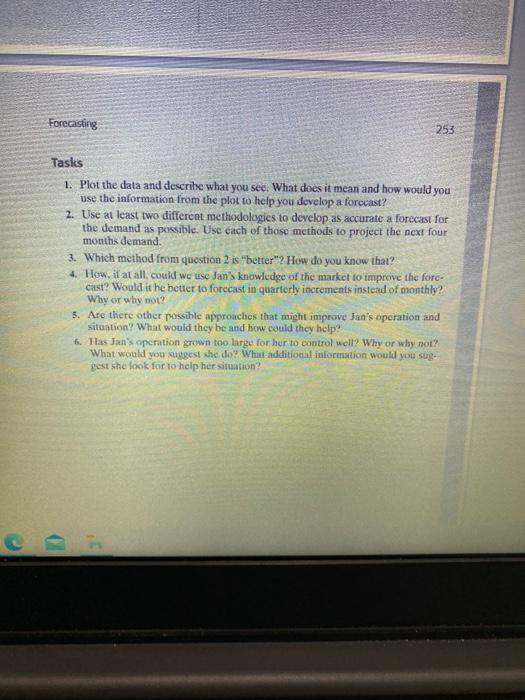
- + | A Read aloud | Draw NORTHCUTT BIKES: THE FORECASTING PROBLEM Jan Northcuti, owner of Northcott Bikes, started business in 1995 when she noticed The quality of bikes she purchased for sale in her bike shop declining while the prices went up. She also found it more difficult to obtain the features she wanted on ordered bikes without waiting for months. Her frustration turned to a determination to build her own bikes to her particular customer specification. She began by buying all the necessary parts (frames, scals, tires, etc.) and assembling them in a rented garage using two helpers. As the word spread about her shop's responsiveness to options, delivery, and quality, however, the individual customer base grew to include other bike shops in the area. As her business grew and demanded more of her attention, she soon found it necessary to sell the bike shop itself and concentrate on the production of bikes from a fairly large based factory space. As the business continued to grow, she backward integrated more and more processes into her operation, so that now she purchases less than 50% of the compo- neat value of the manufactured bikes. This not only improves her control of produc- tion quality but also helps her control the costs of production and makes the final product more cost attractive to her customers. The Current Situation Jan considers herself hands-on manager and bas typically used her intuition and her knowledge of the market to anticipate production needs. Since one of her founding principles was rapid and reliable delivery to customer specification, she felt she needed to begin production of the basic parts for cach particular style of bike well in advance of domand. In that way she could have the basic frame, wheels and standard accessories started in production prior to the recognition of actual demand, leaving only the optional add-ons to assemble once the order cuine in Her turnaround time for an order of less than all the industry average is considered a major strategie advantage, and she feels it is vital for her to maintain or even improve on response time if she is to maintain her successful operation As the customer base has grown however, the number of customers Jan known personally has shrunk significantly as a percentage of the total costumer tresse for Northcutt Dikes and many of these new customer expecting or demanding very short response times as that is what attracted them to Northcutt Bikes in the first place. This condition, in addition to the validity of overall demand, has put a strain on capacity planning She finds that times thereot of idle time (adding galicantly to costs), whereas at other times the demand exceed capacity and lurts customer response time. The production facity has thereiste turned to trying to projet demand for cert models and actually build ing shed coods inventory of these models This has not prove to be to 52 Chapter 8 satisfactory, as it has actually hurt costs and some response times. Reasons include the following: The finished goods inventory is often not the "right" inventory, meaning short- ages for some goods and excessive inventory of others. This condition both hurts responsiveness and increases inventory costs. Often to help maintain responsiveness, inventory is withdrawn from finished goods and reworked, adding to product cost Reworking inventory uses valuable capacity for other customer orders, again resulting in poorer response times and/or increased costs due to expediting. Existing production orders and rework orders are both competing for vital equipment and resources during times of high demand, and scheduling has become a nightmare. The inventory problem has grown to the point that additional storage space is needed, and that is a cost that Jan would like to avoid if possible. Another problem Jan faces is the volatility of od for bikes. Since she is worried about unproductive idle time and yet does not wish to lay off her workers during times of low demand, she has allowed them to continue to work steadily and build inished goods. This makes the problem of building the right finished goods even more important, especially given the tight availability of storage space Past Demand The following shows the monthly demand for one major product line: the standard 26-inch 10-speed street bike. Although it is only one of Jan's products, it is represen- tative of most of the major product lines correnly being produced by Northeutt Bikes. Il lan can find a way to use this data 10 more constructively understand her demand, she feels she can probably use the same methodologies to project demand for other major product families. Such knowledge can allow her, she feels to plan more effectively and continue to be responsive while still controlling costs ACTUAL DEMAND 07 101 73 13 Month Jay Hey March April May 16 01 1111 10 114 15 TINT 100 Sebe 3 Forecasting 253 Tasks 1. Plot the data and describe what you see. What does it mean and how would you use the information from the plot to help you develop a forecast? 2. Use at least two different methodologies to develop as accurate a forecast for the demand as possible. Use cach of those methods to project the next four months demand. 3. Which method from question 2 is "better"? How do you know that? 4. How, if at all. could we use Jan's knowledge of the market to improve the forc- cast? Would it he better to forecast in quarterly increments instead of monthly? Why or why not? 5. Are there other possible approaches that might improve Jan's operation and situation? What would they be and how could they help Has Jan's operation grown too large for her to control well? Why or why not? What would you suggest she do? What additional information would you sug- gest she look for to help her situation









 Study Help