







Question: Read the case study and answer the questions at the end with explanations THE TIMES 100 vodafone www.thetimes 100.co.uk Using Business Principles to support ethical
Read the case study and answer the questions at the end with explanations
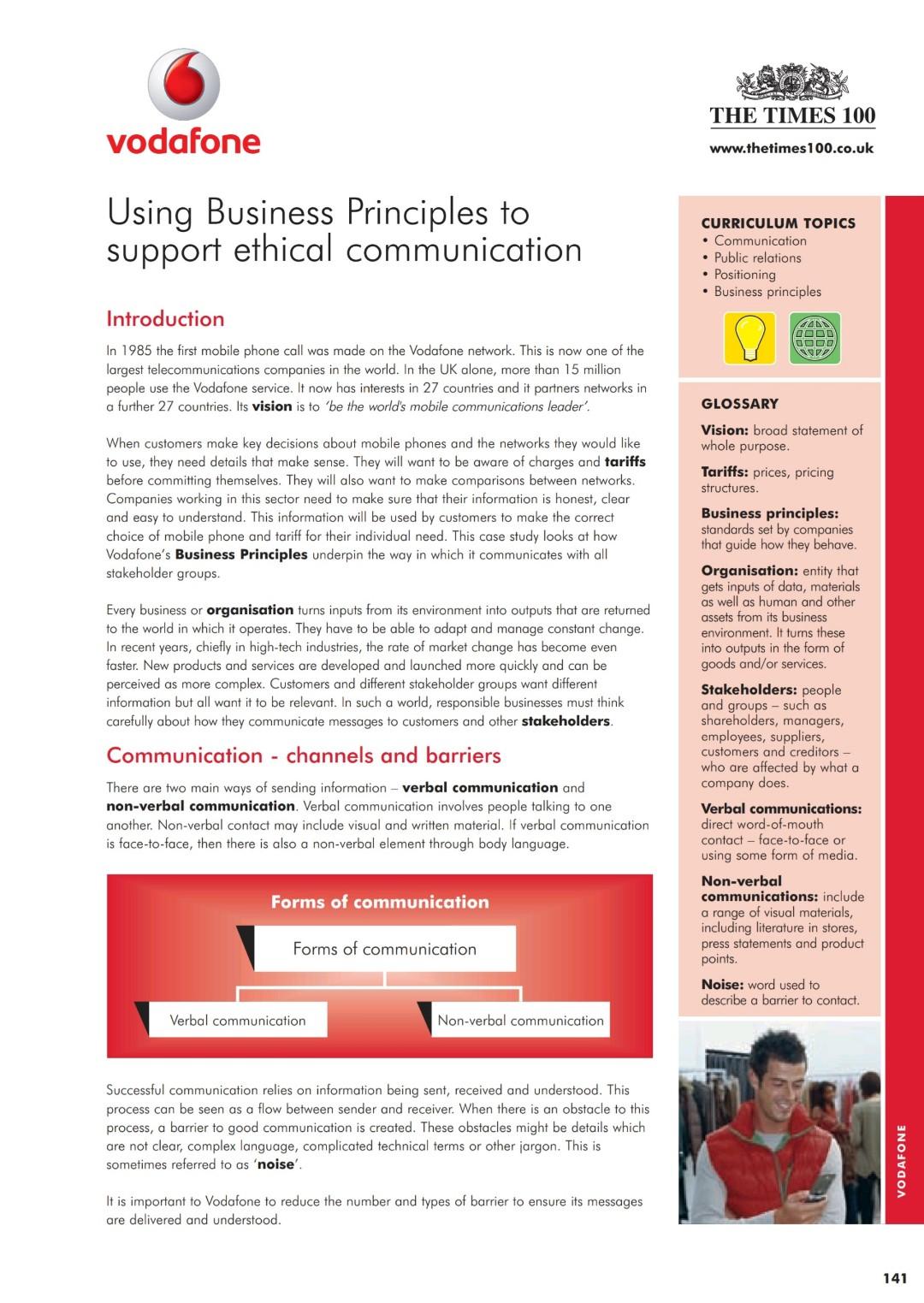
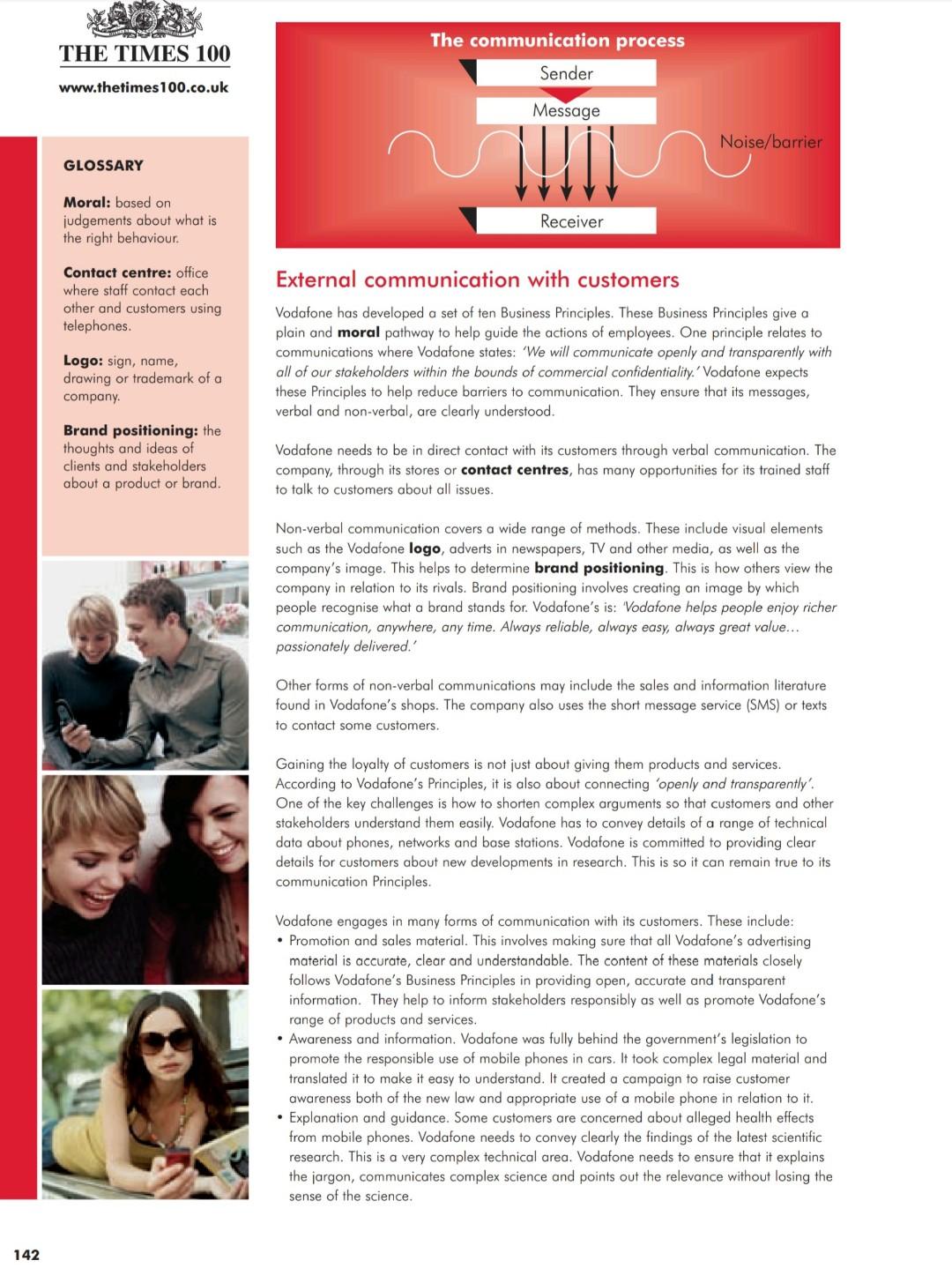
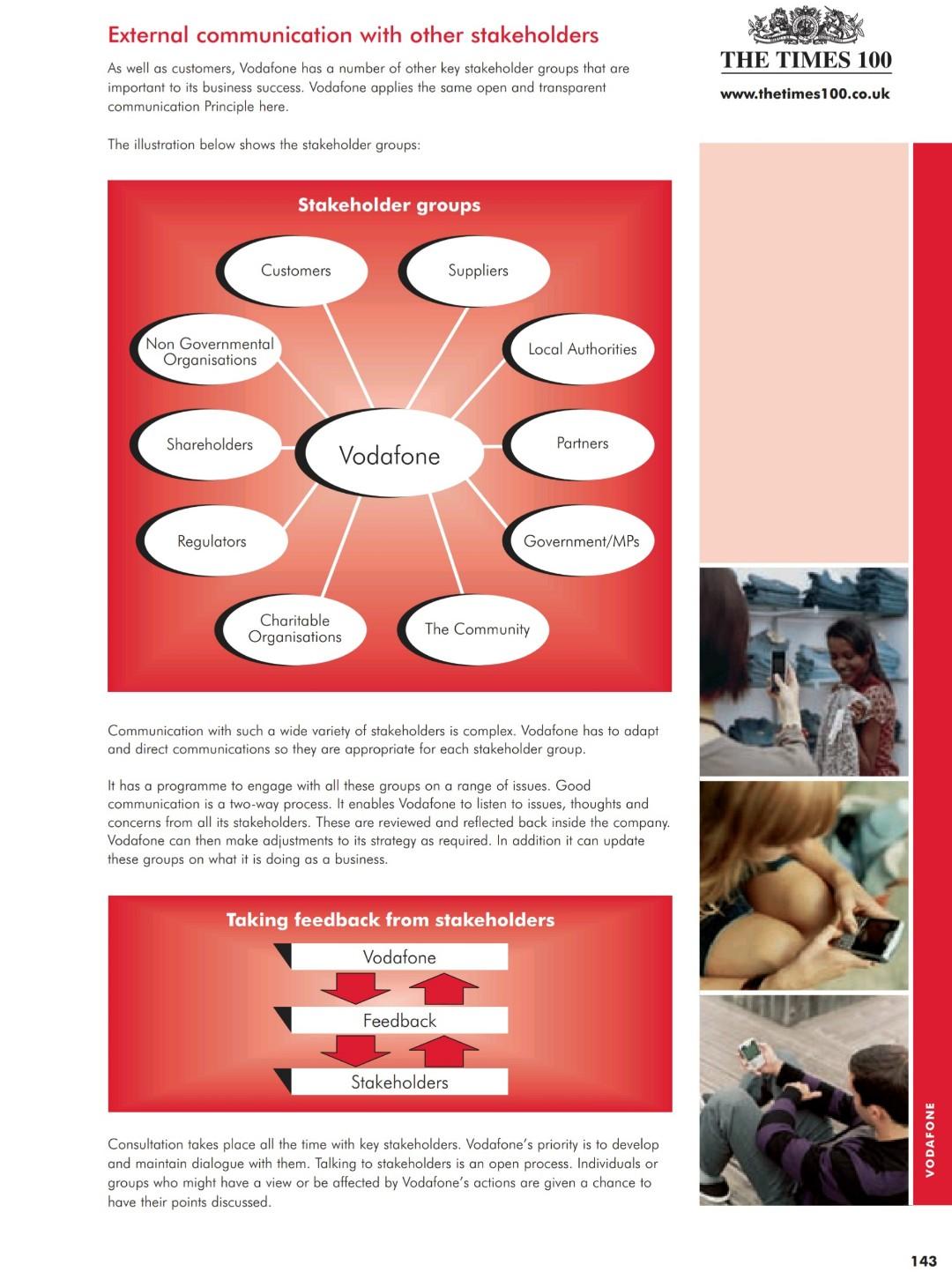
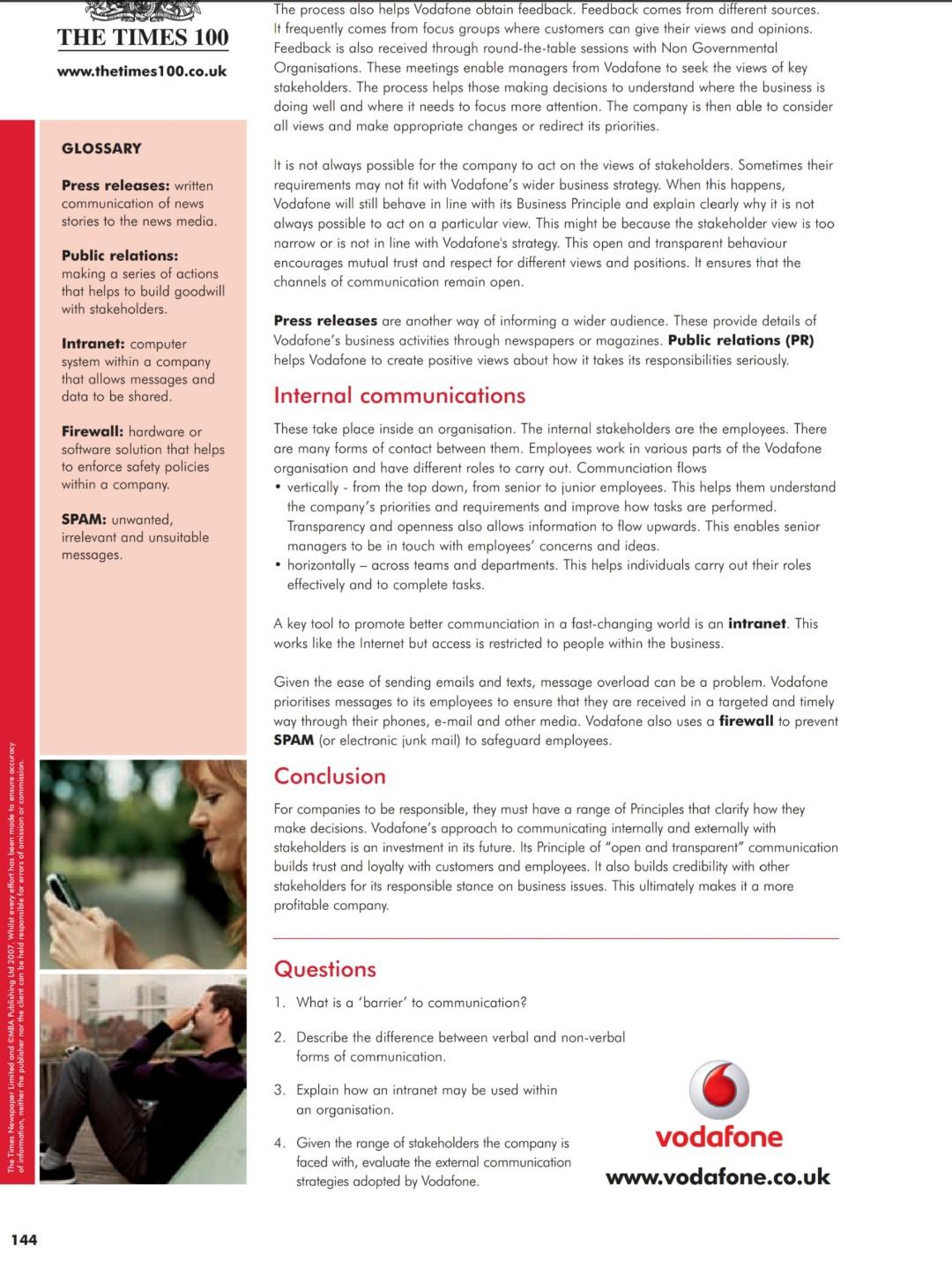
THE TIMES 100 vodafone www.thetimes 100.co.uk Using Business Principles to support ethical communication CURRICULUM TOPICS Communication Public relations Positioning Business principles Introduction AAN OD DODD PD In 1985 the first mobile phone call was made on the Vodafone network. This is now one of the largest telecommunications companies in the world. In the UK alone, more than 15 million people use the Vodafone service. It now has interests in 27 countries and it partners networks in a further 27 countries. Its vision is to be the world's mobile communications leader'. GLOSSARY When customers make key decisions about mobile phones and the networks they would like to use, they need details that make sense. They will want to be aware of charges and tariffs before committing themselves. They will also want to make comparisons between networks. Companies working in this sector need to make sure that their information is honest, clear and easy to understand. This information will be used by customers to make the correct choice of mobile phone and tariff for their individual need. This case study looks at how Vodafone's Business Principles underpin the way in which it communicates with all stakeholder groups. Every business or organisation turns inputs from its environment into outputs that are returned to the world in which it operates. They have to be able to adapt and manage constant change. In recent years, chiefly in high-tech industries, the rate of market change has become even faster. New products and services are developed and launched more quickly and can be perceived as more complex. Customers and different stakeholder groups want different information but all want it to be relevant. In such a world, responsible businesses must think carefully about how they communicate messages to customers and other stakeholders. Vision: broad statement of whole purpose. Tariffs: prices, pricing structures. Business principles: standards set by companies that guide how they behave. Organisation: entity that gets inputs of data, materials as well as human and other assets from its business environment. It turns these into outputs in the form of goods and/or services. Stakeholders: people and groups - such as shareholders, managers, employees, suppliers, customers and creditors - who are affected by what a company does. Verbal communications: direct word-of-mouth contact - face-to-face or using some form of media. Non-verbal communications: include a range of visual materials, including literature in stores, press statements and product points. Noise: word used to describe a barrier to contact. Communication - channels and barriers There are two main ways of sending information - verbal communication and non-verbal communication. Verbal communication involves people talking to one another. Non-verbal contact may include visual and written material. If verbal communication is face-to-face, then there is also a non-verbal element through body language. Forms of communication Forms of communication Verbal communication Non-verbal communication Successful communication relies on information being sent, received and understood. This process can be seen as a flow between sender and receiver. When there is an obstacle to this process, a barrier to good communication is created. These obstacles might be details which are not clear, complex language, complicated technical terms or other jargon. This is sometimes referred to as 'noise'. VODAFONE It is important to Vodafone to reduce the number and types of barrier to ensure its messages are delivered and understood. 141 The communication process THE TIMES 100 Sender www.thetimes 100.co.uk Message Noise/barrier GLOSSARY Moral: based on judgements about what is the right behaviour Receiver Contact centre: office where staff contact each other and customers using telephones. External communication with customers Vodafone has developed a set of ten Business Principles. These Business Principles give a plain and moral pathway to help guide the actions of employees. One principle relates to communications where Vodafone states: 'We will communicate openly and transparently with all of our stakeholders within the bounds of commercial confidentiality. Vodafone expects these Principles to help reduce barriers to communication. They ensure that its messages, verbal and non-verbal, are clearly understood. Logo: sign, name, drawing or trademark of a company Brand positioning: the thoughts and ideas of clients and stakeholders about a product or brand. Vodafone needs to be in direct contact with its customers through verbal communication. The company, through its stores or contact centres, has many opportunities for its trained staff to talk to customers about all issues. Non-verbal communication covers a wide range of methods. These include visual elements such as the Vodafone logo, adverts in newspapers, TV and other media, as well as the company's image. This helps to determine brand positioning. This is how others view the company in relation to its rivals. Brand positioning involves creating an image by which people recognise what a brand stands for. Vodafone's is: 'Vodafone helps people enjoy richer communication, anywhere, any time. Always reliable, always easy, always great value... passionately delivered.' Other forms of non-verbal communications may include the sales and information literature found in Vodafone's shops. The company also uses the short message service (SMS) or texts to contact some customers. Gaining the loyalty of customers is not just about giving them products and services. According to Vodafone's Principles, it is also about connecting 'openly and transparently'. One of the key challenges is how to shorten complex arguments so that customers and other stakeholders understand them easily. Vodafone has to convey details of a range of technical data about phones, networks and base stations. Vodafone is committed to providing clear details for customers about new developments in research. This is so it can remain true to its communication Principles Vodafone engages in many forms of communication with its customers. These include: Promotion and sales material. This involves making sure that all Vodafone's advertising material is accurate, clear and understandable. The content of these materials closely follows Vodafone's Business Principles in providing open, accurate and transparent information. They help to inform stakeholders responsibly as well as promote Vodafone's range of products and services. Awareness and information. Vodafone was fully behind the government's legislation to promote the responsible use of mobile phones in cars. It took complex legal material and translated it to make it easy to understand. It created a campaign to raise customer awareness both of the new law and appropriate use of a mobile phone in relation to it. Explanation and guidance. Some customers are concerned about alleged health effects from mobile phones. Vodafone needs to convey clearly the findings of the latest scientific research. This is a very complex technical area. Vodafone needs to ensure that it explains the jargon, communicates complex science and points out the relevance without losing the sense of the science. 142 THE TIMES 100 External communication with other stakeholders As well as customers, Vodafone has a number of other key stakeholder groups that are important to its business success. Vodafone applies the same open and transparent communication Principle here. www.thetimes100.co.uk The illustration below shows the stakeholder groups: Stakeholder groups Customers Suppliers Non Governmental Organisations Local Authorities Shareholders Partners Vodafone Regulators Government/MPS Charitable Organisations The Community Communication with such a wide variety of stakeholders is complex. Vodafone has to adapt and direct communications so they are appropriate for each stakeholder group. It has a programme to engage with all these groups on a range of issues. Good communication is a two-way process. It enables Vodafone to listen to issues, thoughts and concerns from all its stakeholders. These are reviewed and reflected back inside the company. Vodafone can then make adjustments to its strategy as required. In addition it can update these groups on what it is doing as a business. Taking feedback from stakeholders Vodafone Feedback Stakeholders Consultation takes place all the time with key stakeholders. Vodafone's priority is to develop and maintain dialogue with them. Talking to stakeholders is an open process. Individuals or groups who might have a view or be affected by Vodafone's actions are given a chance to have their points discussed. VODAFONE 143
Step by Step Solution
There are 3 Steps involved in it
1 Expert Approved Answer
Step: 1 Unlock

Question Has Been Solved by an Expert!
Get step-by-step solutions from verified subject matter experts
Step: 2 Unlock
Step: 3 Unlock
 Study Help