







Question: read the case study attached below: after reading the case answer this question: Knowing that perception often equals the truth, what are important considerations that
read the case study attached below: 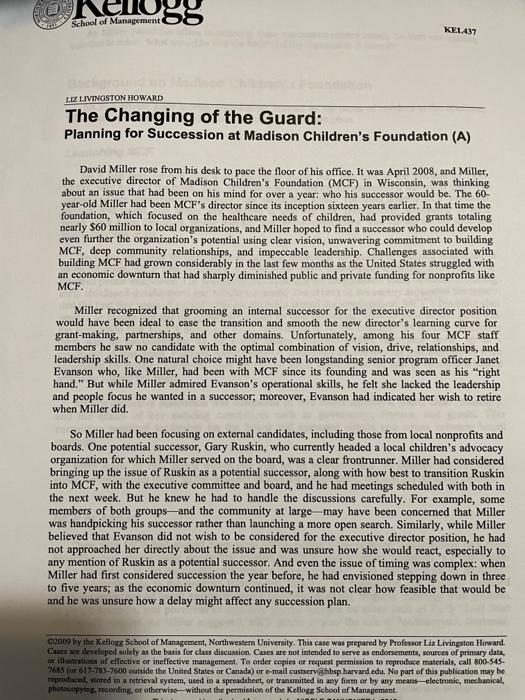
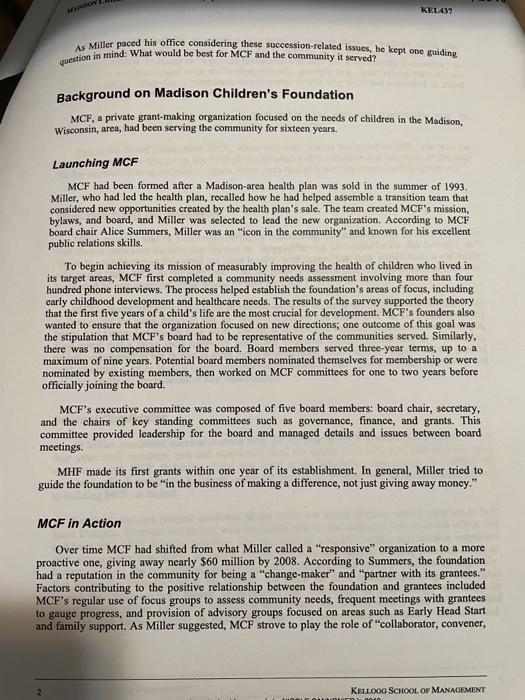
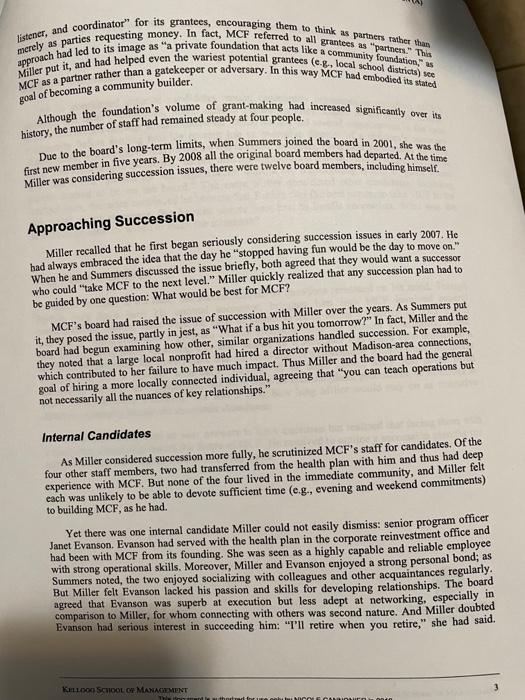
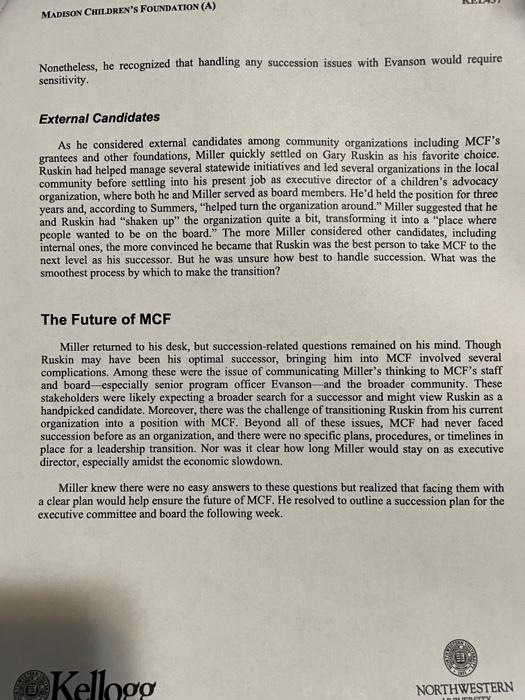
School of Management KEL437 LIZ LIVINGSTON HOWARD The Changing of the Guard: Planning for Succession at Madison Children's Foundation (A) David Miller rose from his desk to pace the floor of his office. It was April 2008, and Miller, the executive director of Madison Children's Foundation (MCF) in Wisconsin, was thinking about an issue that had been on his mind for over a year: who his successor would be. The 60- year-old Miller had been MCF's director since its inception sixteen years earlier. In that time the foundation, which focused on the healthcare needs of children, had provided grants totaling nearly 560 million to local organizations, and Miller hoped to find a successor who could develop even further the organization's potential using clear vision, unwavering commitment to building MCF, deep community relationships, and impeccable leadership. Challenges associated with building MCF had grown considerably in the last few months as the United States struggled with an economic downturn that had sharply diminished public and private funding for nonprofits like MCF. Miller recognized that grooming an internal successor for the executive director position would have been ideal to ease the transition and smooth the new director's learning curve for grant-making, partnerships, and other domains. Unfortunately, among his four MCF staff members he saw no candidate with the optimal combination of vision, drive, relationships, and leadership skills. One natural choice might have been longstanding senior program officer Janet Evanson who, like Miller, had been with MCF since its founding and was seen as his "right hand." But while Miller admired Evanson's operational skills, he felt she lacked the leadership and people focus he wanted in a successor, moreover, Evanson had indicated her wish to retire when Miller did. So Miller had been focusing on external candidates, including those from local nonprofits and boards. One potential successor, Gary Ruskin, who currently headed a local children's advocacy organization for which Miller served on the board, was a clear frontrunner. Miller had considered bringing up the issue of Ruskin as a potential successor, along with how best to transition Ruskin into MCF, with the executive committee and board, and he had meetings scheduled with both in the next week. But he knew he had to handle the discussions carefully. For example, some members of both groups and the community at large may have been concerned that Miller was handpicking his successor rather than launching a more open search. Similarly, while Miller believed that Evanson did not wish to be considered for the executive director position, he had not approached her directly about the issue and was unsure how she would react, especially to any mention of Ruskin as a potential successor. And even the issue of timing was complex: when Miller had first considered succession the year before, he had envisioned stepping down in three to five years; as the economic downtum continued, it was not clear how feasible that would be and he was unsure how a delay might affect any succession plan. 2009 by the Kellogg School of Management, Northwestern University. This case was prepared by Professor Liz Livingston Howard. Casame developed solely as the basis for class discussion. Cases are not intended to serve as endorsements, sources of primary data of illustration of elective or ineffective management. To order copies or request permission to reproduce materials, call 800-545- 7685 (617-783-7600 outside the United States or Canada) or e-mail custservi@bsp harvard.edu. No part of this publication may be reproduced, stored in a retrieval system, used in a spreadsheet, or transmitted in any form or by any means-electronic, mechanical photocopyin, recording, or otherwise--without the permission of the Kellogg School of Management. MON KEL437 question in mind: What would be best for MCF and the community it served? he kept one guiding Background on Madison Children's Foundation MCF, a private grant-making organization focused on the needs of children in the Madison, Wisconsin, area, had been serving the community for sixteen years. Launching MCF MCF had been formed after a Madison-area health plan was sold in the summer of 1993 Miller, who had led the health plan, recalled how he had helped assemble a transition team that considered new opportunities created by the health plan's sale. The team created MCF's mission, bylaws, and board, and Miller was selected to lead the new organization. According to MCF board chair Alice Summers, Miller was an "icon in the community" and known for his excellent public relations skills. To begin achieving its mission of measurably improving the health of children who lived in its target areas, MCF first completed a community needs assessment involving more than four hundred phone interviews. The process helped establish the foundation's areas of focus, including early childhood development and healthcare needs. The results of the survey supported the theory that the first five years of a child's life are the most crucial for development. MCF's founders also wanted to ensure that the organization focused on new directions, one outcome of this goal was the stipulation that MCF's board had to be representative of the communities served. Similarly, there was no compensation for the board. Board members served three-year terms, up to a maximum of nine years. Potential board members nominated themselves for membership or were nominated by existing members, then worked on MCF committees for one to two years before officially joining the board. MCF's executive committee was composed of five board members: board chair, secretary, and the chairs of key standing committees such as governance, finance, and grants. This committee provided leadership for the board and managed details and issues between board meetings. MHF made its first grants within one year of its establishment. In general, Miller tried to guide the foundation to be "in the business of making a difference, not just giving away money." MCF in Action Over time MCF had shifted from what Miller called a "responsive" organization to a more proactive one, giving away nearly $60 million by 2008. According to Summers, the foundation had a reputation in the community for being a "change-maker" and "partner with its grantees." Factors contributing to the positive relationship between the foundation and grantees included MCF's regular use of focus groups to assess community needs, frequent meetings with grantees to gauge progress, and provision of advisory groups focused on areas such as Early Head Start and family support. As Miller suggested, MCF strove to play the role of "collaborator, convener, KELLOOG SCHOOL OF MANAGEMENT merely as parties requesting money. In fact, MCF referred to all grantees as partners. This listener, and coordinator for its grantees, encouraging them to think as partners rather than approach had led to its image as a private foundation that acts like a community foundations Miller put it, and had helped even the wariest potential grantees (eg, local school districts) see MCF as a partner rather than a gatekeeper or adversary. In this way MCF had embodied its stated Although the foundation's volume of grant-making had increased significantly over its goal of becoming a community builder history, the number of staff had remained steady at four people. Due to the board's long-term limits, when Summers joined the board in 2001, she was the first new member in five years. By 2008 all the original board members had departed. At the time Miller was considering succession issues, there were twelve board members, including himself. Approaching Succession Miller recalled that he first began seriously considering succession issues in early 2007. He had always embraced the idea that the day he "stopped having fun would be the day to move on. When he and Summers discussed the issue briefly, both agreed that they would want a successor who could take MCF to the next level." Miller quickly realized that any succession plan had to be guided by one question: What would be best for MCF? MCF's board had raised the issue of succession with Miller over the years. As Summers put it, they posed the issue, partly in jest, as "What if a bus hit you tomorrow?" In fact, Miller and the board had begun examining how other, similar organizations handled succession. For example, they noted that a large local nonprofit had hired a director without Madison-area connections, which contributed to her failure to have much impact. Thus Miller and the board had the general goal of hiring a more locally connected individual, agreeing that you can teach operations but not necessarily all the nuances of key relationships." Internal Candidates As Miller considered succession more fully, he scrutinized MCF's staff for candidates. Of the four other staff members, two had transferred from the health plan with him and thus had deep experience with MCF. But none of the four lived in the immediate community, and Miller felt each was unlikely to be able to devote sufficient time (c.g., evening and weekend commitments) to building MCF, as he had. Yet there was one internal candidate Miller could not easily dismiss: senior program officer Janet Evanson. Evanson had served with the health plan in the corporate reinvestment office and had been with MCF from its founding. She was seen as a highly capable and reliable employee with strong operational skills. Moreover, Miller and Evanson enjoyed a strong personal bond; as Summers noted, the two enjoyed socializing with colleagues and other acquaintances regularly. But Miller felt Evanson lacked his passion and skills for developing relationships. The board agreed that Evanson was superb at execution but less adept at networking, especially in comparison to Miller, for whom connecting with others was second nature. And Miller doubted Evanson had serious interest in succeeding him: "T'll retire when you retire," she had said. KDOO SCHOOL OF MANAGEMENT This CABLE MADISON CHILDREN'S FOUNDATION (A) Nonetheless, he recognized that handling any succession issues with Evanson would require sensitivity. External Candidates As he considered external candidates among community organizations including MCF's grantees and other foundations, Miller quickly settled on Gary Ruskin as his favorite choice. Ruskin had helped manage several statewide initiatives and led several organizations in the local community before settling into his present job as executive director of a children's advocacy organization, where both he and Miller served as board members. He'd held the position for three years and, according to Summers, "helped turn the organization around." Miller suggested that he and Ruskin had "shaken up" the organization quite a bit, transforming it into a "place where people wanted to be on the board." The more Miller considered oth candidates, including internal ones, the more convinced he became that Ruskin was the best person to take MCF to the next level as his successor. But he was unsure how best to handle succession. What was the smoothest process by which to make the transition? The Future of MCF Miller returned to his desk, but succession-related questions remained on his mind. Though Ruskin may have been his optimal successor, bringing him into MCF involved several complications. Among these were the issue of communicating Miller's thinking to MCF's staff and board especially senior program officer Evanson and the broader community. These stakeholders were likely expecting a broader search for a successor and might view Ruskin as a handpicked candidate. Moreover, there was the challenge of transitioning Ruskin from his current organization into a position with MCF. Beyond all of these issues, MCF had never faced succession before as an organization, and there were no specific plans, procedures, or timelines in place for a leadership transition. Nor was it clear how long Miller would stay on as executive director, especially amidst the economic slowdown. Miller knew there were no easy answers to these questions but realized that facing them with a clear plan would help ensure the future of MCF. He resolved to outline a succession plan for the executive committee and board the following week. Kellogo NORTHWESTERN DETTY after reading the case answer this question:
Knowing that perception often equals the truth, what are important considerations that David Miller should contemplate in actively shaping perceptions as he moves the Board and staff through the succession process?
Step by Step Solution
There are 3 Steps involved in it
1 Expert Approved Answer
Step: 1 Unlock

Question Has Been Solved by an Expert!
Get step-by-step solutions from verified subject matter experts
Step: 2 Unlock
Step: 3 Unlock
 Study Help