Question: Read the Case Study below and answer the following questions. Each question is worth (5 Marks). Case 2: IT in Health Care: Voice Recognition Tools
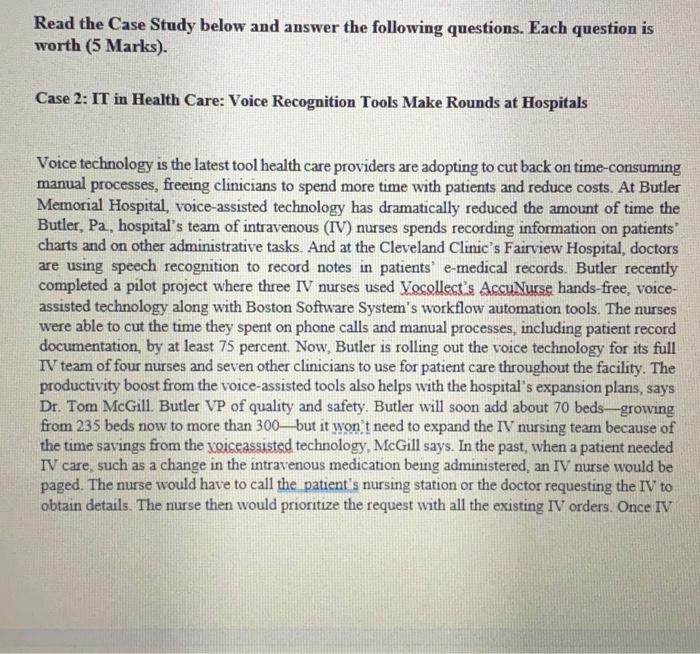
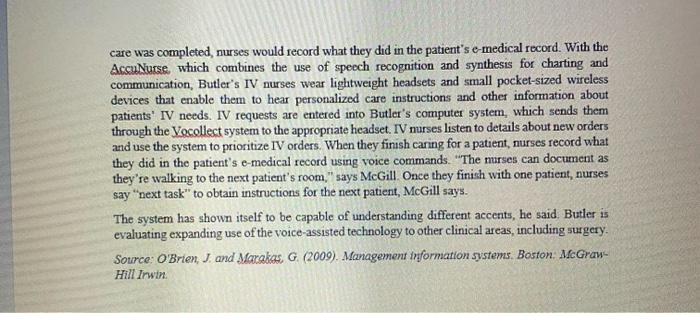
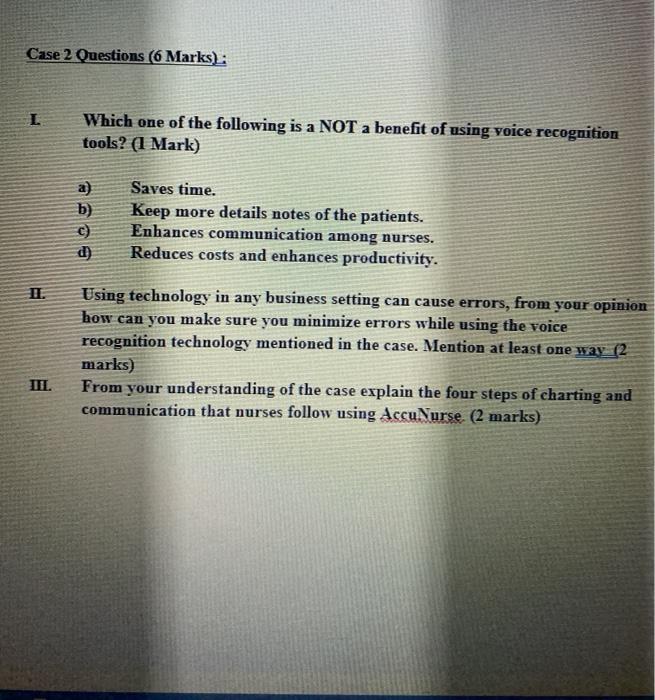
Read the Case Study below and answer the following questions. Each question is worth (5 Marks). Case 2: IT in Health Care: Voice Recognition Tools Make Rounds at Hospitals Voice technology is the latest tool health care providers are adopting to cut back on time-consuming manual processes, freeing clinicians to spend more time with patients and reduce costs. At Butler Memorial Hospital, voice-assisted technology has dramatically reduced the amount of time the Butler, Pa, hospital's team of intravenous (IV) nurses spends recording information on patients charts and on other administrative tasks. And at the Cleveland Clinic's Fairview Hospital, doctors are using speech recognition to record notes in patients' e-medical records. Butler recently completed a pilot project where three IV nurses used Vocollect's AccuNurse hands-free, voice- assisted technology along with Boston Software System's workflow automation tools. The nurses were able to cut the time they spent on phone calls and manual processes, including patient record documentation, by at least 75 percent. Now, Butler is rolling out the voice technology for its full IV team of four nurses and seven other clinicians to use for patient care throughout the facility. The productivity boost from the voice-assisted tools also helps with the hospital's expansion plans, says Dr. Tom McGill. Butler VP of quality and safety. Butler will soon add about 70 beds-growing from 235 beds now to more than 300but it won't need to expand the IV nursing team because of the time savings from the voiceassisted technology, McGill says. In the past, when a patient needed IV care, such as a change in the intravenous medication being administered an IV nurse would be paged. The nurse would have to call the patient's nursing station or the doctor requesting the IV to obtain details. The nurse then would prioritize the request with all the existing IV orders. Once IV care was completed, nurses would record what they did in the patient's e-medical record. With the AccuNurse which combines the use of speech recognition and synthesis for charting and communication, Butler's IV nurses wear lightweight headsets and small pocket-sized wireless devices that enable them to hear personalized care instructions and other information about patients' IV needs. IV requests are entered into Butler's computer system, which sends them through the Vocollect system to the appropriate headset. IV murses listen to details about new orders and use the system to prioritize IV orders. When they finish caring for a patient, nurses record what they did in the patient's e-medical record using voice commands. "The murses can document as they're walking to the next patient's room," says McGill Once they finish with one patient, nurses say "next task" to obtain instructions for the next patient, McGill says. The system has shown itself to be capable of understanding different accents, he said. Butler is evaluating expanding use of the voice-assisted technology to other clinical areas, including surgery Source: O'Brien, J. and Marakas G. (2009). Management information systems. Boston: McGraw- Hill Irwin Case 2 Questions (6 Marks): L Which one of the following is a NOT a benefit of using voice recognition tools? (1 Mark) b) c) Saves time. Keep more details notes of the patients. Enhances communication among nurses. Reduces costs and enhances productivity. e Using technology in any business setting can cause errors, from your opinion how can you make sure you minimize errors while using the voice recognition technology mentioned in the case. Mention at least one way (2 marks) From your understanding of the case explain the four steps of charting and communication that nurses follow using AccuNurse. (2 marks) 111









 Study Help