







Question: Read the case study below and answer the questions that follows poper Government-funded schools' procurement of products and services represents a significant sum of money
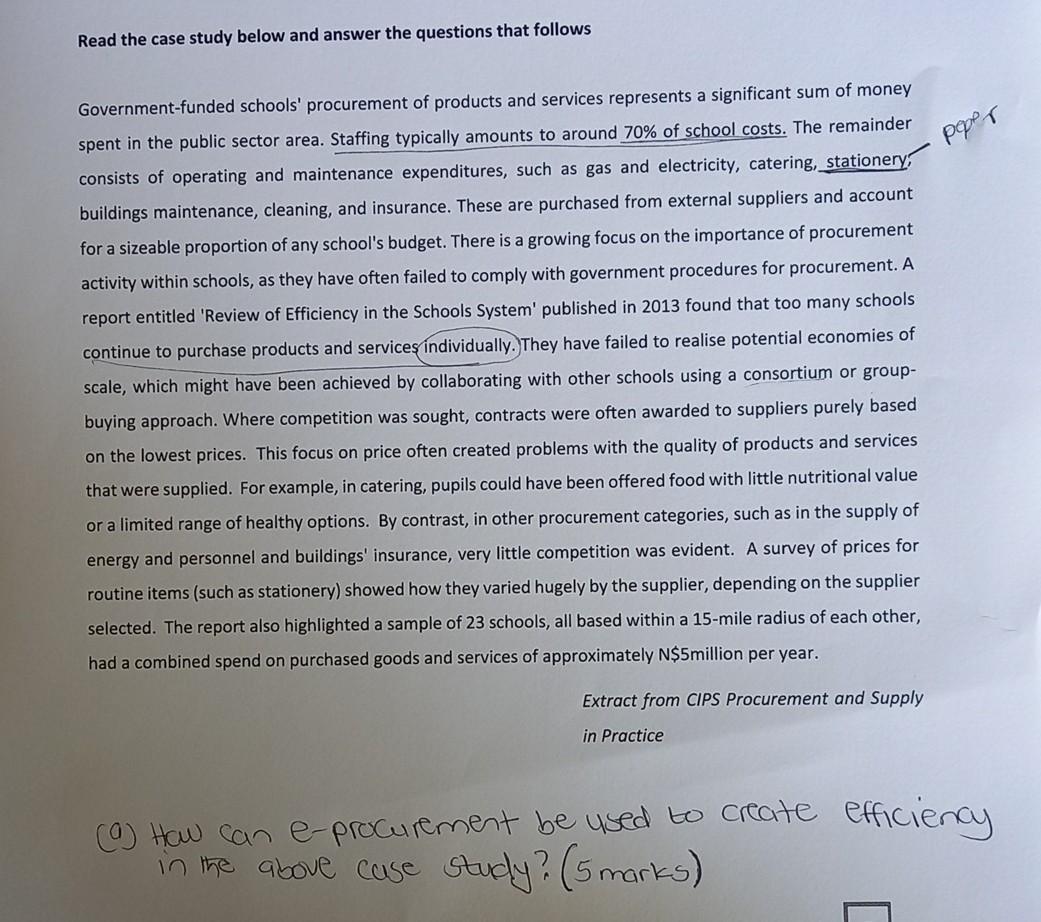
Read the case study below and answer the questions that follows poper Government-funded schools' procurement of products and services represents a significant sum of money spent in the public sector area. Staffing typically amounts to around 70% of school costs. The remainder consists of operating and maintenance expenditures, such as gas and electricity, catering, stationery buildings maintenance, cleaning, and insurance. These are purchased from external suppliers and account for a sizeable proportion of any school's budget. There is a growing focus on the importance of procurement activity within schools, as they have often failed to comply with government procedures for procurement. A report entitled 'Review of Efficiency in the Schools System' published in 2013 found that too many schools continue to purchase products and services individually. They have failed to realise potential economies of scale, which might have been achieved by collaborating with other schools using a consortium or group- buying approach. Where competition was sought, contracts were often awarded to suppliers purely based on the lowest prices. This focus on price often created problems with the quality of products and services that were supplied. For example, in catering, pupils could have been offered food with little nutritional value or a limited range of healthy options. By contrast, in other procurement categories, such as in the supply of energy and personnel and buildings' insurance, very little competition was evident. A survey of prices for routine items (such as stationery) showed how they varied hugely by the supplier, depending on the supplier selected. The report also highlighted a sample of 23 schools, all based within a 15-mile radius of each other, had a combined spend on purchased goods and services of approximately N$5million per year. Extract from CIPS Procurement and Supply in Practice @ How can e-procurement be used to create efficiency in the above case study
Step by Step Solution
There are 3 Steps involved in it
1 Expert Approved Answer
Step: 1 Unlock

Question Has Been Solved by an Expert!
Get step-by-step solutions from verified subject matter experts
Step: 2 Unlock
Step: 3 Unlock
 Study Help