Question: Read the Case Study Blake Electronics at the end of chapter 3. Let's let the quantitative analysis stay at home for this exercise and use
Read the Case Study "Blake Electronics" at the end of chapter 3. Let's let the quantitative analysis stay at home for this exercise and use your qualitative skills instead. After reading the case study text, give me your best analysis of the decision making process at Blake Electronics. I don't need a "great work" or "terrible" reply from you. Don't rewrite what is in the case, and please do not quote from it. What I would like you to do is to think about the company and tell me your assessment of how they make decisions. Stock or pat answers will get you nowhere. I suggest that you first type your response in a Word document so that you can spell and grammar check it. Also, please don't copy someone else's thoughts on this subject. You are submitting this through a SimCheck check, and it will catch and plagiarism. Give me about 250 words (about half a page of text) about how you perceive the inner decision workings of Blake Electronics. No outside articles or journals or collaborations. Just plain old basic observation.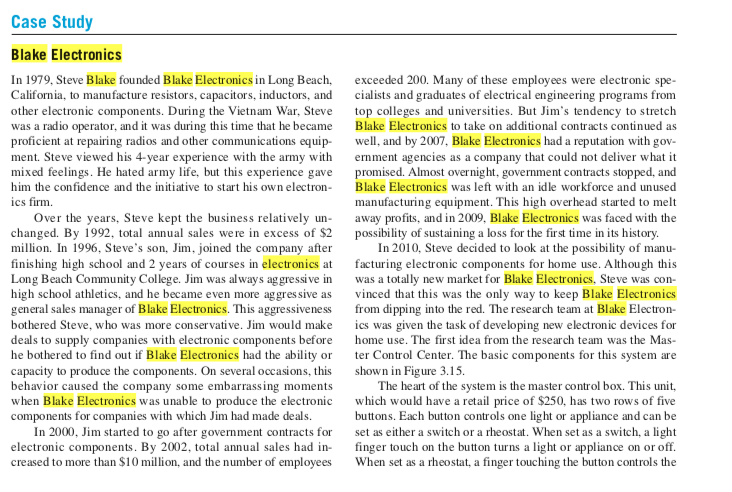
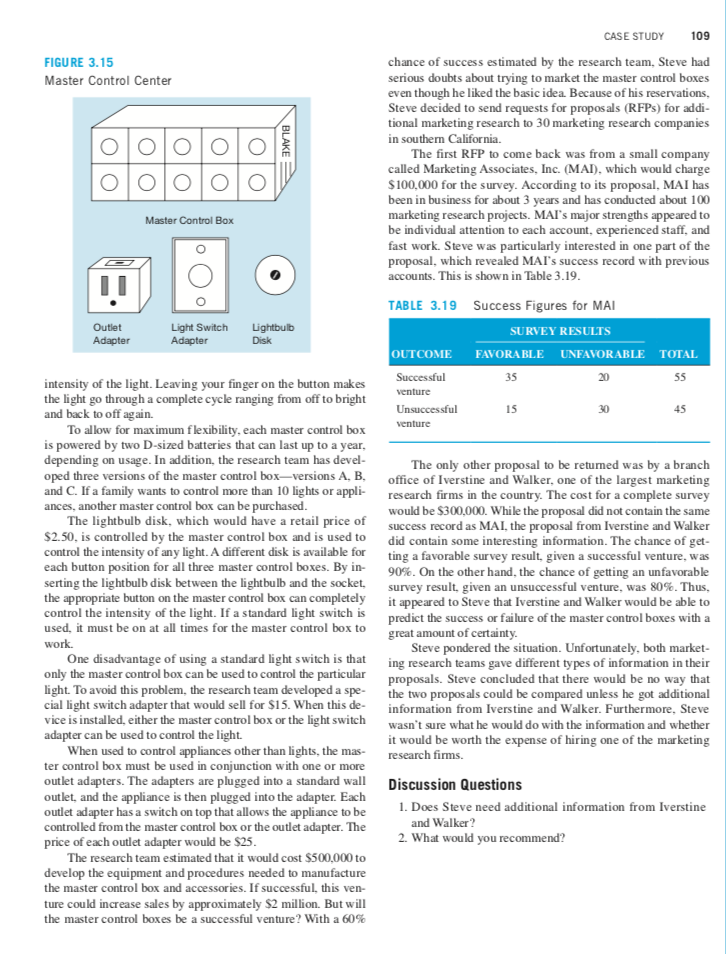
Case Study Blake Electronics In 1979, Steve Blake founded Blake Electronics in Long Beach, exceeded 200. Many of these employees were electronic spe- California, to manufacture resistors, capacitors, inductors, and cialists and graduates of electrical engineering programs from other electronic components. During the Vietnam War, Stevetop colleges and universities. But Jim's tendency to stretch was a radio operator, and it was during this time that he became Blake Electronics to take on additional contracts continued as proficient at repairing radios and other communications equip well, and by 2007, Blake Electronics had a reputation with gov- ment. Steve viewed his 4-year experience with the army with ernment agencies as a company that could not deliver what it mixed feelings. He hated army life, but this experience gave promised. Almost over night, government contracts stopped, and him the confidence and the initiative to start his own electron Blake Electronics was left with an idle workforce and unused ics firm. manufacturing equipment. This high overhead started to melt Over the years, Steve kept the business relatively un away profits, and in 2009, Blake Electronics was faced with the changed. By 1992, total annual sales were in excess of $2 possibility of sustaining a loss for the first time in its history. million. In 1996, Steve's son, Jim, joined the company after In 2010, Steve decided to look at the possibility of manu- finishing high school and 2 years of courses in electronics at facturing electronic components for home use. Although this Long Beach Community College. Jim was always aggressive in was a totally new market for Blake Electronics, high school athletics, and he became even more aggressive as vinced that this was the only way to keep Blake Electronics general sales manager of Blake Electronics. This aggressiveness from dipping into the red. The research team at Blake Electron- bothered Steve, who was more conservative. Jim would make ics was given the task of developing new electronic devices for home use. The first idea from the research team was the Mas- he bothered to find out if Blake Electronics had the ability or capacity to produce the components. On several occasions, this shown in Figure 3.15. behavior caused the company some embarrassing moments The heart of the system is the master control box. This unit, when Blake Electronics was unable to produce the electronic which would have a retail price of $250, has two rows of five components for companies with which Jim had made deals. buttons. Each button controls one light or appliance and can be In 2000, Jim started to go after government contracts for set as either a switch or a rheostat. When set as a switch, a light electronic components. By 2002, total annual sales had in- finger touch on the button turns a light or appliance on or off. creased to more than $10 million, and the number of employees When set as a rheostat, a finger touching the button controls the CASE STUDY 109 FIGURE 3.15 Master Control Center chance of success estimated by the research team, Steve had serious doubts about trying to market the master control boxes even though he liked the basic idea. Because of his reservations, Steve decided to send requests for proposals (RFPs) for addi- tional marketing research to 30 marketing research companies in southern California. The first RFP to come back was from a small company called Marketing Associates, Inc. (MAI), which would charge $100,000 for the survey. According to its proposal, MAI has been in business for about 3 years and has conducted about 100 marketing research projects. MAI's major strengths appeared to be individual attention to each account, experienced staff, and fast work. Steve was particularly interested in one part of the proposal, which revealed MAI's success record with previous accounts. This is shown in Table 3.19. Master Control Box TABLE 3.19 Outlet Adapter Light Switch Adapter Lightbulb Disk Success Figures for MAI SURVEY RESULTS FAVORABLE UNFAVORABLE TOTAL 35 OUTCOME Successful venture Unsuccessful venture 15 intensity of the light. Leaving your finger on the button makes the light go through a complete cycle ranging from off to bright and back to off again. To allow for maximum flexibility, each master control box is powered by two D-sized batteries that can last up to a year, depending on usage. In addition, the research team has devel- oped three versions of the master control box-versions A, B, and C. If a family wants to control more than 10 lights or appli- ances, another master control box can be purchased. The lightbulb disk, which would have a retail price of $2.50, is controlled by the master control box and is used to control the intensity of any light. A different disk is available for each button position for all three master control boxes. By in- serting the lightbulb disk between the lightbulb and the socket, the appropriate button on the master control box can completely control the intensity of the light. If a standard light switch is used, it must be on at all times for the master control box to work. One disadvantage of using a standard light switch is that only the master control box can be used to control the particular light. To avoid this problem, the research team developed a spe- cial light switch adapter that would sell for $15. When this de vice is installed, either the master control box or the light switch adapter can be used to control the light. When used to control appliances other than lights, the mas ter control box must be used in conjunction with one or more outlet adapters. The adapters are plugged into a standard wall outlet, and the appliance is then plugged into the adapter. Each outlet adapter has a switch on top that allows the appliance to be controlled from the master control box or the outlet adapter. The price of each outlet adapter would be $25. The research team estimated that it would cost $500,000 to develop the equipment and procedures needed to manufacture the master control box and accessories. If successful, this ven- ture could increase sales by approximately $2 million. But will the master control boxes be a successful venture? With a 60% The only other proposal to be returned was by a branch office of Iverstine and Walker, one of the largest marketing research firms in the country. The cost for a complete survey would be $300,000. While the proposal did not contain the same success record as MAI, the proposal from Iverstine and Walker did contain some interesting information. The chance of get- ting a favorable survey result, given a successful venture, was 90%. On the other hand, the chance of getting an unfavorable survey result, given an unsuccessful venture, was 80%. Thus, it appeared to Steve that Iverstine and Walker would be able to predict the success or failure of the master control boxes with a great amount of certainty. Steve pondered the situation. Unfortunately, both market ing research teams gave different types of information in their proposals. Steve concluded that there would be no way that the two proposals could be compared unless he got additional information from Iverstine and Walker. Furthermore, Steve wasn't sure what he would do with the information and whether it would be worth the expense of hiring one of the marketing research firms. Discussion Questions 1. Does Steve need additional information from Iverstine and Walker? 2. What would you recommend









 Study Help