







Question: Read the case study given below and answer the following questions: For part three (around 750 words) ? Evaluate the factors (external, competitive and internal)
Read the case study given below and answer the following questions:
For part three (around 750 words)
? Evaluate the factors (external, competitive and internal) that might explain how
Nokia gained and lost its position as a market leader in the mobile phone market.
For part four (around 500 words)
?Critically reflect the utilisation of product innovation and reflect on the top three lessons that innovation managers can learn from Nokia's experience of product innovation on the basis of your individual portfolio.
Give a brief conclusion summarising Nokia's performance and how it links to their product innovation strategies.
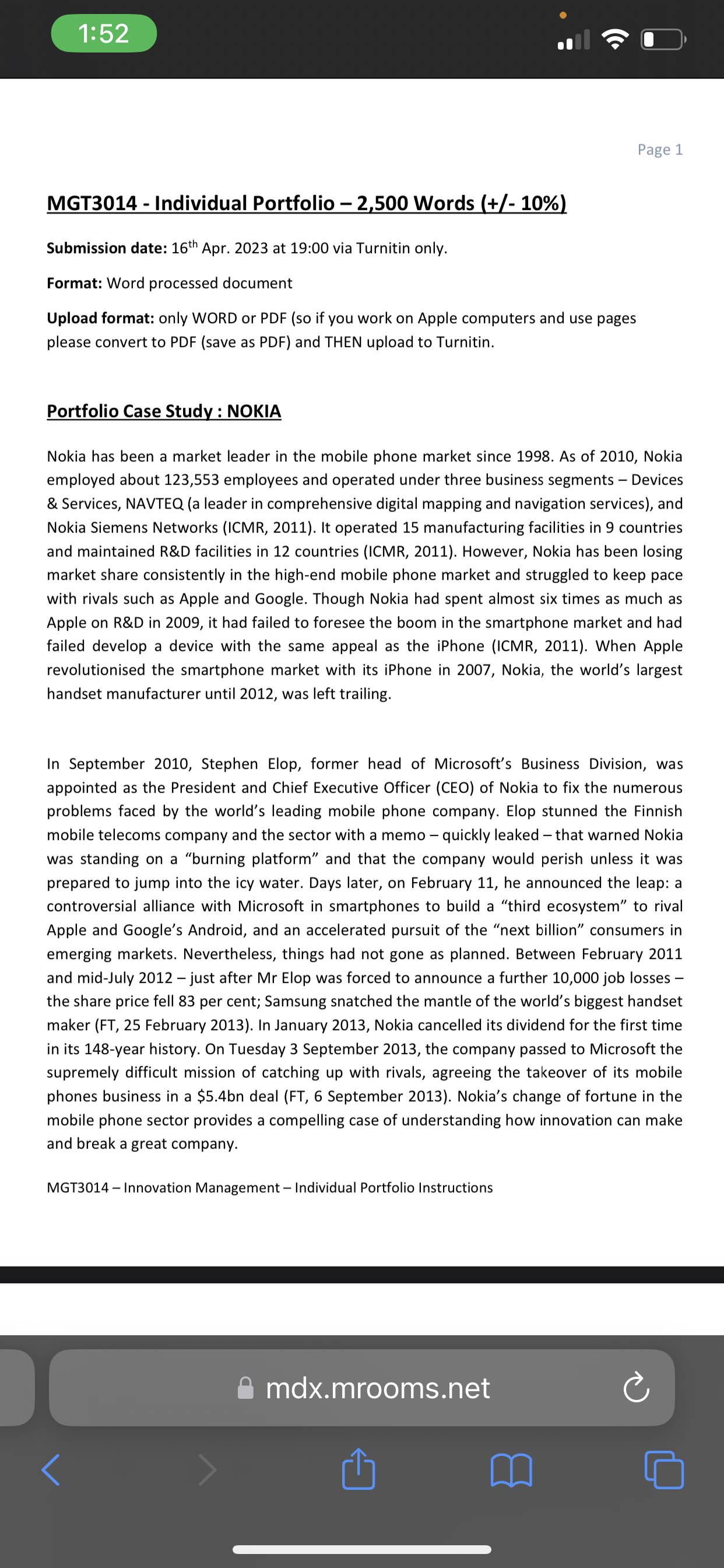
1:52 Page 1 MGT3014 - Individual Portfolio - 2,500 Words (+/- 10%) Submission date: 16th Apr. 2023 at 19:00 via Turnitin only. Format: Word processed document Upload format: only WORD or PDF (so if you work on Apple computers and use pages please convert to PDF (save as PDF) and THEN upload to Turnitin. Portfolio Case Study : NOKIA Nokia has been a market leader in the mobile phone market since 1998. As of 2010, Nokia employed about 123,553 employees and operated under three business segments - Devices & Services, NAVTEQ (a leader in comprehensive digital mapping and navigation services), and Nokia Siemens Networks (ICMR, 2011). It operated 15 manufacturing facilities in 9 countries and maintained R&D facilities in 12 countries (ICMR, 2011). However, Nokia has been losing market share consistently in the high-end mobile phone market and struggled to keep pace with rivals such as Apple and Google. Though Nokia had spent almost six times as much as Apple on R&D in 2009, it had failed to foresee the boom in the smartphone market and had failed develop a device with the same appeal as the iphone (ICMR, 2011). When Apple revolutionised the smartphone market with its iPhone in 2007, Nokia, the world's largest handset manufacturer until 2012, was left trailing. In September 2010, Stephen Elop, former head of Microsoft's Business Division, was appointed as the President and Chief Executive Officer (CEO) of Nokia to fix the numerous problems faced by the world's leading mobile phone company. Elop stunned the Finnish mobile telecoms company and the sector with a memo - quickly leaked - that warned Nokia was standing on a "burning platform" and that the company would perish unless it was prepared to jump into the icy water. Days later, on February 11, he announced the leap: a controversial alliance with Microsoft in smartphones to build a "third ecosystem" to rival Apple and Google's Android, and an accelerated pursuit of the "next billion" consumers in emerging markets. Nevertheless, things had not gone as planned. Between February 2011 and mid-July 2012 - just after Mr Elop was forced to announce a further 10,000 job losses - the share price fell 83 per cent; Samsung snatched the mantle of the world's biggest handset maker (FT, 25 February 2013). In January 2013, Nokia cancelled its dividend for the first time in its 148-year history. On Tuesday 3 September 2013, the company passed to Microsoft the supremely difficult mission of catching up with rivals, agreeing the takeover of its mobile phones business in a $5.4bn deal (FT, 6 September 2013). Nokia's change of fortune in the mobile phone sector provides a compelling case of understanding how innovation can make and break a great company. MGT3014 - Innovation Management - Individual Portfolio Instructions max.mrooms.net C
Step by Step Solution
There are 3 Steps involved in it

Get step-by-step solutions from verified subject matter experts
 Study Help