Question: Read the case study on 3M on pages 201-203 and answer the following questions: Describe how the concept of creative abrasion on pages 186-187 may
Read the case study on 3M on pages 201-203 and answer the following questions:
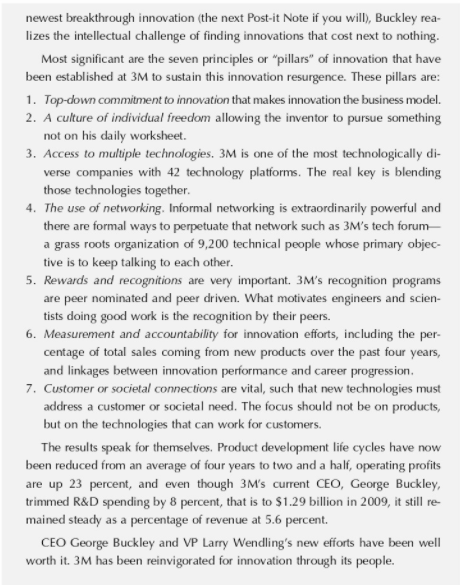
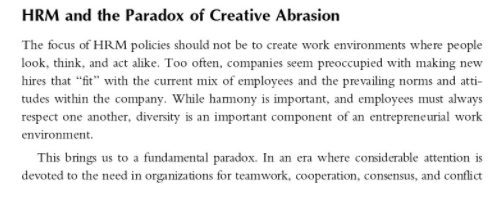
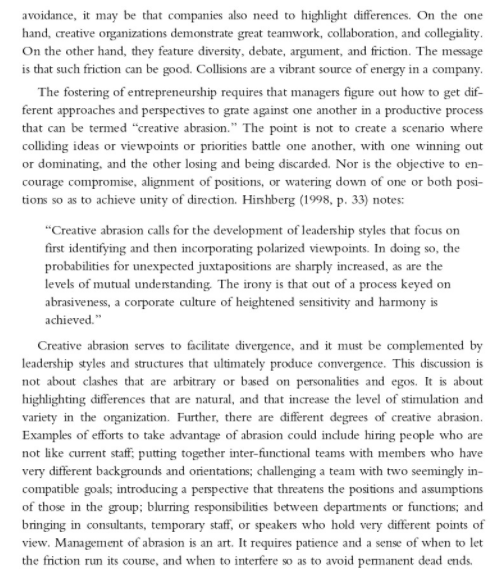
- Describe how the concept of creative abrasion on pages 186-187 may be applied to 3Ms pillars of innovation.
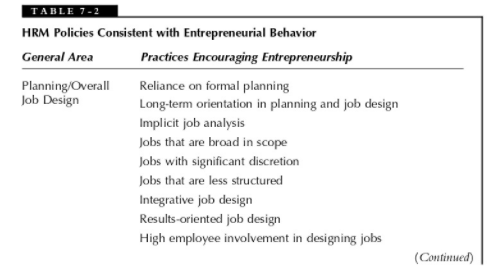
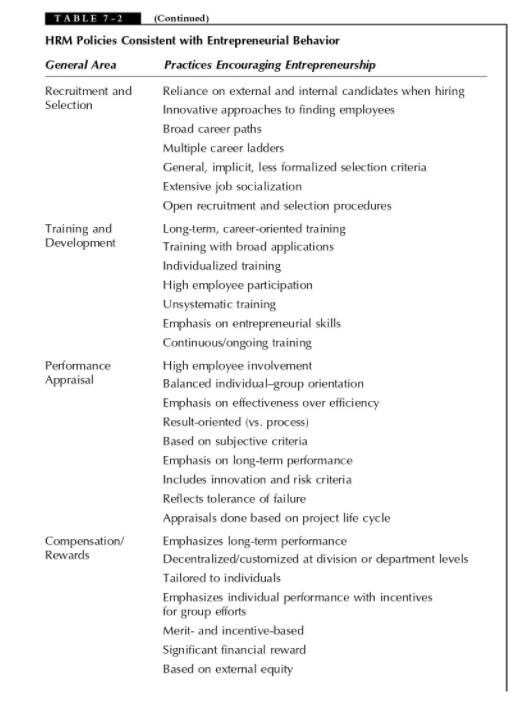
- How does 3Ms approach compare to Human Resource Management policies as applied to entrepreneurial behavior as described on Table 7-2 on pages 188-189?
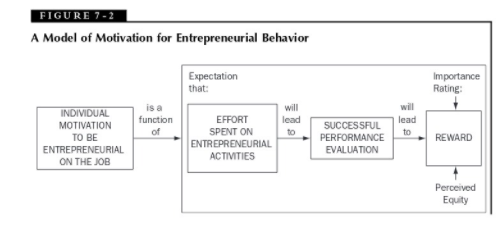
- Relate the critical role of reward systems on pages to the 3M pillars.
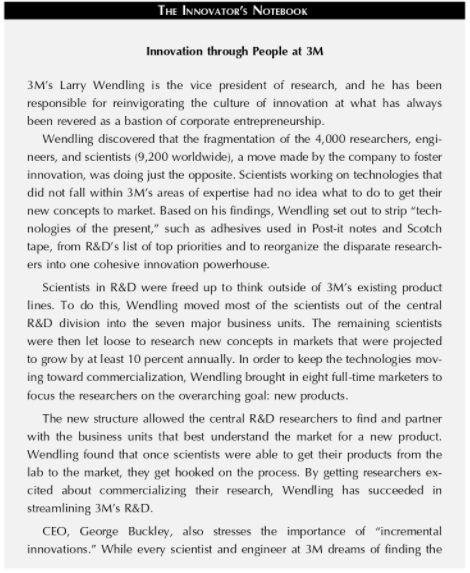
THE INNOVATOR'S NOTEBOOK Innovation through People at 3M 3M's Larry Wendling is the vice president of research, and he has been responsible for reinvigorating the culture of innovation at what has always been revered as a bastion of corporate entrepreneurship Wendling discovered that the fragmentation of the 4,000 researchers, engi- neers, and scientists (9,200 worldwide), a move made by the company to foster innovation, was doing just the opposite. Scientists working on technologies that did not fall within 3M's areas of expertise had no idea what to do to get their new concepts to market. Based on his findings, Wendling set out to strip "tech- nologies of the present," such as adhesives used in Post-it notes and Scotch tape, from R&D's list of top priorities and to reorganize the disparate research- ers into one cohesive innovation powerhouse. Scientists in R&D were freed up to think outside of 3M's existing product lines. To do this, Wendling moved most of the scientists out of the central R&D division into the seven major business units. The remaining scientists were then let loose to research new concepts in markets that were projected to grow by at least 10 percent annually. In order to keep the technologies mov- ing toward commercialization, Wendling brought in eight full-time marketers to focus the researchers on the overarching goal: new products. The new structure allowed the central R&D researchers to find and partner with the business units that best understand the market for a new product. Wendling found that once scientists were able to get their products from the lab to the market, they get hooked on the process. By getting researchers ex- cited about commercializing their research, Wendling has succeeded in streamlining 3M's R&D. CEO, George Buckley, also stresses the importance of "incremental innovations." While every scientist and engineer at 3M dreams of finding the newest breakthrough innovation (the next Post-it Note if you will), Buckley rea- lizes the intellectual challenge of finding innovations that cost next to nothing. Most significant are the seven principles or pillars" of innovation that have been established at 3M to sustain this innovation resurgence. These pillars are: 1. Top-down commitment to innovation that makes innovation the business model. 2. A culture of individual freedom allowing the inventor to pursue something not on his daily worksheet. 3. Access to multiple technologies. 3M is one of the most technologically di- verse companies with 42 technology platforms. The real key is blending those technologies together. 4. The use of networking. Informal networking is extraordinarily powerful and there are formal ways to perpetuate that network such as 3M's tech forum- a grass roots organization of 9,200 technical people whose primary objec- tive is to keep talking to each other. 5. Rewards and recognitions are very important. 3M's recognition programs are peer nominated and peer driven. What motivates engineers and scien- tists doing good work is the recognition by their peers. 6. Measurement and accountability for innovation efforts, including the per- centage of total sales coming from new products over the past four years, and linkages between innovation performance and career progression. 7. Customer or societal connections are vital, such that new technologies must address a customer or societal need. The focus should not be on products, but on the technologies that can work for customers. The results speak for themselves. Product development life cycles have now been reduced from an average of four years to two and a half, operating profits are up 23 percent, and even though 3M's current CEO, George Buckley, trimmed R&D spending by 8 percent, that is to $1.29 billion in 2009, it still re mained steady as a percentage of revenue at 5.6 percent. CEO George Buckley and VP Larry Wendling's new efforts have been well worth it. 3M has been reinvigorated for innovation through its people. HRM and the Paradox of Creative Abrasion The focus of HRM policies should not be to create work environments where people look, think, and act alike. Too often, companies seem preoccupied with making new hires that "fit" with the current mix of employees and the prevailing norms and atti- tudes within the company. While harmony is important, and employees must always respect one another, diversity is an important component of an entrepreneurial work environment This brings us to a fundamental paradox. In an era where considerable attention is devoted to the need in organizations for teamwork, cooperation, consensus, and conflict avoidance, it may be that companies also need to highlight differences. On the one hand, creative organizations demonstrate great teamwork, collaboration, and collegiality. On the other hand, they feature diversity, debate, argument, and friction. The message is that such friction can be good. Collisions are a vibrant source of energy in a company. The fostering of entrepreneurship requires that managers figure out how to get dif- ferent approaches and perspectives to grate against one another in a productive process that can be termed "creative abrasion. The point is not to create a scenario where colliding ideas or viewpoints or priorities battle one another, with one winning out or dominating, and the other losing and being discarded. Nor is the objective to en- courage compromise, alignment of positions, or watering down of one or both posi- tions so as to achieve unity of direction. Hirshberg (1998, p. 33) notes: "Creative abrasion calls for the development of leadership styles that focus on first identifying and then incorporating polarized viewpoints. In doing so, the probabilities for unexpected juxtapositions are sharply increased, as are the levels of mutual understanding. The irony is that out of a process keyed on abrasiveness, a corporate culture of heightened sensitivity and harmony is achieved." Creative abrasion serves to facilitate divergence, and it must be complemented by leadership styles and structures that ultimately produce convergence. This discussion is not about clashes that are arbitrary or based on personalities and egos. It is about highlighting differences that are natural, and that increase the level of stimulation and variety in the organization. Further, there are different degrees of creative abrasion. Examples of efforts to take advantage of abrasion could include hiring people who are not like current staff; putting together inter-functional teams with members who have very different backgrounds and orientations; challenging a team with two seemingly in- compatible goals, introducing a perspective that threatens the positions and assumptions of those in the group; blurring responsibilities between departments or functions; and bringing in consultants, temporary staff, or speakers who hold very different points of view. Management of abrasion is an art. It requires patience and a sense of when to let the friction run its course, and when to interfere so as to avoid permanent dead ends. TABLE 7-2 HRM Policies Consistent with Entrepreneurial Behavior General Area Practices Encouraging Entrepreneurship Planning/Overall Reliance on formal planning Job Design Long-term orientation in planning and job design Implicit job analysis Jobs that are broad in scope Jobs with significant discretion Jobs that are less structured Integrative job design Results-oriented job design High employee involvement in designing jobs (Continued) TABLE 7-2 (Continued) HRM Policies Consistent with Entrepreneurial Behavior General Area Practices Encouraging Entrepreneurship Recruitment and Reliance on external and internal candidates when hiring Selection Innovative approaches to finding employees Broad career paths Multiple career ladders General, implicit, less formalized selection criteria Extensive job socialization Open recruitment and selection procedures Training and Long-term, Career-oriented training Development Training with broad applications Individualized training High employee participation Unsystematic training Emphasis on entrepreneurial skills Continuous/ongoing training Performance High employee involvement Appraisal Balanced individual-group orientation Emphasis on effectiveness over efficiency Result-oriented (vs. process) Based on subjective criteria Emphasis on long-term performance Includes innovation and risk criteria Reflects tolerance of failure Appraisals done based on project life cycle Compensation/ Emphasizes long-term performance Rewards Decentralized/customized at division or department levels Tailored to individuals Emphasizes individual performance with incentives for group efforts Merit- and incentive-based Significant financial reward Based on external equity FIGURE 7-2 A Model of Motivation for Entrepreneurial Behavior Expectation that: Importance Rating: is a function of will lead INDIVIDUAL MOTIVATION TO BE ENTREPRENEURIAL ON THE JOB will lead to EFFORT SPENT ON ENTREPRENEURIAL ACTIVITIES SUCCESSFUL PERFORMANCE EVALUATION REWARD Perceived Equity




