Question: Read the Case Study on Four Square in your text on pages 31-32. Write a 300-400 response incorporating the answers to the following questions: 1.
 Read the Case Study on Four Square in your text on pages 31-32. Write a 300-400 response incorporating the answers to the following questions: 1. How did the partners use their skill sets and education to complement each other when developing Four Square? 2. How is Four Square providing value to its users? 3.What did the entrepreneurs know about gaming theory to integrate it into their product? 4. Of the seven formulas mentioned at the end of the article, which two speak the most strongly to you? Why?
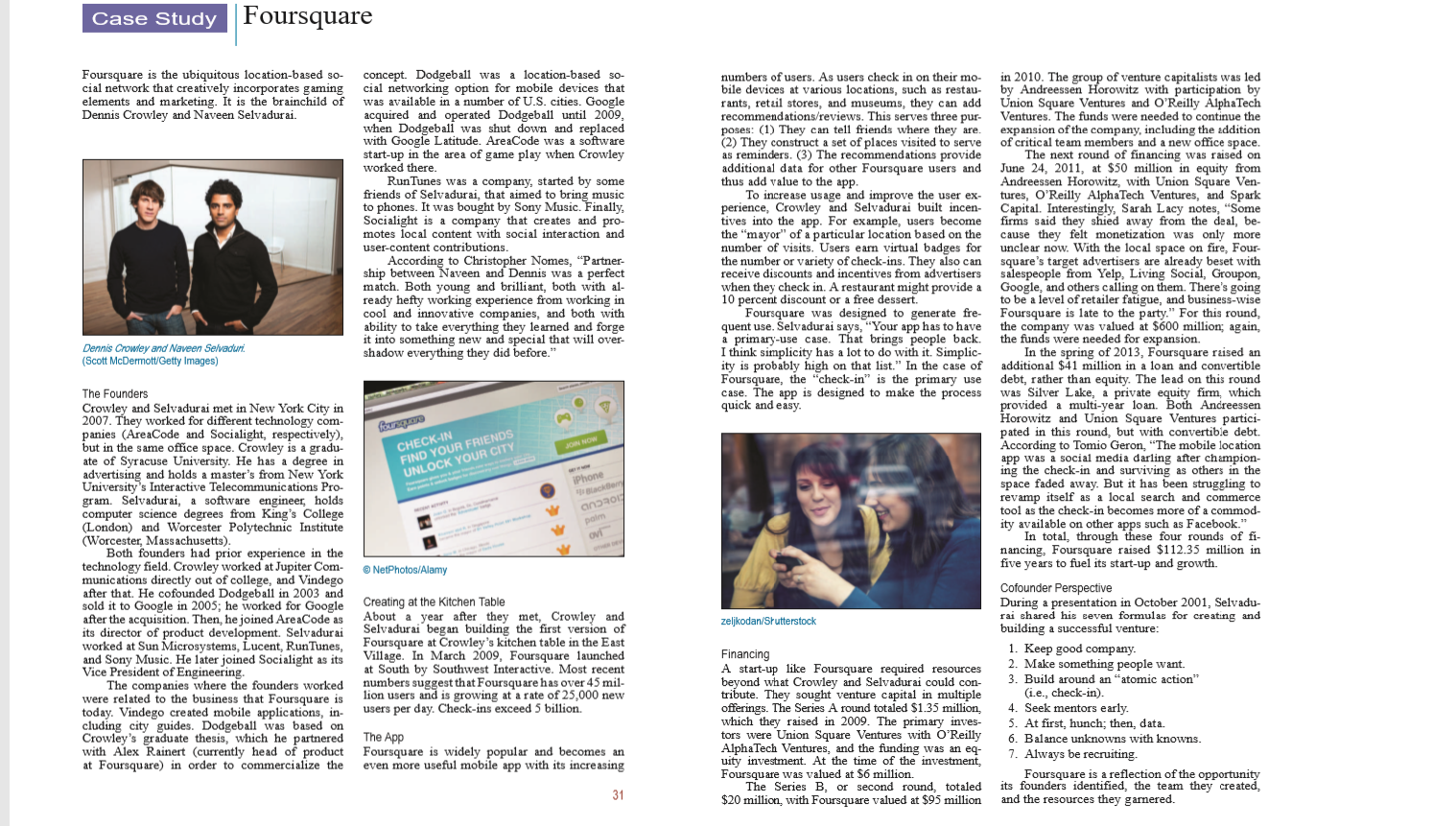
Case Study Foursquare Foursquare is the ubiquitous location-based so- elements and marketing. It is the brainchild of Dennis Crowley and Naveen Selvadurai. concept. Dodgeball was a location-based so- cial networking option for mobile devices that was available in a number of U.S. cities. Google acquired and operated Dodgeball until 2009, when Dodgeball was shut down and replaced with Google Latitude. AreaCode was a software start-up in the area of game play when Crowley worked there. RunTunes was a company, started by some friends of Selvadurai, that aimed to bring music to phones. It was bought by Sony Music. Finally, Socialight is a company that creates and pro- motes local content with social interaction and user-content contributions. According to Christopher Nomes, "Partner- ship between Naveen and Dennis was a perfect match. Both young and brilliant, both with al- ready hefty working experience from working in cool and innovative companies, and both with ability to take everything they learned and forge it into something new and special that will over- shadow everything they did before." numbers of users. As users check in on their mo- bile devices at various locations, such as restau- rants, retail stores, and museums, they can add recommendations/reviews. This serves three pur- poses: (1) They can tell friends where they are (2) They construct a set of places visited to serve as reminders. (3) The recommendations provide additional data for other Foursquare users and thus add value to the app. To increase usage and improve the user ex- perience, Crowley and Selvadurai built incen- tives into the app. For example, users become the "mayor" of a particular location based on the number of visits. Users earn virtual badges for the number or variety of check-ins. They also can receive discounts and incentives from advertisers when they check in. A restaurant might provide a 10 percent discount or a free dessert. Foursquare was designed to generate fre- quent use. Selvadurai says, "Your app has to have a primary-use case. That brings people back. I think simplicity has a lot to do with it. Simplic- ity is probably high on that list." In the case of Foursquare, the "check-in" is the primary use case. The app is designed to make the process quick and easy. in 2010. The group of venture capitalists was led by Andreessen Horowitz with participation by Union Square Ventures and O'Reilly Alpha Tech Ventures. The funds were needed to continue the expansion of the company, including the addition of critical team members and a new office space. The next round of financing was raised on June 24, 2011, at $50 million in equity from Andreessen Horowitz, with Union Square Ven- tures, O'Reilly AlphaTech Ventures, and Spark Capital Interestingly, Sarah Lacy notes, "Some firms said they shied away from the deal, be- cause they felt monetization was only more unclear now. With the local space on fire, Four- square's target advertisers are already beset with salespeople from Yelp, Living Social, Groupon Google, and others calling on them. There's going to be a level of retailer fatigue, and business-wise Foursquare is late to the party." For this round, the company was valued at $600 million again, the funds were needed for expansion. In the spring of 2013, Foursquare raised an additional $41 million in a loan and convertible debt, rather than equity. The lead on this round was Silver Lake, a private equity firm, which provided a multi-year loan. Both Andreessen Horowitz and Union Square Ventures partici- pated in this round, but with convertible debt. According to Tomio Geron, "The mobile location app was a social media darling after champion- ing the check-in and surviving as others in the space faded away. But it has been struggling to revamp itself as a local search and commerce tool as the check-in becomes more of a commod- ity available on other apps such as Facebook." In total, through these four rounds of fi- nancing, Foursquare raised $112.35 million in five years to fuel its start-up and growth. Dennis Crowley and Naveen Selvaduri (Scott McDermott/Getty Images) ON NOW CHECK-IN FIND YOUR FRIENDS UNLOCK YOUR CITY IPhone Blackiem andao palm ovi NetPhotos/Alamy The Founders Crowley and Selvadurai met in New York City in 2007. They worked for different technology com- panies (AreaCode and Socialight, respectively). but in the same office space. Crowley is a gradu- ate of Syracuse University. He has a degree in advertising and holds a master's from New York University's Interactive Telecommunications Pro- gram. Selvadurai, a software engineer, holds computer science degrees from King's College (London) and Worcester Polytechnic Institute (Worcester, Massachusetts). Both founders had prior experience in the technology field. Crowley worked at Jupiter Com- munications directly out of college, and Vindego after that. He cofounded Dodgeball in 2003 and sold it to Google in 2005; he worked for Google after the acquisition. Then, he joined AreaCode as its director of product development. Selvadurai worked at Sun Microsystems, Lucent, RunTunes, and Sony Music. He later joined Socialight as its Vice President of Engineering. The companies where the founders worked were related to the business that Foursquare is today. Vindego created mobile applications, in- cluding city guides. Dodget Crowley's graduate thesis, which he partnered with Alex Rainert (currently head of product at Foursquare) in order to commercialize the zeljkodan/Shutterstock Creating at the Kitchen Table About a year after they met, Crowley and Selvadurai began building the first version of Foursquare at Crowley's kitchen table in the East Village. In March 2009, Foursquare launched at South by Southwest Interactive. Most recent numbers suggest that Foursquare has over 45 mil- lion users and is growing at a rate of 25,000 new users per day. Check-ins exceed 5 billion. Financing A start-up like Foursquare required resources beyond what Crowley and Selvadurai could con- tribute. They sought venture capital in multiple offerings. The Series A round totaled $1.35 million, which they raised in 2009. The primary inves- tors were Union Square Ventures with O'Reilly Alpha Tech Ventures, and the funding was an eq- uity investment. At the time of the investment, Foursquare was valued at $6 million. The Series B, or second round, totaled $20 million, with Foursquare valued at $95 million Cofounder Perspective During a presentation in October 2001, Selvadu- rai shared his seven formulas for creating and building a successful venture: 1. Keep good company. 2. Make something people want. 3. Build around an "atomic action" (i.e., check-in). 4. Seek mentors early. 5. At first, hunch; then, data. 6. Balance unknowns with knowns. 7. Always be recruiting. Foursquare is a reflection of the opportunity its founders identified, the team they created, and the resources they garnered. The App Foursquare is widely popular and becomes an even more useful mobile app with its increasing









 Study Help