Question: Read the Case Study on page 243 - Chapter Role Play: Adding Value - Self Leadership and Teamwork. Payroll Systems, Inc. Write a paper answering
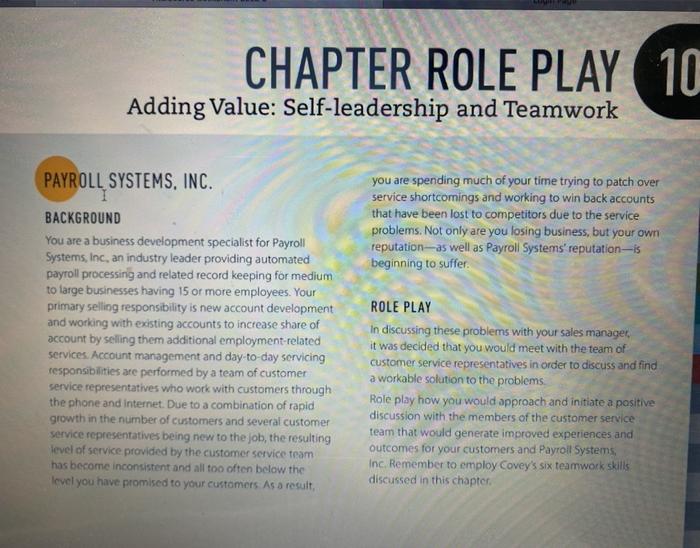
Read the Case Study on page 243 - Chapter Role Play: Adding Value - Self Leadership and Teamwork. Payroll Systems, Inc.
Write a paper answering the following questions:
What problem or problems are being presented in the case study?
What do you need to discuss with your sales manager?
What is at stake?
How will you approach your customer service team in order to improve experiences and outcomes for your customers?
What outcomes are you hoping to achieve?
Note: Refer specifically to Covey's six teamwork skills from Chapter 10. book (Sell 6th by thomas ingram)
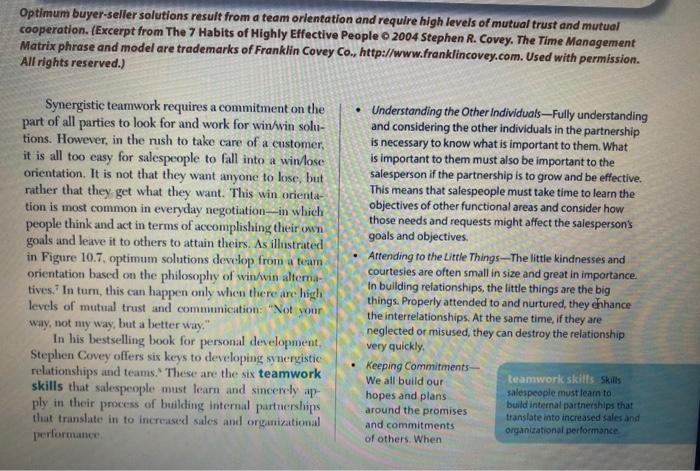
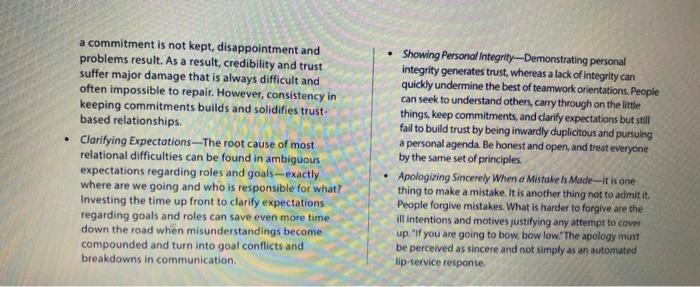
CHAPTER ROLE PLAY 10 Adding Value: Self-leadership and Teamwork you are spending much of your time trying to patch over service shortcomings and working to win back accounts that have been lost to competitors due to the service problems. Not only are you losing business, but your own reputation as well as Payroll Systems' reputation-is beginning to suffer PAYROLL SYSTEMS, INC. I BACKGROUND You are a business development specialist for Payroll Systems, Inc, an industry leader providing automated payroll processing and related record keeping for medium to large businesses having 15 or more employees. Your primary selling responsibility is new account development and working with existing accounts to increase share of account by selling them additional employment-related services. Account management and day-to-day servicing responsibilities are performed by a team of customer service representatives who work with customers through the phone and internet. Due to a combination of rapid growth in the number of customers and several customer service representatives being new to the job, the resulting level of service provided by the customer service team has become inconsistent and all too often below the level you have promised to your customers. As a result, ROLE PLAY In discussing these problems with your sales managet it was decided that you would meet with the team of customer service representatives in order to discuss and find a workable solution to the problems Role play how you would approach and initiate a positive discussion with the members of the customer service team that would generate improved experiences and outcomes for your customers and Payroll Systems Inc. Remember to employ Covey's six teamwork skills discussed in this chapter Optimum buyer-seller solutions result from a team orientation and require high levels of mutual trust and mutual cooperation. (Excerpt from The 7 Habits of Highly Effective People o 2004 Stephen R. Covey. The Time Management Matrix phrase and model are trademarks of Franklin Covey Co., http://www.franklincovey.com. Used with permission. All rights reserved.) Synergistic teamwork requires a commitment on the part of all parties to look for and work for win/win solu- tions. However, in the rush to take care of a customer, it is all too easy for salespeople to fall into a winlose orientation. It is not that they want anyone to lose, but rather that they get what they want. This win orienta- tion is most common in everyday negotiation---in which people think and act in terms of accomplishing their own goals and leave it to others to attain theirs. As illustrated in Figure 10.7. optimum solutions develop from a team orientation based on the philosophy of win/win altera tives. In turn, this can happen only when there are high levels of mutual trust and communication: "Not your way, not my way, but a better way." In his bestselling book for personal development Stephen Covey offers six keys to developing synergistic relationships and teams. These are the six teamwork skills that salespeople must learn and sincerely ap ply in their process of building internal partnerships that translate in to increased sales and organizational performance Understanding the Other Individuals-Fully understanding and considering the other individuals in the partnership is necessary to know what is important to them. What is important to them must also be important to the salesperson if the partnership is to grow and be effective. This means that salespeople must take time to learn the objectives of other functional areas and consider how those needs and requests might affect the salesperson's goals and objectives Attending to the Little Things-The little kindnesses and courtesies are often small in size and great in importance. in building relationships, the little things are the big things. Properly attended to and nurtured, they enhance the interrelationships. At the same time, if they are neglected or misused, they can destroy the relationship very quickly Keeping Commitments We all build our teamwork skills Skills hopes and plans salespeople must learn to around the promises build internal partnerships that translate into increased sales and and commitments organizational performance of others. When . a commitment is not kept, disappointment and problems result. As a result, credibility and trust suffer major damage that is always difficult and often impossible to repair. However, consistency in keeping commitments builds and solidifies trust based relationships Clarifying Expectations. The root cause of most relational difficulties can be found in ambiguous expectations regarding roles and goals-exactly where are we going and who is responsible for what? Investing the time up front to clarify expectations regarding goals and roles can save even more time down the road when misunderstandings become compounded and turn into goal conflicts and breakdowns in communication Showing Personal Integrity --Demonstrating personal integrity generates trust, whereas a lack of integrity can quickly undermine the best of teamwork orientations. People can seek to understand others, carry through on the little things, keep commitments, and clarify expectations but still fail to build trust by being inwardly duplicitous and pursuing a personal agenda. Be honest and open, and treat everyone by the same set of principles Apologizing Sincerely When a Mistake Is Made-It is one thing to make a mistake. It is another thing not to admit it. People forgive mistakes. What is harder to forgive are the Till intentions and motives justifying any attempt to cover up, "If you are going to bow bow low. The apology must be perceived as sincere and not simply as an automated lip-service response









 Study Help