







Question: Read the first solved example from Example 6.3 in section 6.3 from the text book. Verify that the three eigenvectors found for the two eigenvalues
Read the first solved example from Example 6.3 in section 6.3 from the text book. Verify that the three eigenvectors found for the two eigenvalues of the matrix in that example are linearly independent and find the components of the vector i = (1, 0, 0) in the basis consisting of them.
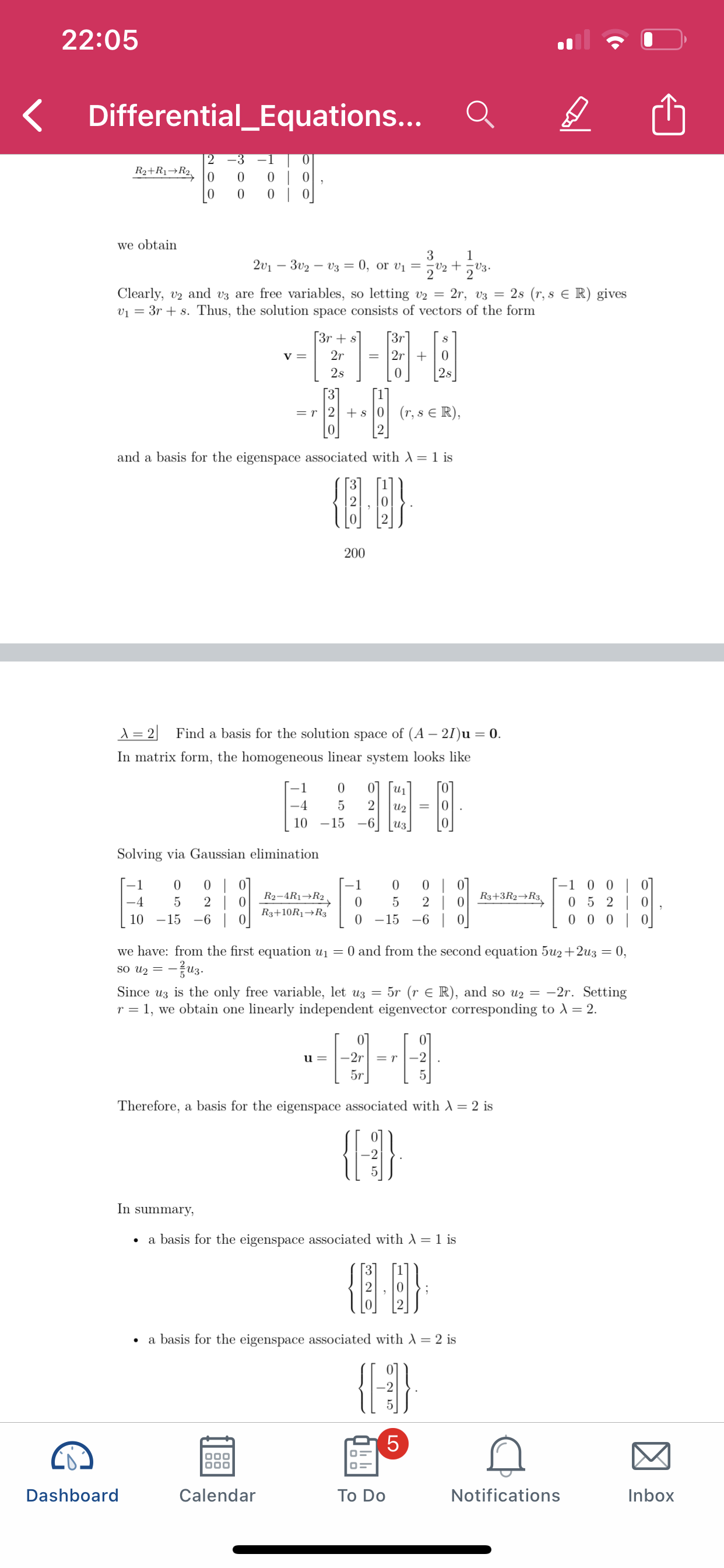
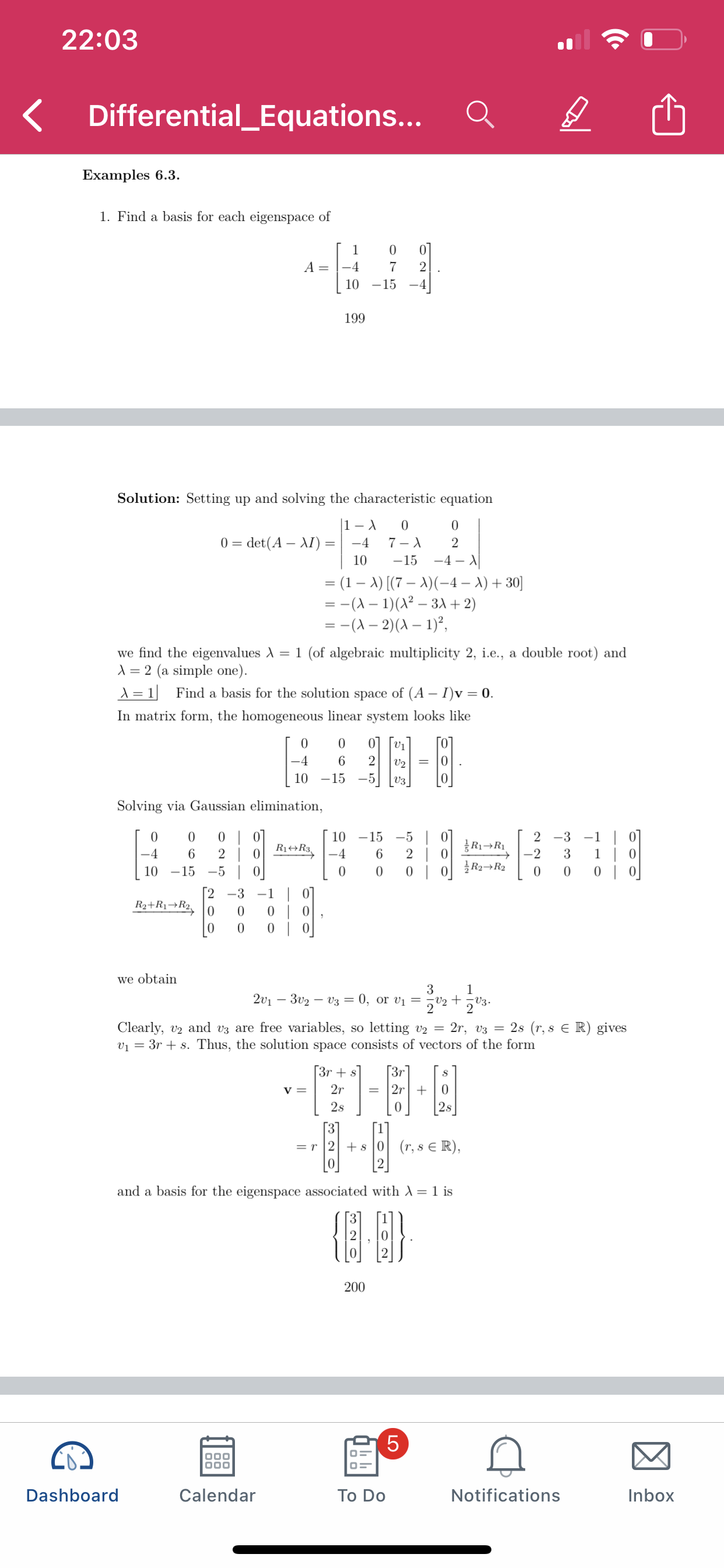
22:05 Differential_Equations... R2+ R1- Rz, -3 we obtain 201 - 302 - V3 = 0, or v1 = 3 Clearly, v2 and v3 are free variables, so letting v2 = 2r, v3 = 2s (r, s E R) gives v1 = 3r + s. Thus, the solution space consists of vectors of the form 3r + s] [3r V = 2r = 27 + 2s 125 2 +s 0 (r, s ER), and a basis for the eigenspace associated with A = 1 is 200 A = 2 Find a basis for the solution space of (A - 2/)u = 0. In matrix form, the homogeneous linear system looks like Solving via Gaussian elimination -10 0 5 2 R2-4R1-R2, 5 2 R3+3R2-+R3 0 52 10 -15 -6 R3+10R1 -R3 0 0 -15 -6 0 0 0 0 we have: from the first equation u1 = 0 and from the second equation 5u2 + 2u3 = 0, so U2 = -U3. Since u3 is the only free variable, let u3 = 5r (r E R), and so u2 = -2r. Setting r = 1, we obtain one linearly independent eigenvector corresponding to 1 = 2. Therefore, a basis for the eigenspace associated with 1 = 2 is In summary, . a basis for the eigenspace associated with ) = 1 is . a basis for the eigenspace associated with ) = 2 is b= 5 0 = n Dashboard Calendar To Do Notifications Inbox22:03 Differential_Equations... Examples 6.3. 1. Find a basis for each eigenspace of 1 0 A = -4 7 2 10 -15 199 Solution: Setting up and solving the characteristic equation 1 -d 0 0 = det(A - XI) = -4 7-1 2 10 -15 -4-1 = (1 - >) [(7 - X)(-4-1)+30] = -(1-1)(12 -31 + 2) = -(1-2)(1 -1)2, we find the eigenvalues A = 1 (of algebraic multiplicity 2, i.e., a double root) and A = 2 (a simple one). A = 1 Find a basis for the solution space of (A - I) v = 0. In matrix form, the homogeneous linear system looks like Solving via Gaussian elimination, o 0 -15 -5 0 -3 6 6 2 ONN co 10 -15 -5 0 0 0 R2-+R2 R2 + R1-+ R2, 3 -1 | o we obtain 201 - 302 - 03 = 0, or v1 = 3 502+ 503. Clearly, v2 and v3 are free variables, so letting v2 = 2r, v3 = 2s (r, s E R) gives v1 = 3r + s. Thus, the solution space consists of vectors of the form V = 2s + 8 0 ( r , S E R ) o 2 and a basis for the eigenspace associated with A = 1 is 200 5 0 = Dashboard Calendar To Do Notifications Inbox
Step by Step Solution
There are 3 Steps involved in it

Get step-by-step solutions from verified subject matter experts
 Study Help