







Question: Read the following articles. The first article exposes the reader to the problem of the Federal Crop Insurance Policy while the second article provides more
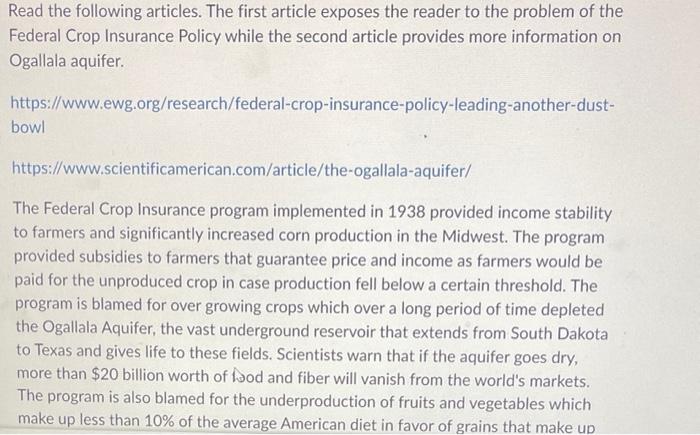
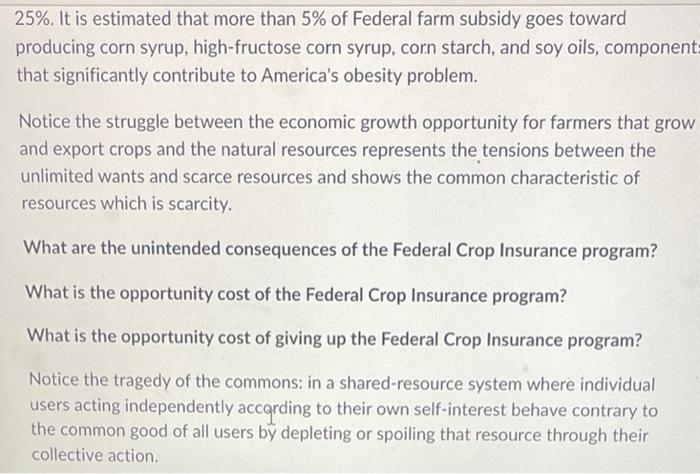

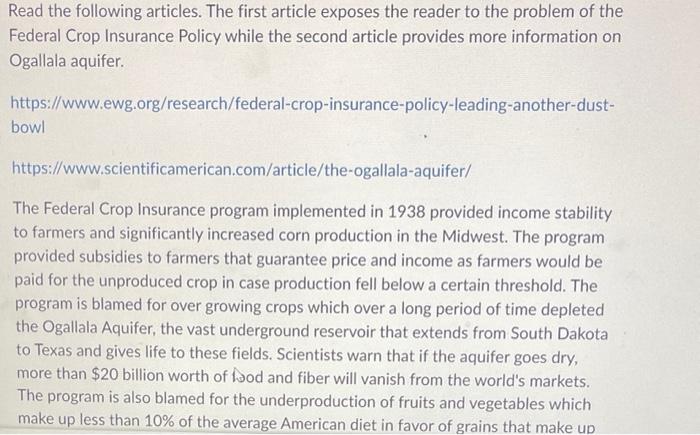
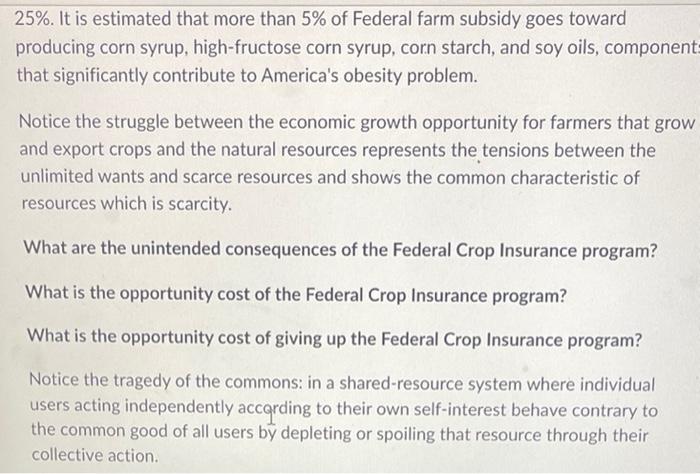

Read the following articles. The first article exposes the reader to the problem of the Federal Crop Insurance Policy while the second article provides more information on Ogallala aquifer. https://www.ewg.org/research/federal-crop-insurance-policy-leading-another-dust- bowl https://www.scientificamerican.com/article/the-ogallala-aquifer/ The Federal Crop Insurance program implemented in 1938 provided income stability to farmers and significantly increased corn production in the Midwest. The program provided subsidies to farmers that guarantee price and income as farmers would be paid for the unproduced crop in case production fell below a certain threshold. The program is blamed for over growing crops which over a long period of time depleted the Ogallala Aquifer, the vast underground reservoir that extends from South Dakota to Texas and gives life to these fields. Scientists warn that if the aquifer goes dry, more than $20 billion worth of food and fiber will vanish from the world's markets. The program is also blamed for the underproduction of fruits and vegetables which make up less than 10% of the average American diet in favor of grains that make up25%. It is estimated that more than 5% of Federal farm subsidy goes toward producing corn syrup, high-fructose corn syrup, corn starch, and soy oils, component that significantly contribute to America's obesity problem. Notice the struggle between the economic growth opportunity for farmers that grow and export crops and the natural resources represents the tensions between the unlimited wants and scarce resources and shows the common characteristic of resources which is scarcity. What are the unintended consequences of the Federal Crop Insurance program? What is the opportunity cost of the Federal Crop Insurance program? What is the opportunity cost of giving up the Federal Crop Insurance program? Notice the tragedy of the commons: in a shared-resource system where individual users acting independently according to their own self-interest behave contrary to the common good of all users by depleting or spoiling that resource through their collective action.As a social planner, how can you solve this problem? Any suggested solutions? Hint: Marginal Thinking
Step by Step Solution
There are 3 Steps involved in it

Get step-by-step solutions from verified subject matter experts
 Study Help