







Question: Read the following case study and answer the questions that follow: South Africa's spaza shops: how regulatory avoidance harms informal workers Small informal retailers are
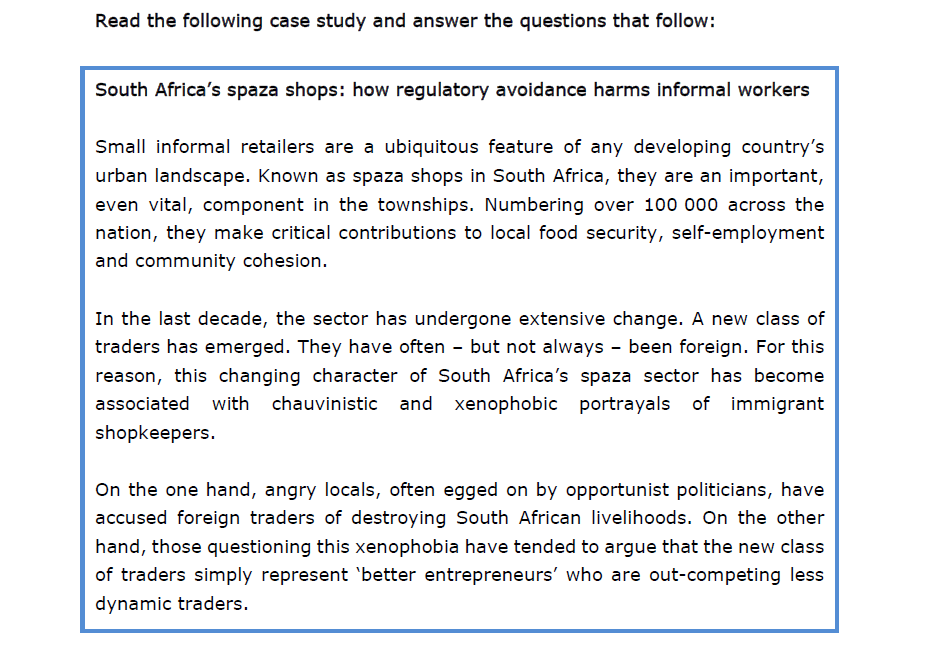
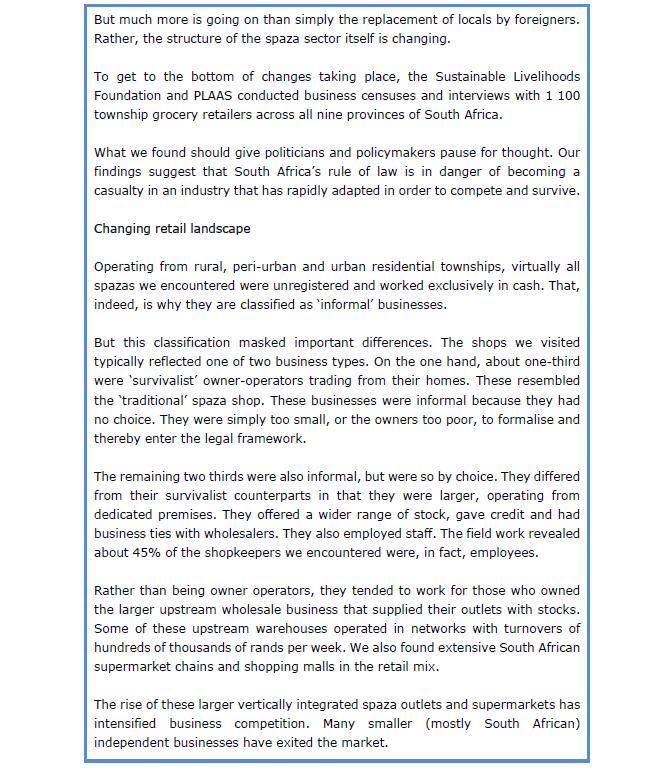
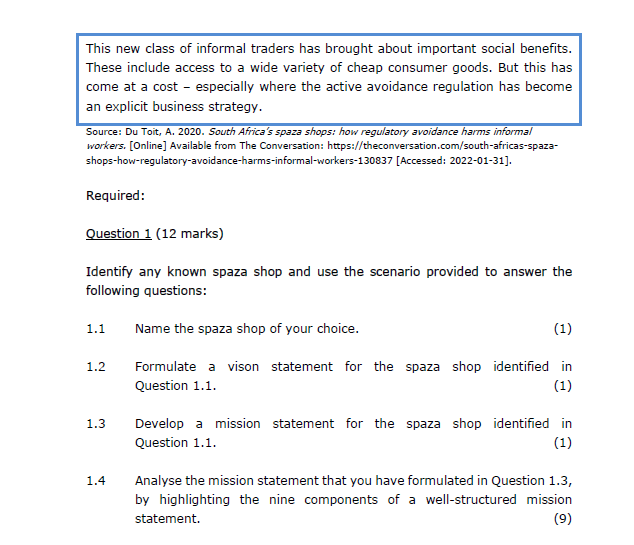
Read the following case study and answer the questions that follow: South Africa's spaza shops: how regulatory avoidance harms informal workers Small informal retailers are a ubiquitous feature of any developing country's urban landscape. Known as spaza shops in South Africa, they are an important, even vital, component in the townships. Numbering over 100 000 across the nation, they make critical contributions to local food security, self-employment and community cohesion. In the last decade, the sector has undergone extensive change. A new class of traders has emerged. They have often but not always - been foreign. For this reason, this changing character of South Africa's spaza sector has become associated with chauvinistic and xenophobic portrayals of immigrant shopkeepers. On the one hand, angry locals, often egged on by opportunist politicians, have accused foreign traders of destroying South African livelihoods. On the other hand, those questioning this xenophobia have tended to argue that the new class of traders simply represent 'better entrepreneurs' who are out-competing less dynamic traders. But much more is going on than simply the replacement of locals by foreigners. Rather, the structure of the spaza sector itself is changing. To get to the bottom of changes taking place, the Sustainable Livelihoods Foundation and PLAAS conducted business censuses and interviews with 1 100 township grocery retailers across all nine provinces of South Africa. What we found should give politicians and policymakers pause for thought. Our findings suggest that South Africa's rule of law is in danger of becoming a casualty in an industry that has rapidly adapted in order to compete and survive. Changing retail landscape Operating from rural, peri-urban and urban residential townships, virtually all spazas we encountered were unregistered and worked exclusively in cash. That, indeed, is why they are classified as 'informal businesses. But this classification masked important differences. The shops we visited typically reflected one of two business types. On the one hand, about one-third were 'survivalist' owner-operators trading from their homes. These resembled the 'traditional spaza shop. These businesses were informal because they had no choice. They were simply too small, or the owners too poor, to formalise and thereby enter the legal framework. The remaining two thirds were also informal, but were so by choice. They differed from their survivalist counterparts in that they were larger, operating from dedicated premises. They offered a wider range of stock, gave credit and had business ties with wholesalers. They also employed staff. The field work revealed about 45% of the shopkeepers we encountered were, in fact, employees. Rather than being owner operators, they tended to work for those who owned the larger upstream wholesale business that supplied their outlets with stocks. Some of these upstream warehouses operated in networks with turnovers of hundreds of thousands of rands per week. We also found extensive South African supermarket chains and shopping malls in the retail mix. The rise of these larger vertically integrated spaza outlets and supermarkets has intensified business competition. Many smaller (mostly South African) independent businesses have exited the market. This new class of informal traders has brought about important social benefits. These include access to a wide variety of cheap consumer goods. But this has come at a cost - especially where the active avoidance regulation has become an explicit business strategy. Source: Du Toit, A. 2020. South Africa's spaza shops: how regulatory avoidance harms informal workers. [Online] Available from The Conversation: https://theconversation.com/south-africas-spaza- shops-how-regulatory-avoidance-harms-informal-workers-130837 [Accessed: 2022-01-31]. Required: Question 1 (12 marks) Identify any known spaza shop and use the scenario provided to answer the following questions: 1.1 Name the spaza shop of your choice. (1) 1.2 Formulate a vison statement for the spaza shop identified in Question 1.1. (1) 1.3 Develop a mission statement for the spaza shop identified in Question 1.1. (1) 1.4 Analyse the mission statement that you have formulated in Question 1.3, by highlighting the nine components of a well-structured mission statement. (9) Read the following case study and answer the questions that follow: South Africa's spaza shops: how regulatory avoidance harms informal workers Small informal retailers are a ubiquitous feature of any developing country's urban landscape. Known as spaza shops in South Africa, they are an important, even vital, component in the townships. Numbering over 100 000 across the nation, they make critical contributions to local food security, self-employment and community cohesion. In the last decade, the sector has undergone extensive change. A new class of traders has emerged. They have often but not always - been foreign. For this reason, this changing character of South Africa's spaza sector has become associated with chauvinistic and xenophobic portrayals of immigrant shopkeepers. On the one hand, angry locals, often egged on by opportunist politicians, have accused foreign traders of destroying South African livelihoods. On the other hand, those questioning this xenophobia have tended to argue that the new class of traders simply represent 'better entrepreneurs' who are out-competing less dynamic traders. But much more is going on than simply the replacement of locals by foreigners. Rather, the structure of the spaza sector itself is changing. To get to the bottom of changes taking place, the Sustainable Livelihoods Foundation and PLAAS conducted business censuses and interviews with 1 100 township grocery retailers across all nine provinces of South Africa. What we found should give politicians and policymakers pause for thought. Our findings suggest that South Africa's rule of law is in danger of becoming a casualty in an industry that has rapidly adapted in order to compete and survive. Changing retail landscape Operating from rural, peri-urban and urban residential townships, virtually all spazas we encountered were unregistered and worked exclusively in cash. That, indeed, is why they are classified as 'informal businesses. But this classification masked important differences. The shops we visited typically reflected one of two business types. On the one hand, about one-third were 'survivalist' owner-operators trading from their homes. These resembled the 'traditional spaza shop. These businesses were informal because they had no choice. They were simply too small, or the owners too poor, to formalise and thereby enter the legal framework. The remaining two thirds were also informal, but were so by choice. They differed from their survivalist counterparts in that they were larger, operating from dedicated premises. They offered a wider range of stock, gave credit and had business ties with wholesalers. They also employed staff. The field work revealed about 45% of the shopkeepers we encountered were, in fact, employees. Rather than being owner operators, they tended to work for those who owned the larger upstream wholesale business that supplied their outlets with stocks. Some of these upstream warehouses operated in networks with turnovers of hundreds of thousands of rands per week. We also found extensive South African supermarket chains and shopping malls in the retail mix. The rise of these larger vertically integrated spaza outlets and supermarkets has intensified business competition. Many smaller (mostly South African) independent businesses have exited the market. This new class of informal traders has brought about important social benefits. These include access to a wide variety of cheap consumer goods. But this has come at a cost - especially where the active avoidance regulation has become an explicit business strategy. Source: Du Toit, A. 2020. South Africa's spaza shops: how regulatory avoidance harms informal workers. [Online] Available from The Conversation: https://theconversation.com/south-africas-spaza- shops-how-regulatory-avoidance-harms-informal-workers-130837 [Accessed: 2022-01-31]. Required: Question 1 (12 marks) Identify any known spaza shop and use the scenario provided to answer the following questions: 1.1 Name the spaza shop of your choice. (1) 1.2 Formulate a vison statement for the spaza shop identified in Question 1.1. (1) 1.3 Develop a mission statement for the spaza shop identified in Question 1.1. (1) 1.4 Analyse the mission statement that you have formulated in Question 1.3, by highlighting the nine components of a well-structured mission statement. (9)
Step by Step Solution
There are 3 Steps involved in it

Get step-by-step solutions from verified subject matter experts
 Study Help