







Question: Read the following case study and answer the questions that follow: CALCOMP: DISASTER BECOMES SUCCESS Flash back to the early 1980s. The only thing world-class
Read the following case study and answer the questions that follow:
CALCOMP: DISASTER BECOMES SUCCESS Flash back to the early 1980s.
The only thing world-class about Calcomp was the mess it was in. The company that practically invented the computer plotter a device engineers and architects use to print intricate, oversized schematics has become arrogant, inattentive and lazy. Every last plotter that rolled off the assembly line didnt work well enough without some rejiggering. A legion of field technicians was needed to make house calls on installed machines that malfunctioned every few weeks. Competitors, such as Hewlett Packard, jumped into the breach, stealing dissatisfied customers. Flash forward to the 1990s Calcomp was recognised as a leader in world-class manufacturing.
No more mass assembly lines. No more bugs. No more field technicians. The difference between the 1980s and 1990s was firstly the quality programme implemented by the President. Quality was seen as the satisfaction of customers, with gracefully built, innovative products that work from the start, rarely breakdown, are competitively priced and upgraded faster than any other competitors products. Secondly, in the early 1980s the manufacturing process was fractured. Product design and manufacturing design were not co-ordinated.
The company stockpiled parts and only checked for defects after it was completely built. In the 1990s inventories were cut to the bare minimum and a preferred supplier programme was initiated. In this way the company managed its demand and reduced the wastage costs. Suppliers used the quality information to transform their businesses and attract new clients. Thirdly, when a new product is conceived, a team of more than a dozen people representing virtually every department shepherds it from development to delivery. With this kind of team work, engineers do not design parts that the factory workers cannot put together. Readjusting attitudes to work was the most important part of the jump to quality.
Today frontline workers are treated with as much respect as the executives. Assembly workers are never reprimanded to stop the assembly line if there was a quality problem. Production managers wear beepers and are expected to respond to problems immediately. The senior vice-president of the plotter division stated the following The product we build tomorrow will be better than the ones we build today
Applying these details above and answer the question based on Calcomp.
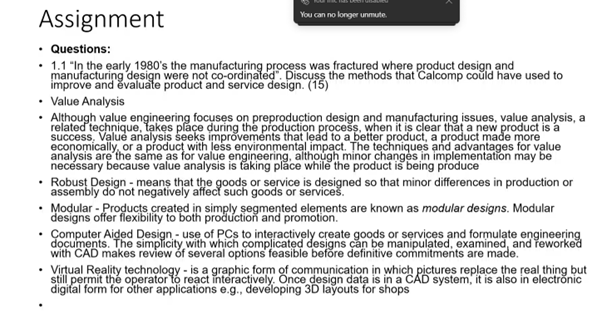
- Questions: - 1.1 "In the early 1980's the manufacturing process was fractured where product design and manufacturing design were not co-ordinated. Discuss the methods that Calcomp could have used to improve and evaluate product and service design. (15) - Value Analysis - Although value engineering focuses on preproduction design and manufacturing issues, value analysis, a related technique, takes place during the production process, when it is clear that a new product is a success. Value analysis seeks improvements that lead to a better product, a product made more economically, or a product with less environmental impact. The techniques and advantages for value analysis are the same as for value engineering, although minor changes in implementation may be necessary because value analysis is taking place while the product is being produce - Robust Design - means that the goods or service is designed so that minor differences in production or assembly do not negatively affeci such goods or services. - Modular - Products created in simply segmented elements are known as modular designs. Modular designs offer flexibility to both production and promotion. - Computer Aided Design - use of PCs to interactively create goods or services and formulate engineering documents. The simplicity with which complicated designs can be manipulated, examined and reworked with CAD makes review of several options feasible before definitive commitments are made. - Virtual Reality technology - is a graphic form of communication in which pictures replace the real thing but still permit the operator to react interactively. Once design data is in a CAD system, it is also in electronic digital form for other applications e.g., developing 3D layouts for shopsStep by Step Solution
There are 3 Steps involved in it

Get step-by-step solutions from verified subject matter experts
 Study Help