







Question: read the following case,which describes th current payment processing system at RFC, and complete the exercise question at the end On a weekly basis, the
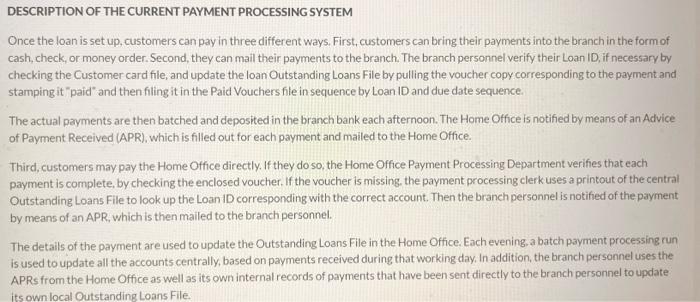
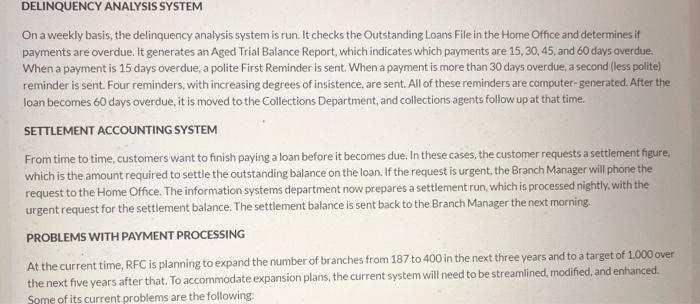
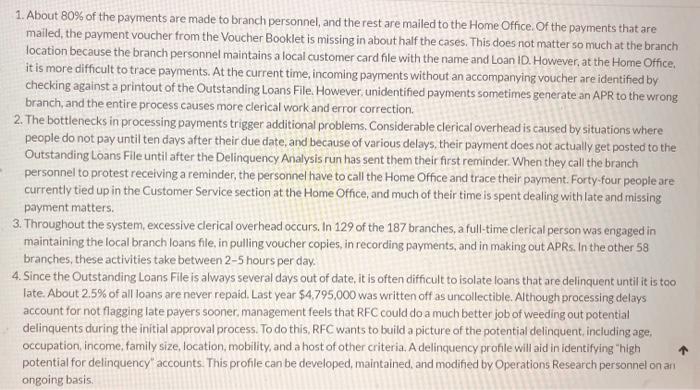

On a weekly basis, the delinquency analysis system is run. It checks the Outstanding Loans File in the Home Office and determines if payments are overdue. It generates an Aged Trial Balance Report, which indicates which payments are 15, 30,45, and 60 day5 overdue. When a payment is 15 days overdue, a polite First Reminder is sent. When a payment is more than 30 days overdue, a second (less polite) reminder is sent. Four reminders, with increasing degrees of insistence, are sent. All of these reminders are computer-generated. After the loan becomes 60 days overdue, it is moved to the Collections Department, and collections agents follow up at that time. SETTLEMENT ACCOUNTING SYSTEM From time to time, customers want to finish paying a loan before it becomes due. In these cases, the customer requests a settlement figure, which is the amount required to settle the outstanding balance on the loan. If the request is urgent, the Branch Manager will phone the request to the Home Office. The information systems department now prepares a settlement run, which is processed nightly, with the urgent request for the settlement balance. The settlement balance is sent back to the Branch Manager the next morning. PROBLEMS WITH PAYMENT PROCESSING At the current time, RFC is planning to expand the number of branches from 187 to 400 in the next three years and to a target of 1.000 over the next five years after that. To accommodate expansion plans, the current system will need to be streamlined, modified, and enhanced. Some of its current problems are the following: 5. Because of error and adjustment activities, it is rarely possible to balance the books for month end before the twelfth (12th) of the succeeding month. This greatly complicates planning for cash flow and frequently requires RFC to borrow more money that it needs and at higher interest charges. CASE EXERCISE 1. What changes in business processes and information do you feel will improve the payment processing system at RFC? sonnel, and the rest are mailed to the Home Office. Of the payments that are location because the branch personn Voucher Booklet is missing in about half the cases. This does not matter so much at the branch it is more difficult to trace payments. At maintains a local customer card file with the name and Loan ID. However, at the Home Office. checking against a printout of the Outstanding Larrent time, incoming payments without an accompanying voucher are identified by branch, and the entire process causes more clerical work and error correction. 2. The bottlenecks in processing payments trigger additional problems, Considerable clerical overhead is caused by situations where people do not pay until ten days after their due date, and because of various delays, their payment does not actually get posted to the Outstanding Loans File until after the Delinquency Analysis run has sent them their first reminder. When they call the branch personnel to protest receiving a reminder, the personnel have to call the Home Office and trace their payment. Forty-four people are currently tied up in the Customer Service section at the Home Office, and much of their time is spent dealing with late and missing payment matters. 3. Throughout the system, excessive clerical overhead occurs. In 129 of the 187 branches, a full-time clerical person was engaged in maintaining the local branch loans file, in pulling voucher copies, in recording payments, and in making out APRs. In the other 58 branches, these activities take between 2-5 hours per day. 4. Since the Outstanding Loans File is always several days out of date, it is often difficult to isolate loans that are delinquent until it is too late. About 2.5% of all loans are never repaid. Last year $4,795,000 was written off as uncollectible. Although processing delays account for not flagging late payers sooner. management feels that RFC could do a much better job of weeding out potential delinquents during the initial approval process. To do this, RFC wants to build a picture of the potential delinquent, including age, occupation, income, family size, location, mobility, and a host of other criteria. A delinquency profile will aid in identifying "high potential for delinquency" accounts. This profile can be developed, maintained, and modified by Operations Research personnel on an ongoing basis. DESCRIPTION OF THE CURRENT PAYMENT PROCESSING SYSTEM Once the loan is set up, customers can pay in three different ways. First, customers can bring their payments into the branch in the form of cash, check, or money order. Second, they can mail their payments to the branch. The branch personnel verify their Loan ID, if necessary by checking the Customer card file, and update the loan Outstanding Loans File by pulling the voucher copy corresponding to the payment and stamping it "paid" and then filing it in the Paid Vouchers file in sequence by Loan ID and due date sequence. The actual payments are then batched and deposited in the branch bank each afternoon. The Home Office is notified by means of an Advice of Payment Received (APR), which is filled out for each payment and mailed to the Home Office. Third, customers may pay the Home Office directly. If they do so, the Home Office Payment Processing Department verifies that each payment is complete, by checking the enclosed voucher. If the voucher is missing, the payment processing clerk uses a printout of the central Outstanding Loans File to look up the Loan ID corresponding with the correct account. Then the branch personnel is notified of the payment by means of an APR, which is then mailed to the branch personnet. The details of the payment are used to update the Outstanding Loans File in the Home Office. Each evening, a batch payment processing run is used to update all the accounts centrally, based on payments received during that working day, In addition, the branch personnel uses the APRs from the Home Office as well as its own internat records of payments that have been sent directly to the branch personnel to update its own local Outstanding Loans File
Step by Step Solution
There are 3 Steps involved in it

Get step-by-step solutions from verified subject matter experts
 Study Help