







Question: Read the following strategy and see the instructions below: (PLEASE SEE THE INSTRUCTIONS BELOW) S-O STRATEGY: TALENT ACQUISITION STRATEGY O: the company has a secondment
Read the following strategy and see the instructions below: (PLEASE SEE THE INSTRUCTIONS BELOW)
S-O STRATEGY: TALENT ACQUISITION STRATEGY O: the company has a secondment program advantage => allows employees to work temporarily in another department or company => they can cultivate new things and new industries => open up career S: because the company has a group of senior executives and experts, in addition, express 2 also has a management board with many years of experience and skills in the railway industry. Besides, he also cooperates with experts in other fields to be able to solve the company's needs. => Choosing S and O to make strategic choices can recruit or hire talents, attract new employees of rival companies with the values that the company has. Therefore, talent acquisition strategy is suitable for S and O. Employees are a company's most valuable asset; Therefore, enterprises are now going to consider attracting the correct and quality talent as one of their primary recruitment goals in order to gain a more competitive edge (Anita, 2019). By luring top talent to work for the company, talent acquisition supports both corporate employee development and the procurement of human capital (Alashmawy and Yazdanifard, 2019). Only a carefully planned and executed talent resourcing process will produce reliable and legal outcomes, giving employers a competitive edge in the battle for talent (Srivastava and Bhatnagar 2008).
HRD Plans, Policies, and Practices to Implement the New HRD Strategy:
a. Leadership Development Programs: The HRD team should design and implement leadership development programs to address the lack of leadership in the company. These programs should focus on developing leadership competencies, such as leadership development workshops, conflict resolution, and team building, decision-making, and communication skills. The company can offer these programs to its managers and high-potential employees to enhance their leadership skills and provide them with clear direction (Rothwell and Kazanas, 2003).
b. Comprehensive Employee Benefits Package: To attract and retain top talent, Express 2 Ltd should offer competitive salaries and benefits packages. This can be achieved through practices such as regular salary reviews, performance-based bonuses, and other perks that are aligned with employee preferences. Research by Tanwar and Prasad (2016) suggests that offering a strong employer brand and competitive compensation packages can help organisations attract and retain top talent.
c. Streamlined Performance Management Process: To ensure that the project is delivered on time and to budget, a performance management system should be established to measure and monitor employee performance. This can include setting performance goals, conducting regular performance reviews, and providing feedback to employees on their performance. This can help to identify areas where employees may require additional training or support to improve their performance (Armstrong and Taylor, 2020).
d. Comprehensive Talent Management Strategy: The company can develop a comprehensive talent management strategy that includes succession planning, career development, and performance management. This strategy can be designed to retain technical, project management, IT, and financial staff, enhance employee motivation and engagement, and build a culture of continuous improvement. The strategy can be evaluated through employee feedback, retention rates, and analysis of the impact on organisational performance (Collings et al., 2019).
e. Collaboration and Teamwork: Provide employees with opportunities to collaborate and work on cross-functional teams. This can help to break down silos and promote a culture of teamwork (Katou and Budhwar, 2010). The collaboration and teamwork can be evaluated through employee feedback, team performance, and analysis of the impact on organisational performance (Huang et al., 2010).
f. Work with the Trade Union Congress: The company should work with the Trade Union Congress to ensure their employment, health, safety, and welfare standards are met and maintain a positive reputation. This can include regular communication and collaboration with union representatives, staying up-to-date with regulatory requirements, involving them in decision-making, and promoting a culture of mutual respect and cooperation (Gold et al., 2017).
Instructions for making HRD strategy include 5 steps on the board
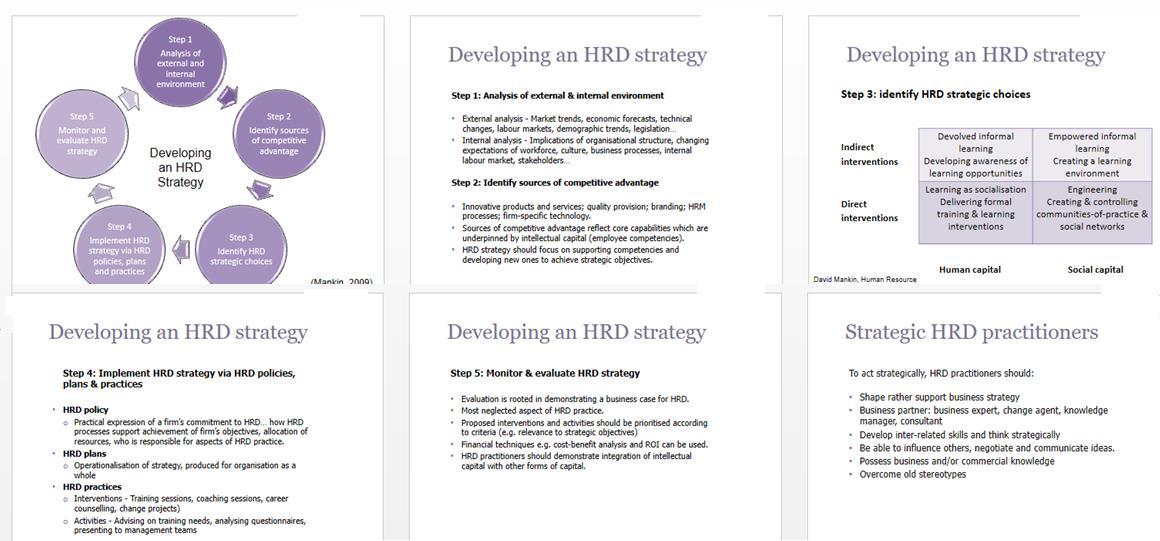
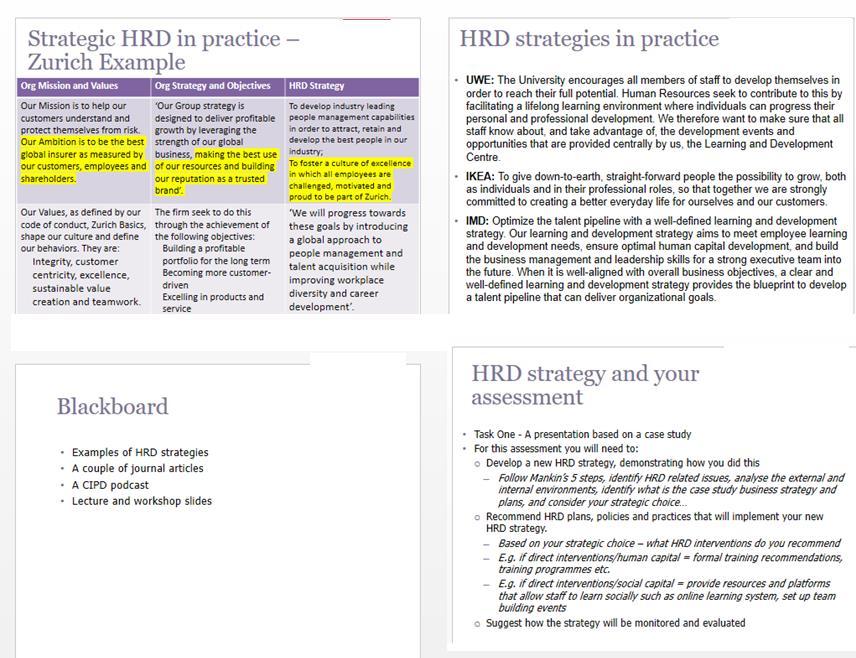
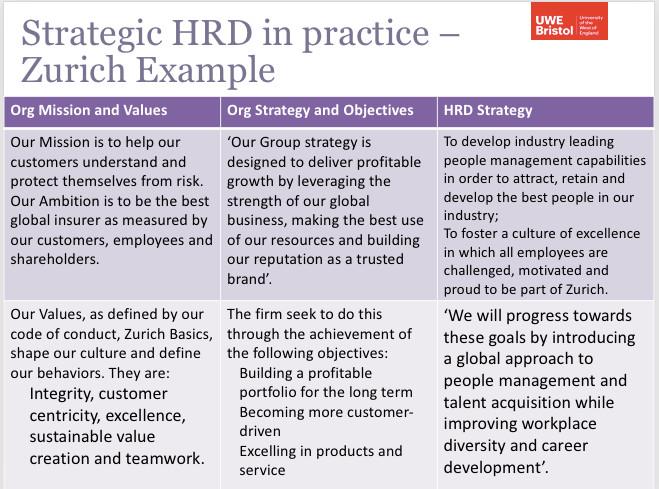
Read the strategy in the above post then give the copetitive advantage and then give the HRD strategy as a table. From the strategy given in the article => give a competitive advantage => HRD strategy like the table in the slide
Developing an HRD strategy Developing an HRD strategy Step 1: Analysis of external \& internal environment Step 3: identify HRD strategic choices - External analysis - Market trends, economic forecasts, technical changes, labour markets, demographic trends, legislation. Internal analysis - Implications of organisational structure, changing expectations of workforte, cu tur labour market, stakeholders. Step 2: Identify sources of competitive advantage - Innovative products and services; quality provision; branding; HRM - Srocesses: firm-speofic technology. - HRderpinned by intellectual capital (employee competenoies). - HRD strategy should focus on supporting competendes ar developing new ones to achieve strategic objectives. Developing an HRD strategy Developing an HRD strategy Strategic HRD practitioners Step 4: Implement HRD strategy via HRD policies, Step 5: Monitor \& evaluate HRD strategy To act strategically, HRD practitioners should: - HRD policy - Evaluation is rooted in demonstrating a business case for HRD. Shape rather support business strategy - Business partner: business expert, change agent, knowledge - Practical expression of a firm's commitment to HRD. how HRD - Proposed interventions and activities should be prioritised according manager, consultant processes support achievement of firm's objectives, allocation resources, who is responsible for aspects of HRD practice. - Develop inter-related skills and think strategically - HRD plans - Financial techniques e.g. cost-benefit analysis and ROI can be used. - Be able to influence others, negotiate and communicate ideas. - Operationalisation of strategy, produced for organisation as a - HRD practibioners should demonstrate integration of intellectual capital with other forms of capital. - Possess business and/or commercial knowledge - Overcome old stereotypes HRD practices Interventions - Training sessions, coaching sessions, career Activities - Advising on training Activities - Advising on training needs, analysing questionnaires, presenting to management teams HRD strategies in practice - UWE: The University encourages all members of staff to develop themselves in order to reach their full potential. Human Resources seek to contribute to this by facilitating a lifelong learning environment where individuals can progress their personal and professional development. We therefore want to make sure that all staff know about, and take advantage of, the development events and opportunities that are provided centrally by us, the Learning and Development Centre. - IKEA: To give down-to-earth, straight-forward people the possibility to grow, both as individuals and in their professional roles, so that together we are strongly committed to creating a better everyday life for ourselves and our customers. - IMD: Optimize the talent pipeline with a well-defined learning and development strategy. Our learning and development strategy aims to meet employee leaming and development needs, ensure optimal human capital development, and build the business management and leadership skills for a strong executive team into the future. When it is well-aligned with overall business objectives, a clear and well-defined learning and development strategy provides the blueprint to develop a talent pipeline that can deliver organizational goals. HRD strategy and your Blackboard assessment - Task One - A presentation based on a case study - Examples of HRD strategies - For this assessment you will need to: - A couple of journal articles - Develop a new HRD strategy, demonstrating how you did this - Follow Mankin's 5 steps, identify HRD related issues, analyse the external and - A CIPD podcast internal environments, identify what is the case study business strategy and - Lecture and workshop slides plans, and consider your strategic choice. - Recommend HRD plans, policies and practices that will implement your new HRD strategy. - Based on your strategic choice - what HRD interventions do you recommend - E.g. If direct interventions/human capital = formal training recommendations, training programmes etc. - E.g. if direct interventions/social capital = provide resources and platforms that allow staff to learn socially such as online learning system, set up team building events - Suggest how the strategy will be monitored and evaluated Strategic HRD in practice Zurich Example HRD Strategy To develop industry leading people management capabilities in order to attract, retain and develop the best people in our industry; To foster a culture of excellence in which all employees are challenged, motivated and proud to be part of Zurich. 'We will progress towards these goals by introducing a global approach to people management and talent acquisition while improving workplace diversity and career development
Step by Step Solution
There are 3 Steps involved in it

Get step-by-step solutions from verified subject matter experts
 Study Help