







Question: Read the given case and answer the questions below. Case # 2: Please do not copy paste from already answered on chegg. I need new
Read the given case and answer the questions below.



Case # 2:


Please do not copy paste from already answered on chegg. I need new answer. I will LIKE your work.
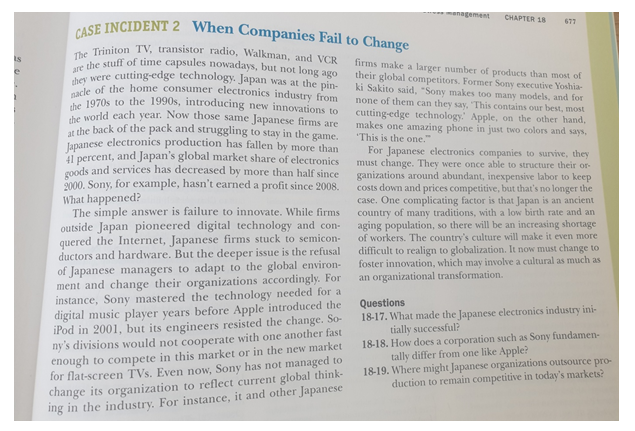
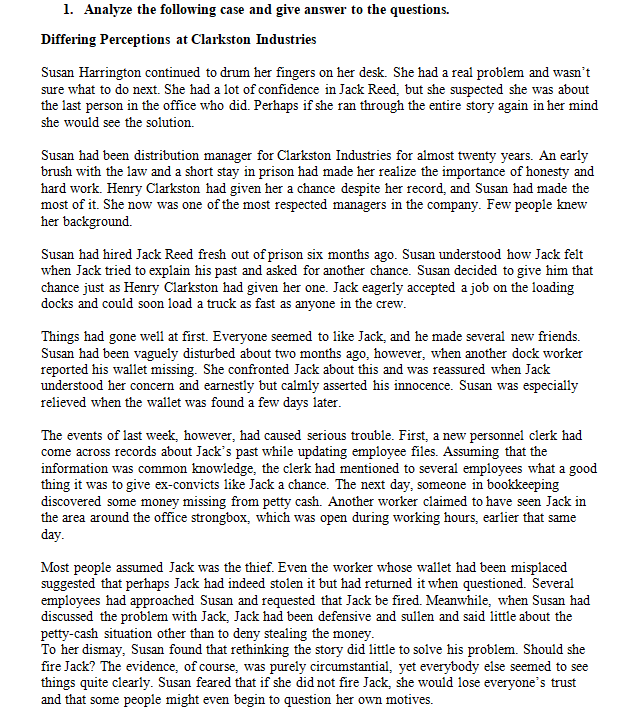
CHAPTER 13 677 CASE INCIDENT 2 When Companies Fail to Change The Triniton TV, transistor radio, Walkman, and VCR they were cutting-edge technology. Japan was at the pin- are the stuff of time capsules nowadays, but not long ago sacle of the home consumer electronics industry from the 1970s to the 1990s, introducing new innovations to the world each year. Now those same Japanese firms are firms make a larger number of products than most of their global competitors. Former Sony executive Yoshia- ki Sakito said, "Sony makes too many models, and for none of them can they say. This contains our best, most cutting-edge technology Apple, on the other hand, At the back of the pack and struggling to stay in the game. makes one amazing phone in just two colors and says, Japanese electronics production has fallen by more than "This is the one." 41 percent, and Japan's global market share of electronics For Japanese electronics companies to survive, they goods and services has decreased by more than half since must change. They were once able to structure their or ganizations around abundant, inexpensive labor to keep 2000. Sony, for example, hasn't earned a profit since 2008. costs down and prices competitive, but that's no longer the What happened? case. One complicating factor is that Japan is an ancient The simple answer is failure to innovate. While firms country of many traditions, with a low birth rate and an outside Japan pioneered digital technology and con- aging population, so there will be an increasing shortage quered the Internet, Japanese firms stuck to semicon- of workers. The country's culture will make it even more ductors and hardware. But the deeper issue is the refusal difficult to realign to globalization. It now must change to of Japanese managers to adapt to the global environ- foster innovation, which may involve a cultural as much as ment and change their organizations accordingly. For an organizational transformation. instance, Sony mastered the technology needed for a Questions digital music player years before Apple introduced the 18-17. What made the Japanese electronics industry ini. iPod in 2001, but its engineers resisted the change. So- tially successful? ny's divisions would not cooperate with one another fast 18-18. How does a corporation such as Sony fundamen- enough to compete in this market or in the new market tally differ from one like Apple? for flat-screen TVs. Even now, Sony has not managed to 18-19. Where might Japanese organizations outsource pro- duction to remain competitive in today's markets? change its organization to reflect current global think- ing in the industry. For instance, it and other Japanese 18.17- What made the Japanese electronics industry initially successful? 18-18. How does a corporation such as Sony fundamentally differ from one like Apple? 18-19. Where might Japanese organizations outsource production to remain competitive in today's market? 1. Analyze the following case and give answer to the questions. Differing Perceptions at Clarkston Industries Susan Harrington continued to drum her fingers on her desk. She had a real problem and wasn't sure what to do next. She had a lot of confidence in Jack Reed, but she suspected she was about the last person in the office who did. Perhaps if she ran through the entire story again in her mind she would see the solution. Susan had been distribution manager for Clarkston Industries for almost twenty years. An early brush with the law and a short stay in prison had made her realize the importance of honesty and hard work. Henry Clarkston had given her a chance despite her record and Susan had made the most of it. She now was one of the most respected managers in the company. Few people knew her background Susan had hired Jack Reed fresh out of prison six months ago. Susan understood how Jack felt when Jack tried to explain his past and asked for another chance. Susan decided to give him that chance just as Henry Clarkston had given her one. Jack eagerly accepted a job on the loading docks and could soon load a truck as fast as anyone in the crew. Things had gone well at first. Everyone seemed to like Jack, and he made several new friends. Susan had been vaguely disturbed about two months ago, however, when another dock worker reported his wallet missing. She confronted Jack about this and was reassured when Jack understood her concern and earnestly but calmly asserted his innocence. Susan was especially relieved when the wallet was found a few days later. The events of last week, however, had caused serious trouble. First, a new personnel clerk had come across records about Jack's past while updating employee files. Assuming that the information was common knowledge, the clerk had mentioned to several employees what a good thing it was to give ex-convicts like Jack a chance. The next day, someone in bookkeeping discovered some money missing from petty cash. Another worker claimed to have seen Jack in the area around the office strongbox, which was open during working hours, earlier that same day. Most people assumed Jack was the thief. Even the worker whose wallet had been misplaced suggested that perhaps Jack had indeed stolen it but had returned it when questioned. Several employees had approached Susan and requested that Jack be fired. Meanwhile, when Susan had discussed the problem with Jack, Jack had been defensive and sullen and said little about the petty-cash situation other than to deny stealing the money. To her dismay, Susan found that rethinking the story did little to solve his problem. Should she fire Jack? The evidence, of course, was purely circumstantial, yet everybody else seemed to see things quite clearly. Susan feared that if she did not fire Jack, she would lose everyone's trust and that some people might even begin to question her own motives. Case Questions 1. Explain the events in this case in terms of perception and attitudes. Does personality play a role? 2. What should Susan do? Should she fire Jack or give him another chance
Step by Step Solution
There are 3 Steps involved in it
1 Expert Approved Answer
Step: 1 Unlock

Question Has Been Solved by an Expert!
Get step-by-step solutions from verified subject matter experts
Step: 2 Unlock
Step: 3 Unlock
 Study Help