Question: Read The Need for Project Management Metrics (C) Case Study in Project Management Case Studies by Kerzner (Pages 421- 424). Provide a synopsis of the
Read "The Need for Project Management Metrics (C) Case Study in Project Management Case Studies by Kerzner (Pages 421- 424).
Provide a synopsis of the case study and answer questions 1- 3 with either a 300- 500 word paragraph OR a table.
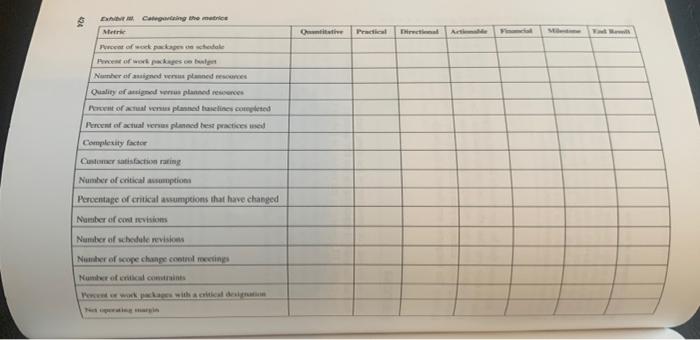
Please help on question 3; Using exhibit 3, categorize the metrics in exhibit 1.
1. What are the risks of reporting on too many metrics?
2. What are the risks of reporting on too few metrics?
3. Using Exhibit 3 categories the metrics and Exhibit 1.
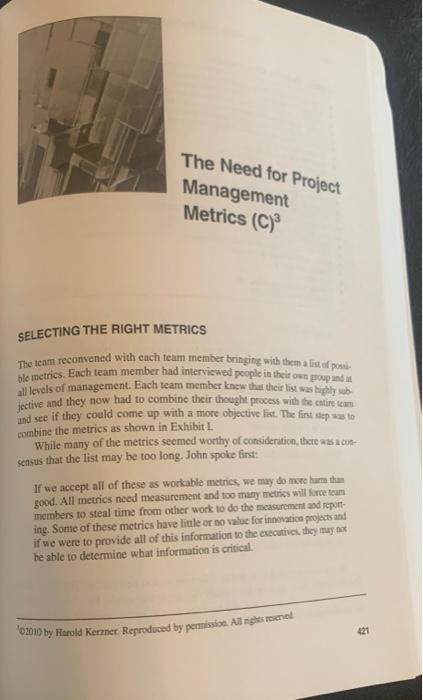
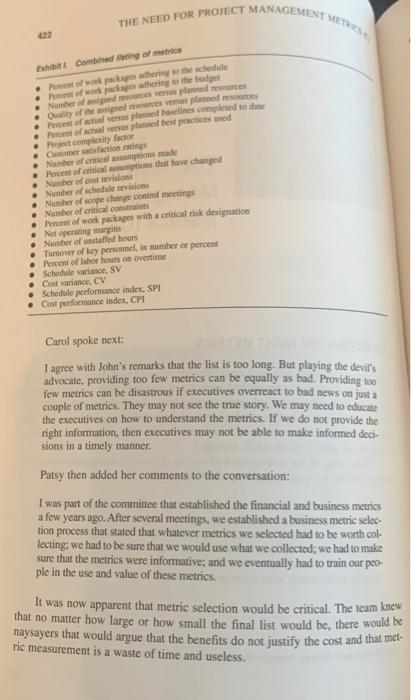
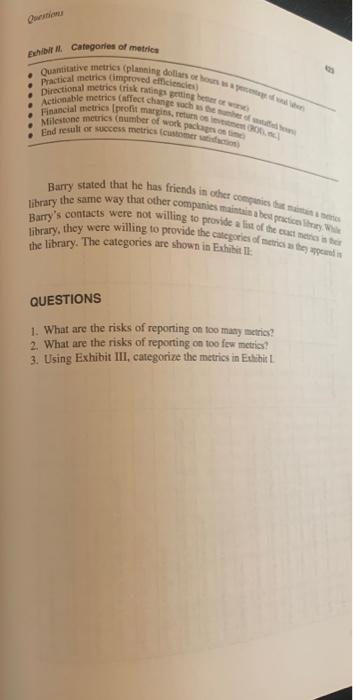
SELECTING THE RIGHT METRICS The team reconvened with each team member bringing with them a lagef posi. blo metrics. Each team member had intervicwed poople is their oen propp and it all levels of management. Each team member knew that their lis was lyphly sh. jective and they now had to combine their thought process with the catire tam and see if they could come up with a more objective last. The first tep sas to combine the metrics as shown in Exhibit 1. While many of the metrics seemed worthy of consideration, there ass a consensus that the list may be too long. John spoke fira: If we accept all of these as workable metrics, we may do moe ham than good. All metrics need measurement and too many metrics will force tam members to steal time from other work to do the meacuremert and repirting. Some of these metrics have little or no value for innovation poojats atsid if we were to provide all of this information to the exacutivex they may not be able to determine what information is critical. ronibits combined ketieng of metrict Carol spoke next: I agree with John's remarks that the list is too long. But playing the devil's advocate, providing too few metrics can be equally as bad. Providing too few metrics can be disastrous if executives overreact to bad news on just a couple of metrics. They may not see the true story. We may need to educate the executives on how to understand the metrics. If we do not provide the right information, then executives may not be able to make informed decisions in a timely manner. Patsy then added her comments to the conversation: I was part of the comimittee that established the financial and business metrics a few years ago. After several meetings, we established a business metric selection process that stated that whatever metrics we selected had to be worth collecting: we had to be sure that we would use what we collected; we had to make sure that the metrics were informative; and we eventually had to train our people in the use and value of these metries. It was now apparent that metric selection would be critical. The team knew hat no matter how large or how small the final list would be, there would naysayers that would argue that the benefits do not justify the cost and that met ic measurement is a waste of time and useless. Exhibir i Categories of metrica - Directional metrics (risk rating eriting betert or withe) litrary the same way that other compunies mainteis a bes prostice liftry. Whit Barry's contacts were not willing to proside a liat of the coct mesa a her library, they were willing to ptovide the catcgunies of nethici a kes apperd in the library. The categories are shown is Exhibit il: QUESTIONS 1. What are the risks of reporting on too many metrics? 2. What are the risks of reporting on 100 fcw metrios? 3. Using Exhibit 1II, categorize the metrics in Eulitir 1









 Study Help