







Question: Read the passage below and identify the authors argument. This Article evidenced an important reality: there are a growing number of international arbitration cases that
Read the passage below and identify the authors argument.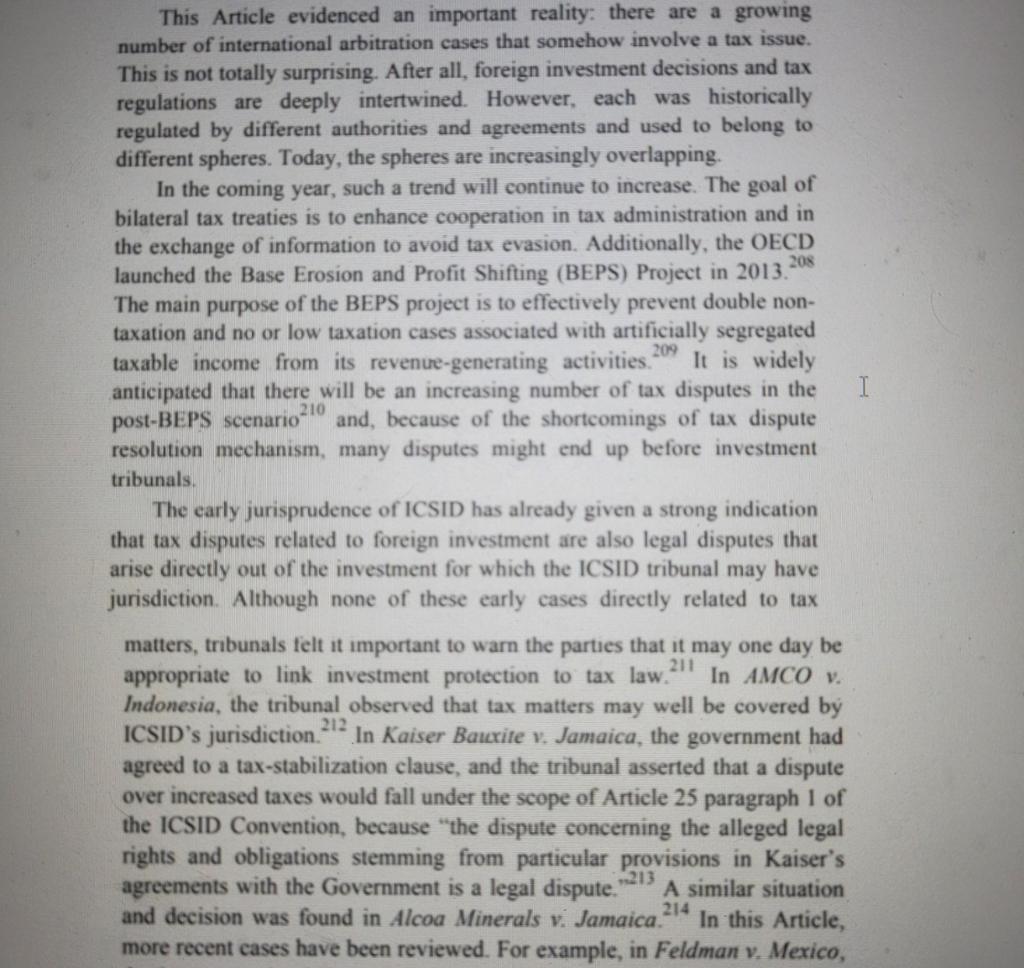
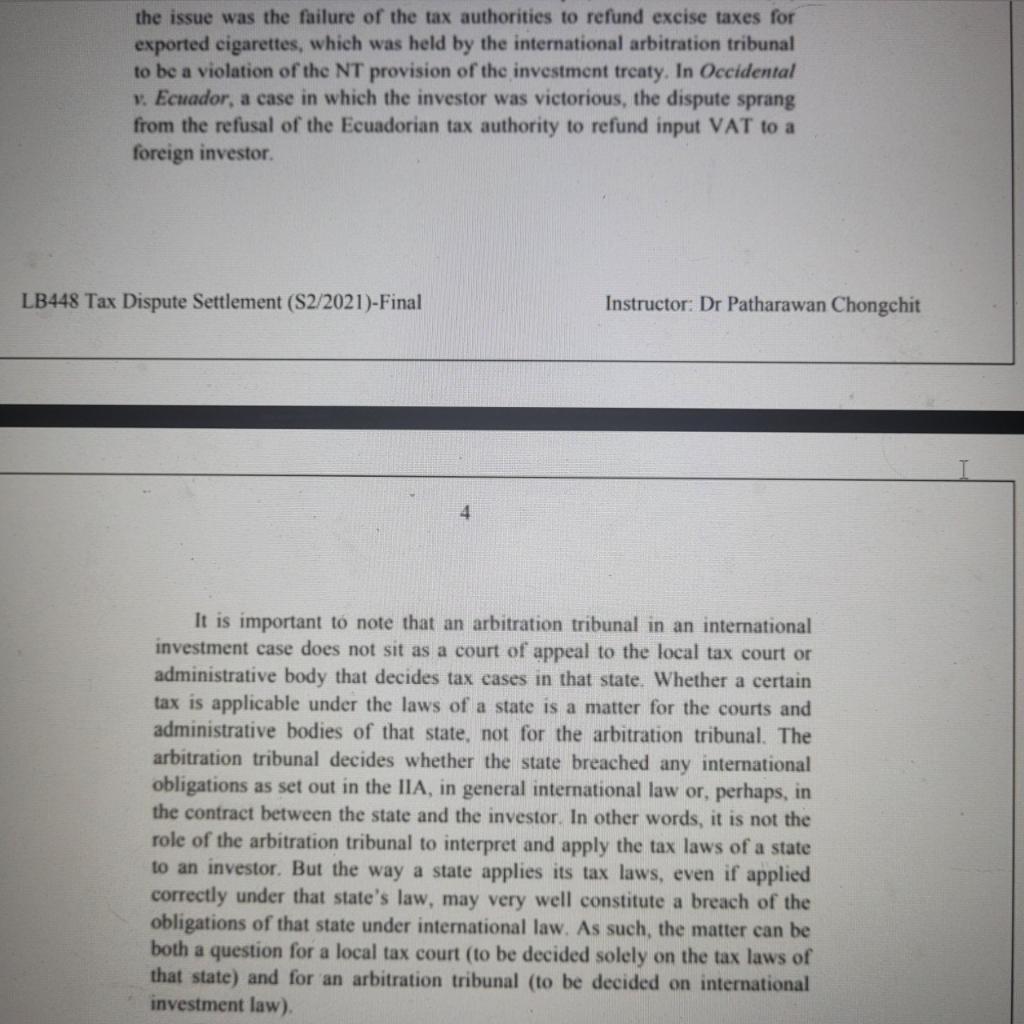
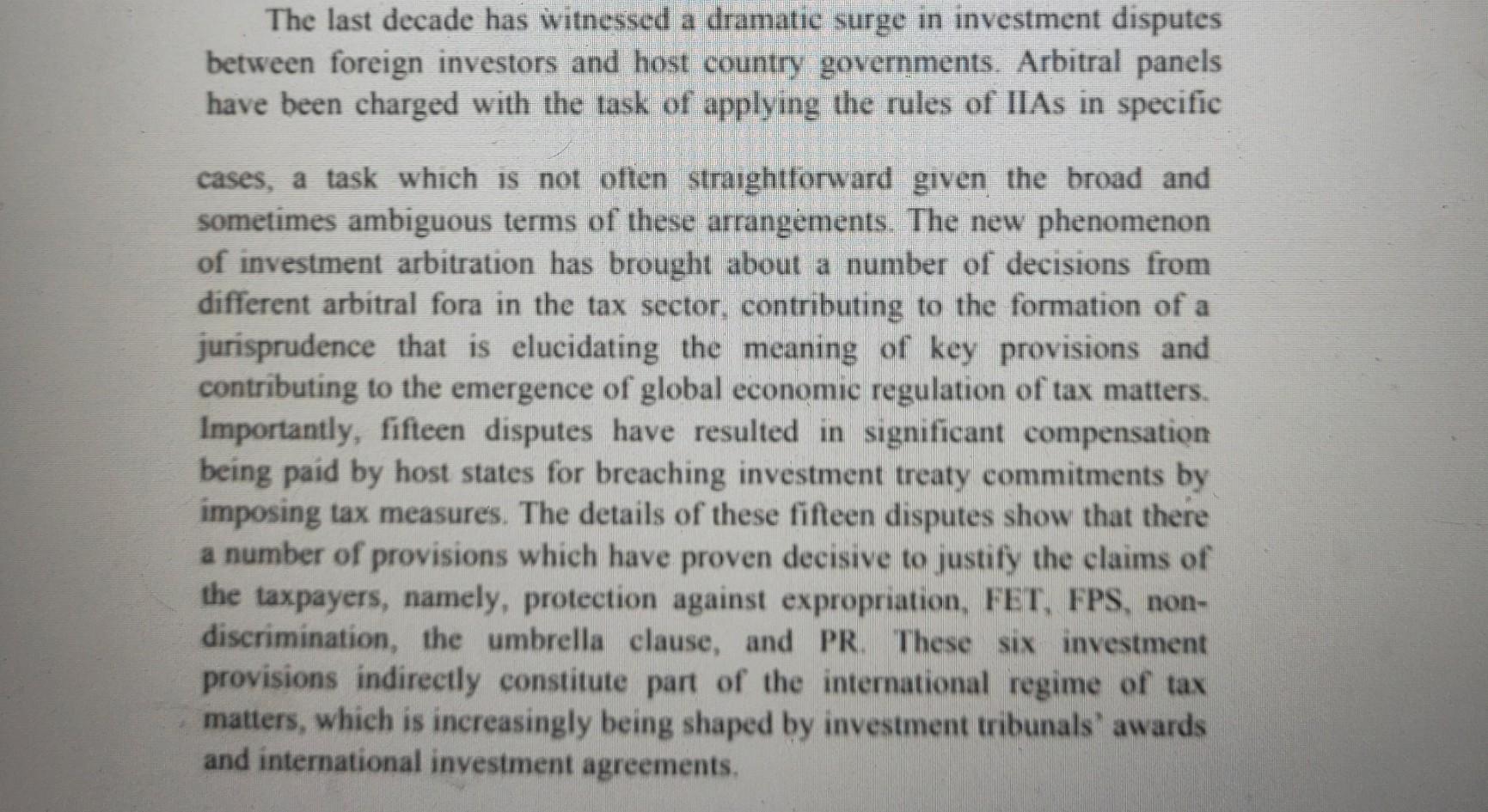
This Article evidenced an important reality: there are a growing number of international arbitration cases that somehow involve a tax issue. This is not totally surprising. After all, foreign investment decisions and tax regulations are deeply intertwined. However, each was historically regulated by different authorities and agreements and used to belong to different spheres. Today, the spheres are increasingly overlapping. In the coming year, such a trend will continue to increase. The goal of bilateral tax treaties is to enhance cooperation in tax administration and in the exchange of information to avoid tax evasion. Additionally, the OECD launched the Base Erosion and Profit Shifting (BEPS) Project in 2013.208 The main purpose of the BEPS project is to effectively prevent double non- taxation and no or low taxation cases associated with artificially segregated taxable income from its revenue-generating activities. 209 It is widely anticipated that there will be an increasing number of tax disputes in the I post-BEPS scenario and, because of the shortcomings of tax dispute resolution mechanism, many disputes might end up before investment tribunals. 210 The early jurisprudence of ICSID has already given a strong indication that tax disputes related to foreign investment are also legal disputes that arise directly out of the investment for which the ICSID tribunal may have jurisdiction. Although none of these early cases directly related to tax 212 matters, tribunals felt it important to warn the parties that it may one day be 211 appropriate to link investment protection to tax law. In AMCO v. Indonesia, the tribunal observed that tax matters may well be covered by ICSID's jurisdiction. In Kaiser Bauxite v. Jamaica, the government had agreed to a tax-stabilization clause, and the tribunal asserted that a dispute over increased taxes would fall under the scope of Article 25 paragraph 1 of the ICSID Convention, because "the dispute concerning the alleged legal rights and obligations stemming from particular provisions in Kaiser's agreements with the Government is a legal dispute. "213 A similar situation and decision was found in Alcoa Minerals v. Jamaica. In this Article, more recent cases have been reviewed. For example, in Feldman v. Mexico, 214 the issue was the failure of the tax authorities to refund excise taxes for exported cigarettes, which was held by the international arbitration tribunal to be a violation of the NT provision of the investment treaty. In Occidental v. Ecuador, a case in which the investor was victorious, the dispute sprang from the refusal of the Ecuadorian tax authority to refund input VAT to a foreign investor. LB448 Tax Dispute Settlement (S2/2021)-Final Instructor: Dr Patharawan Chongchit It is important to note that an arbitration tribunal in an international investment case does not sit as a court of appeal to the local tax court or administrative body that decides tax cases in that state. Whether a certain tax is applicable under the laws of a state is a matter for the courts and administrative bodies of that state, not for the arbitration tribunal. The arbitration tribunal decides whether the state breached any international obligations as set out in the IIA, in general international law or, perhaps, in the contract between the state and the investor. In other words, it is not the role of the arbitration tribunal to interpret and apply the tax laws of a state to an investor. But the way a state applies its tax laws, even if applied correctly under that state's law, may very well constitute a breach of the obligations of that state under international law. As such, the matter can be both a question for a local tax court (to be decided solely on the tax laws of that state) and for an arbitration tribunal (to be decided on international investment law). The last decade has witnessed a dramatic surge in investment disputes between foreign investors and host country governments. Arbitral panels I have been charged with the task of applying the rules of IIAs in specific cases, a task which is not often straightforward given the broad and sometimes ambiguous terms of these arrangements. The new phenomenon of investment arbitration has brought about a number of decisions from different arbitral fora in the tax sector, contributing to the formation of a jurisprudence that is elucidating the meaning of key provisions and contributing to the emergence of global economic regulation of tax matters. Importantly, fifteen disputes have resulted in significant compensation being paid by host states for breaching investment treaty commitments by imposing tax measures. The details of these fifteen disputes show that there a number of provisions which have proven decisive to justify the claims of the taxpayers, namely, protection against expropriation, FET, FPS, non- discrimination, the umbrella clause, and PR. These six investment provisions indirectly constitute part of the international regime of tax matters, which is increasingly being shaped by investment tribunals' awards and international investment agreements. This Article evidenced an important reality: there are a growing number of international arbitration cases that somehow involve a tax issue. This is not totally surprising. After all, foreign investment decisions and tax regulations are deeply intertwined. However, each was historically regulated by different authorities and agreements and used to belong to different spheres. Today, the spheres are increasingly overlapping. In the coming year, such a trend will continue to increase. The goal of bilateral tax treaties is to enhance cooperation in tax administration and in the exchange of information to avoid tax evasion. Additionally, the OECD launched the Base Erosion and Profit Shifting (BEPS) Project in 2013.208 The main purpose of the BEPS project is to effectively prevent double non- taxation and no or low taxation cases associated with artificially segregated taxable income from its revenue-generating activities. 209 It is widely anticipated that there will be an increasing number of tax disputes in the I post-BEPS scenario and, because of the shortcomings of tax dispute resolution mechanism, many disputes might end up before investment tribunals. 210 The early jurisprudence of ICSID has already given a strong indication that tax disputes related to foreign investment are also legal disputes that arise directly out of the investment for which the ICSID tribunal may have jurisdiction. Although none of these early cases directly related to tax 212 matters, tribunals felt it important to warn the parties that it may one day be 211 appropriate to link investment protection to tax law. In AMCO v. Indonesia, the tribunal observed that tax matters may well be covered by ICSID's jurisdiction. In Kaiser Bauxite v. Jamaica, the government had agreed to a tax-stabilization clause, and the tribunal asserted that a dispute over increased taxes would fall under the scope of Article 25 paragraph 1 of the ICSID Convention, because "the dispute concerning the alleged legal rights and obligations stemming from particular provisions in Kaiser's agreements with the Government is a legal dispute. "213 A similar situation and decision was found in Alcoa Minerals v. Jamaica. In this Article, more recent cases have been reviewed. For example, in Feldman v. Mexico, 214 the issue was the failure of the tax authorities to refund excise taxes for exported cigarettes, which was held by the international arbitration tribunal to be a violation of the NT provision of the investment treaty. In Occidental v. Ecuador, a case in which the investor was victorious, the dispute sprang from the refusal of the Ecuadorian tax authority to refund input VAT to a foreign investor. LB448 Tax Dispute Settlement (S2/2021)-Final Instructor: Dr Patharawan Chongchit It is important to note that an arbitration tribunal in an international investment case does not sit as a court of appeal to the local tax court or administrative body that decides tax cases in that state. Whether a certain tax is applicable under the laws of a state is a matter for the courts and administrative bodies of that state, not for the arbitration tribunal. The arbitration tribunal decides whether the state breached any international obligations as set out in the IIA, in general international law or, perhaps, in the contract between the state and the investor. In other words, it is not the role of the arbitration tribunal to interpret and apply the tax laws of a state to an investor. But the way a state applies its tax laws, even if applied correctly under that state's law, may very well constitute a breach of the obligations of that state under international law. As such, the matter can be both a question for a local tax court (to be decided solely on the tax laws of that state) and for an arbitration tribunal (to be decided on international investment law). The last decade has witnessed a dramatic surge in investment disputes between foreign investors and host country governments. Arbitral panels I have been charged with the task of applying the rules of IIAs in specific cases, a task which is not often straightforward given the broad and sometimes ambiguous terms of these arrangements. The new phenomenon of investment arbitration has brought about a number of decisions from different arbitral fora in the tax sector, contributing to the formation of a jurisprudence that is elucidating the meaning of key provisions and contributing to the emergence of global economic regulation of tax matters. Importantly, fifteen disputes have resulted in significant compensation being paid by host states for breaching investment treaty commitments by imposing tax measures. The details of these fifteen disputes show that there a number of provisions which have proven decisive to justify the claims of the taxpayers, namely, protection against expropriation, FET, FPS, non- discrimination, the umbrella clause, and PR. These six investment provisions indirectly constitute part of the international regime of tax matters, which is increasingly being shaped by investment tribunals' awards and international investment agreements
Step by Step Solution
There are 3 Steps involved in it

Get step-by-step solutions from verified subject matter experts
 Study Help