





Question: read the passages and answer the 4 questions The data provides compelling insights into the wellbeing of today's women, who have been christened the sandwich

read the passages and answer the 4 questions read the passages and answer the 4 questions The
read the passages and answer the 4 questions The
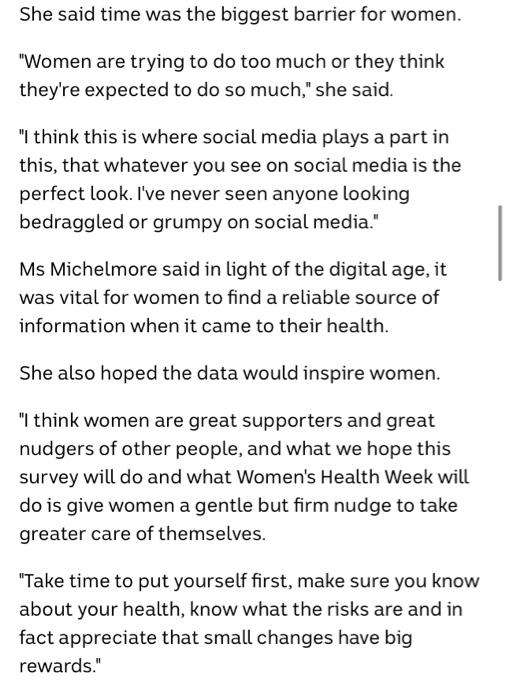
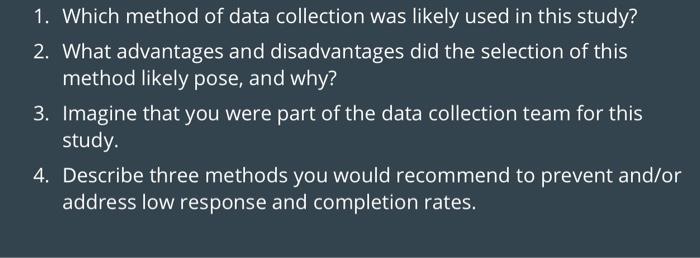
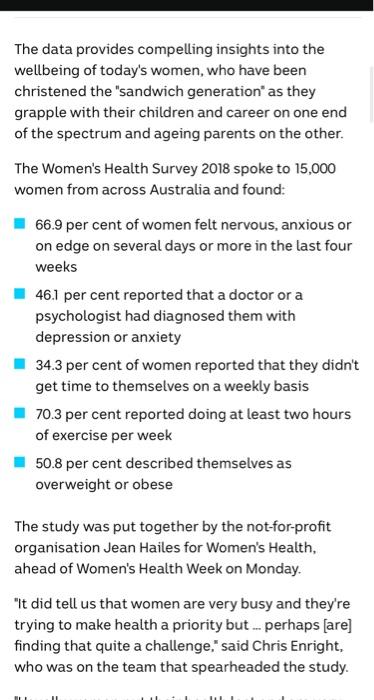
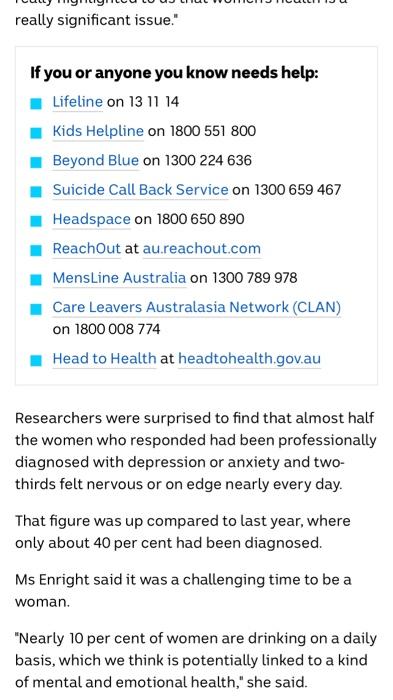
The data provides compelling insights into the wellbeing of today's women, who have been christened the "sandwich generation" as they grapple with their children and career on one end of the spectrum and ageing parents on the other. The Women's Health Survey 2018 spoke to 15,000 women from across Australia and found: 66.9 per cent of women felt nervous, anxious or on edge on several days or more in the last four weeks 46.1 per cent reported that a doctor or a psychologist had diagnosed them with depression or anxiety 34.3 per cent of women reported that they didn't get time to themselves on a weekly basis 70.3 per cent reported doing at least two hours of exercise per week 50.8 per cent described themselves as overweight or obese The study was put together by the not-for-profit organisation Jean Hailes for Women's Health, ahead of Women's Health Week on Monday. "It did tell us that women are very busy and they're trying to make health a priority but .. perhaps [are] finding that quite a challenge," said Chris Enright, who was on the team that spearheaded the study. really significant issue." If you or anyone you know needs help: Lifeline on 131114 Kids Helpline on 1800551800 Beyond Blue on 1300224636 Suicide Call Back Service on 1300659467 Headspace on 1800650890 ReachOut at aureachout.com MensLine Australia on 1300789978 Care Leavers Australasia Network (CLAN) on 1800008774 Head to Health at headtohealth.gov.au Researchers were surprised to find that almost half the women who responded had been profesionally diagnosed with depression or anxiety and twothirds felt nervous or on edge nearly every day. That figure was up compared to last year, where only about 40 per cent had been diagnosed. Ms Enright said it was a challenging time to be a woman. "Nearly 10 per cent of women are drinking on a daily basis, which we think is potentially linked to a kind of mental and emotional health," she said. She said time was the biggest barrier for women. "Women are trying to do too much or they think they're expected to do so much," she said. "I think this is where social media plays a part in this, that whatever you see on social media is the perfect look. l've never seen anyone looking bedraggled or grumpy on social media." Ms Michelmore said in light of the digital age, it was vital for women to find a reliable source of information when it came to their health. She also hoped the data would inspire women. "I think women are great supporters and great nudgers of other people, and what we hope this survey will do and what Women's Health Week will do is give women a gentle but firm nudge to take greater care of themselves. "Take time to put yourself first, make sure you know about your health, know what the risks are and in fact appreciate that small changes have big rewards." 1. Which method of data collection was likely used in this study? 2. What advantages and disadvantages did the selection of this method likely pose, and why? 3. Imagine that you were part of the data collection team for this study. 4. Describe three methods you would recommend to prevent and/or address low response and completion rates

Step by Step Solution

There are 3 Steps involved in it

1 Expert Approved Answer
Step: 1 Unlock blur-text-image

Question Has Been Solved by an Expert!

Get step-by-step solutions from verified subject matter experts

Step: 2 Unlock
Step: 3 Unlock

Students Have Also Explored These Related General Management Questions!