



Question: *Read the question carefully and answer it clearly and in an explanatory way. 1) Consider a two-period economy with no investment opportunities: first and second
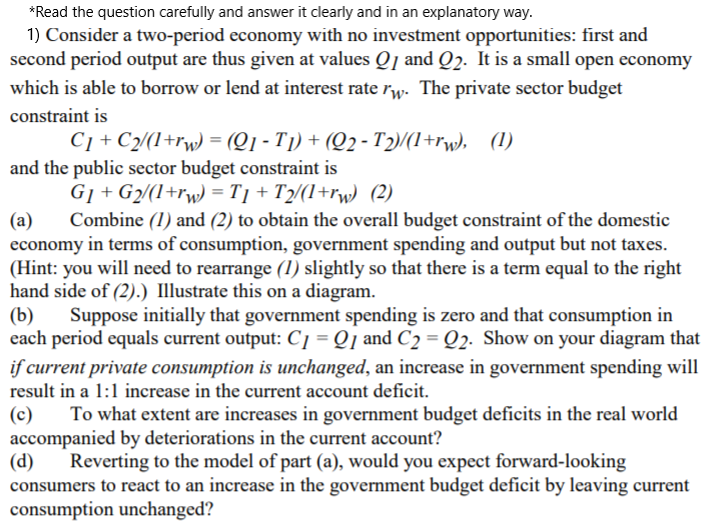
*Read the question carefully and answer it clearly and in an explanatory way. 1) Consider a two-period economy with no investment opportunities: first and second period output are thus given at values Qy and Q2. It is a small open economy which is able to borrow or lend at interest rate rw. The private sector budget constraint is C] + C2/(1+rw) = (21-T1) + (Q2 - T2)/(1+rw), (1) and the public sector budget constraint is G] + G2/(1+rw) = T1+T2/(1+rw) (2) (a) Combine (1) and (2) to obtain the overall budget constraint of the domestic economy in terms of consumption, government spending and output but not taxes. (Hint: you will need to rearrange (1) slightly so that there is a term equal to the right hand side of (2).) Illustrate this on a diagram. (b) Suppose initially that government spending is zero and that consumption in each period equals current output: C1 = Q and C2 = Q2. Show on your diagram that if current private consumption is unchanged, an increase in government spending will result in a 1:1 increase in the current account deficit. (c) To what extent are increases in government budget deficits in the real world accompanied by deteriorations in the current account? (d) Reverting to the model of part (a), would you expect forward-looking consumers to react to an increase in the government budget deficit by leaving current consumption unchanged? *Read the question carefully and answer it clearly and in an explanatory way. 1) Consider a two-period economy with no investment opportunities: first and second period output are thus given at values Qy and Q2. It is a small open economy which is able to borrow or lend at interest rate rw. The private sector budget constraint is C] + C2/(1+rw) = (21-T1) + (Q2 - T2)/(1+rw), (1) and the public sector budget constraint is G] + G2/(1+rw) = T1+T2/(1+rw) (2) (a) Combine (1) and (2) to obtain the overall budget constraint of the domestic economy in terms of consumption, government spending and output but not taxes. (Hint: you will need to rearrange (1) slightly so that there is a term equal to the right hand side of (2).) Illustrate this on a diagram. (b) Suppose initially that government spending is zero and that consumption in each period equals current output: C1 = Q and C2 = Q2. Show on your diagram that if current private consumption is unchanged, an increase in government spending will result in a 1:1 increase in the current account deficit. (c) To what extent are increases in government budget deficits in the real world accompanied by deteriorations in the current account? (d) Reverting to the model of part (a), would you expect forward-looking consumers to react to an increase in the government budget deficit by leaving current consumption unchanged
Step by Step Solution
There are 3 Steps involved in it

Get step-by-step solutions from verified subject matter experts