







Question: Read the short case Amazon Effect Is Hiking Pay and Fueling Land Rush in U.S. from Chapter 1 in the textbook; a copy of it
Read the short case Amazon Effect Is Hiking Pay and Fueling Land Rush in U.S. from Chapter 1 in the textbook; a copy of it is uploaded on Canvas. Answer the following questions in their entirety: 1. What is meant by the Amazon Effect presented in this case? 2. What challenges do managers of these warehouses face when the unemployment rate is low? When the unemployment rate is high? 3. What planning responsibilities do managers have as competition for employees and real estate heats up in this area of the country? What strategies can managers employ to retain talented employees? 4. What would you describe as the core competency and competitive advantage of Amazon? Your document should also have a brief Introduction and Conclusion (3-4 sentences each).
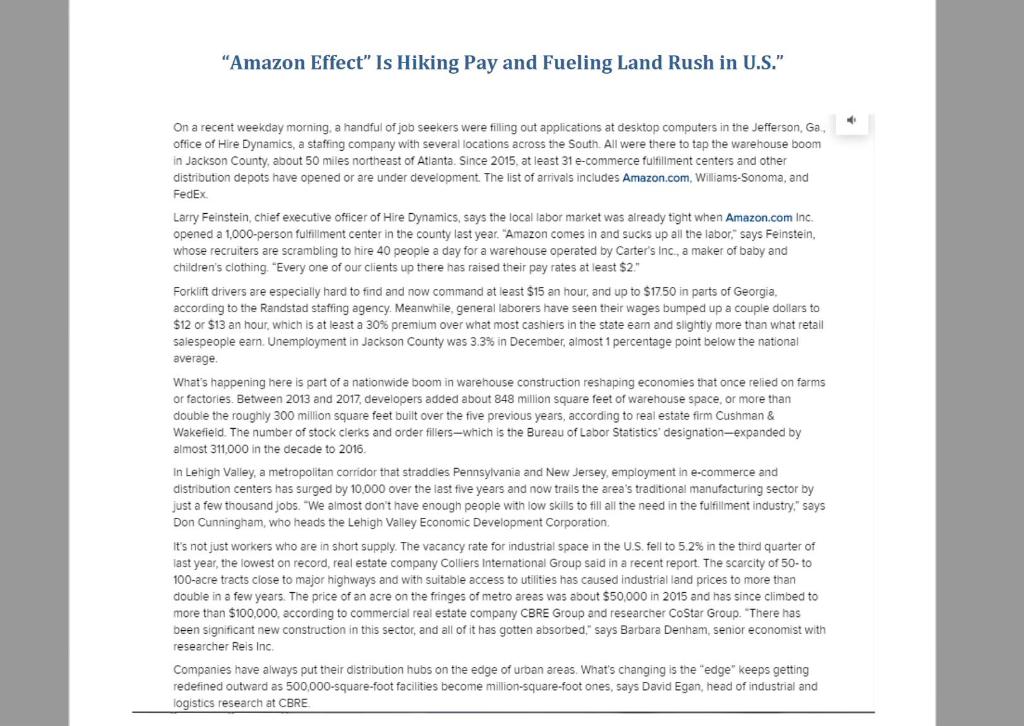
"Amazon Effect" Is Hiking Pay and Fueling Land Rush in U.S." On a recent weekday morning, a handful of job seekers were filling out applications at desktop computers in the Jefferson, Ga, office of Hire Dynamics, a staffing company with several locations across the South All were there to tap the warehouse boom in Jackson County, about 50 miles northeast of Atlanta. Since 2015 at least 31 e-commerce fulfillment centers and other distribution depots have opened or are under development. The list of arrivals includes Amazon.com, Williams-Sonoma, and FedEx Larry Feinstein, chief executive officer of Hire Dynamics, says the local labor market was already tight when Amazon.com Inc. opened a 1,000-person fulfillment center in the county last year. "Amazon comes in and sucks up all the labor," says Feinstein, whose recruiters are scrambling to hire 40 people a day for a warehouse operated by Carter's inc, a maker of baby and children's clothing. "Every one of our clients up there has raised their pay rates at least $2." Forklift drivers are especially hard to find and now command at least $15 an hour, and up to $17.50 in parts of Georgia, according to the Randstad staffing agency. Meanwhile, general laborers have seen their wages bumped up a couple dollars to $12 or $13 an hour, which is at least a 30% premium over what most cashiers in the state eam and slightly more than what retail salespeople earn. Unemployment in Jackson County was 3.3% in December, almost 1 percentage point below the national average What's happening here is part of a nationwide boom in warehouse construction reshaping economies that once relied on farms or factories. Between 2013 and 2017 developers added about 848 million square feet of warehouse space, or more than double the roughly 300 million square feet built over the five previous years, according to real estate firm Cushman & Wakefield. The number of stock clerks and order fillers-which is the Bureau of Labor Statistics' designation-expanded by almost 311.000 in the decade to 2016 In Lehigh Valley, a metropolitan corridor that straddles Pennsylvania and New Jersey, employment in e-commerce and distribution centers has surged by 10,000 over the last five years and now trails the area's traditional manufacturing sector by just a few thousand jobs. "We almost don't have enough people with low skills to fill all the need in the fulfillment industry," says Don Cunningham, who heads the Lehigh Valley Economic Development Corporation it's not just workers who are in short supply. The vacancy rate for industrial space in the U.S. fell to 5.2% in the third quarter of last year, the lowest on record, real estate company Colliers International Group said in a recent report. The scarcity of 50-to 100-acre tracts close to major highways and with suitable access to utilities has caused industrial land prices to more than double in a few years. The price of an acre on the fringes of metro areas was about $50,000 in 2015 and has since climbed to more than $100,000, according to commercial real estate company CBRE Group and researcher Costar Group. There has been significant new construction in this sector, and all of it has gotten absorbed." says Barbara Denham, senior economist with researcher Rels Inc Companies have always put their distribution hubs on the edge of urban areas. What's changing is the "edge" keeps getting redefined outward as 500,000-square-foot facilities become million-square-foot ones, says David Egan, head of industrial and logistics research at CBRE
Step by Step Solution
There are 3 Steps involved in it

Get step-by-step solutions from verified subject matter experts
 Study Help