Question: Read the text below and complete the SOP template. Ref. No. Date Page No. Title : Department/ Unit Purpose Who can perform this SOP? Equipment/Tools
Read the text below and complete the SOP template.
| | Ref. No. | |
| | Date | |
| | Page No. | |
| | | |
| Title : |
| Department/ Unit | |
| Purpose | |
| Who can perform this SOP? | |
| Equipment/Tools Needed: |
| Personal Protective Equipment | None |
| Tools | None |
| Reference Materials | |
| Others | |
| Prepared by: | |
| Reviewed by: | |
| Approved by: | |
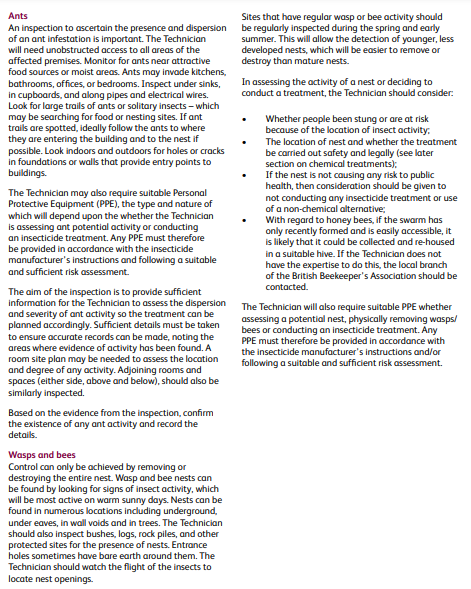
Sites that have regular wasp or bee activity should be regularly inspected during the spring and early summer. This will allow the detection of younger, less developed nests, which will be easier to remove or destroy than mature nests. In assessing the activity of a nest or deciding to conduct a treatment, the Technician should consider: Ants An inspection to ascertain the presence and dispersion of an ant infestation is important. The Technician will need unobstructed access to all areas of the affected premises. Monitor for ants near attractive food sources or moist areas. Ants may invade kitchens bathrooms, offices, or bedrooms. Inspect under sinks, in cupboards, and along pipes and electrical wires. Look for large trails of ants or solitary insects - which may be searching for food or nesting sites. If ant trails are spotted, ideally follow the ants to where they are entering the building and to the nest if possible. Look indoors and outdoors for holes or cracks in foundations or walls that provide entry points to buildings. The Technician may also require suitable Personal Protective Equipment (PPE), the type and nature of which will depend upon the whether the Technician is assessing ant potential activity or conducting an insecticide treatment. Any PPE must therefore be provided in accordance with the insecticide manufacturer's instructions and following a suitable and sufficient risk assessment. The aim of the inspection is to provide sufficient information for the Technician to assess the dispersion and severity of ant activity so the treatment can be planned accordingly. Sufficient details must be taken to ensure accurate records can be made, noting the areas where evidence of activity has been found. A room site plan may be needed to assess the location and degree of any activity. Adjoining rooms and spaces (either side, above and below), should also be Similarly inspected. Based on the evidence from the inspection, confirm the existence of any ant activity and record the details. Wasps and bees Control can only be achieved by removing or destroying the entire nest. Wasp and bee nests can be found by looking for signs of insect activity, which will be most active on warm sunny days. Nests can be found in numerous locations including underground under eaves, in wall voids and in trees. The Technician should also inspect bushes, logs, rock piles, and other protected sites for the presence of nests. Entrance holes sometimes have bare earth around them. The Technician should watch the flight of the insects to locate nest openings Whether people been stung or are at risk because of the location of insect activity, The location of nest and whether the treatment be carried out safety and legally (see later section on chemical treatments) If the nest is not causing any risk to public health, then consideration should be given to not conducting any insecticide treatment or use of a non-chemical alternative; With regard to honey bees, if the swarm has only recently formed and is accessible, it is likely that it could be collected and re-housed in a suitable hive. If the Technician does not have the expertise to do this, the local branch of the British Beekeeper's Association should be contacted. The Technician will also require suitable PPE whether assessing a potential nest, physically removing wasps/ bees or conducting an insecticide treatment. Any PPE must therefore be provided in accordance with the insecticide manufacturer's instructions and/or following a suitable and sufficient risk assessment









 Study Help