Question: Read this CASE Uber: Ethically Most Challenged Tech Company? and answer this question: Do you agree with Peter Thiels assessment that Uber is the most
Read this CASE Uber: Ethically Most Challenged Tech Company? and answer this question: Do you agree with Peter Thiels assessment that Uber is the most ethically challenged company in Silicon Valley? Why or why not? Explain.
Note: i need long asnwer. No copy from other chegg answer please
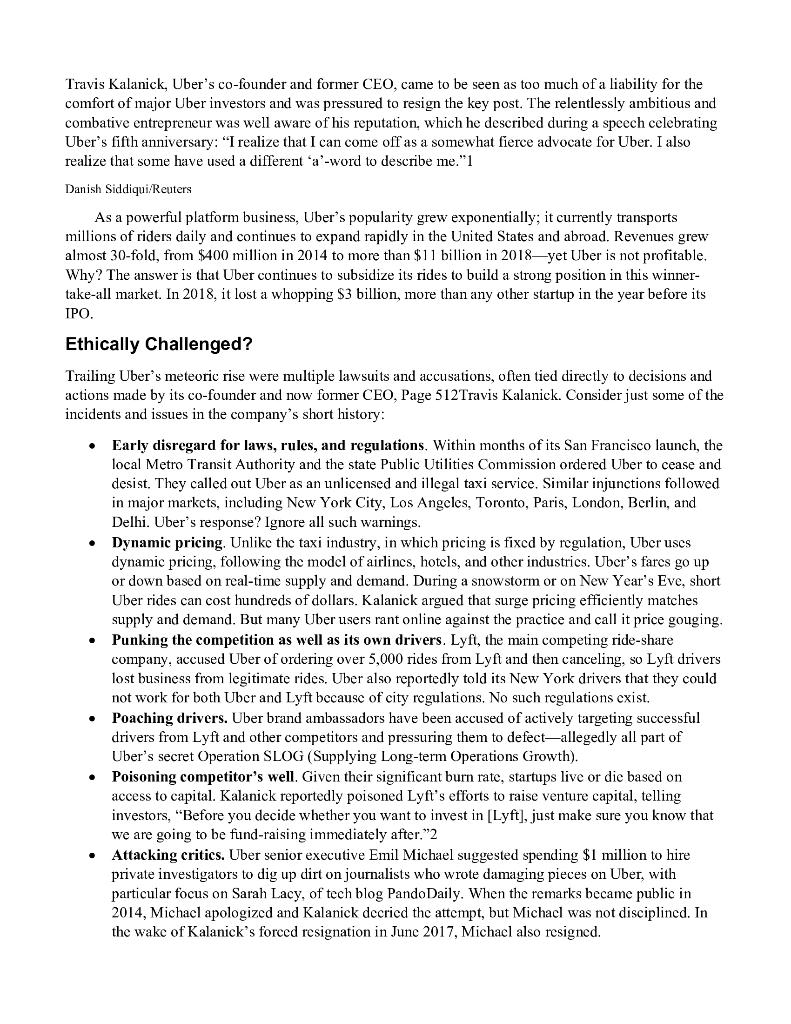
Frank T. Rothaermel prepared this MiniCase from public sources. This MiniCase is developed for the purpose of class discussion. It is not intended to be used for any kind of endorsement, source of data, or depiction of ellicient or inellicient management. All opin ions expressed, all errors and omissions are entirely the author's. Revised and updated: June 3,2019. orank T. Rothaermel. UBER'S pre-initial public offering (IPO) valuation was as high as $120 billion, making it the most valuable privately held company ever. Yet when Uber had its IPO on May 10,2019 , it was valued at $76 billion at the end of its first trading day. What happened to the difference in valuations? Where did the S44 billion or some 37 percent of its valuation go? Answer: It evaporated-and many argue that the pattern of unethical behavior over the years was a major contributing factor. Unicorns (private startups with a valuation of $1 billion or higher) such as Uber are not subject to the same public scrutiny as publicly traded companies are, which allows them to push the envelope in their legal and cthical business practices. A potential downside, however, is that a track record of ethics and legal problems may prevent a successful IPO in the future. In the process of achieving such success, Uber's unethical, if not illegal, activity generated controversy after controversy. Before we look more closely at those ethical issues, we need to understand the business success that could have tempted Uber to engage in ethical shortcuts. Record-Breaking Growth Facebook took seven years to reach a valuation of $50 billion for a private, venture-capital-backed firm; Uber only took five. If we compare Uber with the car-rental giant Hertz-which has 150 locations, a fleet of 500,000 cars, and about 30,000 employecs - it's astounding to learn that Hertz reaches less than 1 percent of Uber's valuation. Uber reached its astronomical valuation because it successfully expanded both in the United States and globally. Today this ride-hailing company serves approximately 600 cities in more than 60 countries worldwide and with 100 million monthly users. Travis Kalanick, Uber's co-founder and former CEO, came to be seen as too much of a liability for the comfort of major Uber investors and was pressured to resign the key post. The relentlessly ambitious and combative entrepreneur was well aware of his reputation, which he described during a speech celebrating Uber's fifth anniversary: "I realize that I can come off as a somewhat fierce advocate for Uber. I also realize that some have used a different 'a'-word to describe me."1 Danish Siddiqui/Reuters As a powerful platform business, Uber's popularity grew exponentially; it currently transports millions of riders daily and continues to expand rapidly in the United States and abroad. Revenues grew almost 30 -fold, from $400 million in 2014 to more than $11 billion in 2018 -yet Uber is not profitable. Why? The answer is that Uber continues to subsidize its rides to build a strong position in this winnertake-all market. In 2018 , it lost a whopping $3 billion, more than any other startup in the year before its IPO. Ethically Challenged? Trailing Uber's meteoric rise were multiple lawsuits and accusations, often tied directly to decisions and actions made by its co-founder and now former CEO, Page 512 Travis Kalanick. Consider just some of the incidents and issues in the company's short history: - Early disregard for laws, rules, and regulations. Within months of its San Francisco launch, the local Metro Transit Authority and the state Public Utilities Commission ordered Uber to cease and desist. They called out Uber as an unlicensed and illegal taxi service. Similar injunctions followed in major markets, including New York City, Los Angeles, Toronto, Paris, London, Berlin, and Delhi. Uber's response? Ignore all such warnings. - Dynamic pricing. Unlike the taxi industry, in which pricing is fixed by regulation, Uber uses dynamic pricing, following the model of airlines, hotels, and other industrics. Uber's fares go up or down based on real-time supply and demand. During a snowstorm or on New Year's Eve, short Uber rides can cost hundreds of dollars. Kalanick argued that surge pricing efficiently matches supply and demand. But many Uber users rant online against the practice and call it price gouging. - Punking the competition as well as its own drivers. Lyft, the main competing ride-share company, accused Uber of ordering over 5,000 rides from Lyft and then canceling, so Lyft drivers lost business from legitimate rides. Uber also reportedly told its New York drivers that they could not work for both Uber and Lyft because of city regulations. No such regulations cxist. - Poaching drivers. Uber brand ambassadors have been accused of actively targeting successful drivers from Lyft and other competitors and pressuring them to defect-allegedly all part of Uber's secret Operation SLOG (Supplying Long-term Operations Growth). - Poisoning competitor's well. Given their significant burn rate, startups live or die based on access to capital. Kalanick reportedly poisoned Lyft's efforts to raise venture capital, telling investors, "Before you decide whether you want to invest in [Lyft], just make sure you know that we are going to be fund-raising immediately after."2 - Attacking critics. Uber senior executive Emil Michael suggested spending $1 million to hire private investigators to dig up dirt on journalists who wrote damaging pieces on Uber, with particular focus on Sarah Lacy, of tech blog PandoDaily. When the remarks became public in 2014, Michacl apologized and Kalanick decricd the attempt, but Michacl was not disciplined. In the wake of Kalanick's forced resignation in June 2017, Michacl also resigned. - Tech transfer by stealth. Uber opened its Advanced Tech Center in Pittsburgh in 2015 to devclop autonomous cars and sophisticated mapping scrvices. Funding rescarch at Carnegic Mellon University's National Robotics Enginecring Center (NREC) brought Uber access to the university's scientists. A few months later, Uber poached the entire NREC research team with signing bonuses, twice the salaries, and stock options. The NREC was left a shell, with its entire future in question. - Allegations of sexual harassment and gender discrimination. A blog post by a former Uber engineer went viral. It alleged rampant sexual harassment, persistent mistreatment of female employees, and the company's failure to respond to complaints. The former employee said that women engineers in her work group dropped from 25 percent to as low as 3 percent within a year because of the hostile work environment. She also claimed managers downgraded her performance review for reporting a supervising manager for harassment. - Slow response. Public outcry forced Kalanick to act on the allegations of sexual harassment, and once he acted, he went big. He hired former U.S. Attorney General Eric Holder to lead an internal investigation with Arianna Huffington, then Uber's only female board member. - Operation Greyball. The New York Times exposed Uber's use of stealth technology for a number of years to foil law enforcement and regulators investigating Uber and its drivers. 3 In a secret operation code-named Greyball, Uber programmed its software to set up GPS rings around government offices and track low-cost phones and credit cards linked to government accounts. Thus, when law enforcement officers posed as Uber customers, Uber showed them dummy screens with fake Uber cars moving, none of which would stop and pick them up. Greyball was deployed worldwide, especially in cities where Uber was outlawed. - Kalanick caught on video. When an Uber driver complained to Kalanick about recent fare cuts, he told the driver upon leaving the vehicle, "You know what, some people don't like to take responsibility for their own sh,"4 and slammed the door. Kalanick did not realize he was being filmed by the driver's dashboard cam. The driver uploaded the video to social media, where it went viral.Page 513 - Waymo lawsuit. Waymo, a unit of Alphabet (Google's parent company), sued Uber for stealing Waymo's proprietary self-driving technology. When Uber acquired the autonomous-vehicle startup Otto, its founder, Anthony Levandowski, was working for Waymo at the same time on its autonomous-vehicle program. Waymo accused Levandowski of stealing more than 14,000 proprietary files from the firm. Uber settled the lawsuit with Waymo in the spring of 2018 , giving it $245 million in equity and making the promise that it would not use Waymo's technology in its self-driving cars. For Waymo, the stakes were just too high. According to expert predictions, only one or two technology standards will prevail for self-driving technology. Waymo wants to become the default operating system for self-driving cars with its proprictary technology. Forced to Resign Many of the issues described came to a head in mid-2017. In May, the results of the Holder investigation, along with 50 recommendations, were delivered to the Uber board. In June, responding to pressure from kcy investors, Kalanick formally resigned as CEO. The investors had expressed no confidence in Kalanick's ability to continue to lead the company that he co-founded. You could say the company developed a reputation to live down. Uber's ethical challenges were called out publicly throughout its rise, and as carly as 2014, venture capitalist Peter Thiel called Uber the "most ethically challenged company in Silicon Valley."5 Of course, Thiel, the billionaire co-founder of PayPal and Palantir (a data analytics company), is also an investor in Lyft. Lyft (featured in ChapterCase 9) also went public in the spring of 2019 (before Uber) and ended up with a valuation of $26 billion at the end of its first trading day, roughly one-third that of Uber. Echoing Thicl's assessment, The Wall Strect Journal argued that Uber itsclf-rather than Lyft or oldline taxi and limo services - is its biggest threat, thercby functioning as its own biggest rival. The competitive tactics and comments by Uber executives and constant scandals surrounding Kalanick were harming the company's reputation and becoming a liability. Disaster Averted? Will Travis Kalanick's departure as CEO allow Uber to develop a more grounded and ethical corporate culture? It may take several years to answer that question confidently. Here are some observations about Uber's future. A CYNIC'S VIEW. Critics may sce the resignation of Kalanick as just onc more stunt to reduce heat and scrutiny, and unlikely to result in meaningful change. Corporate culture is never easy to change, this line of reasoning goes, and Kalanick, as co-founder, remains a strong presence in two ways. First, he has contributed too much to the company's DNA (through the imprinting process discussed in Chapter 11), so the company is prone to lapses by nature. And second, Kalanick has not cut his ties; he still remains intimately involved in the company. Although no longer CEO and chairman, Kalanick remains a member of Uber's board of directors. Given this situation, some observers question whether Uber has in place effective corporate governance mechanisms, or whether its cthically and legally questionable competitive tactics and decisions are simply part of its larger intended strategy: to dominate the mobile, on-demand logistics business first and to address any remaining stakeholder grievances next. BEYOND CYNICISM. On the other hand, business as usual for Uber is becoming increasingly problematic. For years, Uber seemed willing to flout rules, laws, and regulations because the service was liked by users who didn't want to see it be removed. Uber's customers were happy because they could hail rides conveniently and cheaply, often in areas that were underserved by regular taxis; drivers were happy because they could choose when and how long to work. Local politicians were cautious about throwing a monkey wrench in the works. Why make your voters unhappy? Such tactics may work fine at the local level, but not beyond. Uber's challenges are growing increasingly broader, both nationally and internationally. Uber now fights well-funded lawsuits instead of hamstrung municipal burcaucrats. Uber can no longer fly under the radar. The company is so big and established that the CEO's boorish behavior or an employee's complaints about sexual harassment quickly go viral on a global basis. EYE ON THE PRIZE. Uber may be at a point in its trajectory where investors simply won't allow it to continue its self-destructive tendency to cut ethical corners. Too much is at stake. In this line of thought, Page 514the biggest opportunity with Uber is not its current business. Uber's goal remains centered around self-driving cars, supported by high-powered mobile logistics networks and online mapping systems. In this vicw, its current business is sccondary. Which takes us back to Uber's inherent disruptive nature. With a fleet of autonomous vehicles offering cheap rides, people don't need to own cars anymore. When car ownership is no longer needed, it will impact the old-line car manufacturers. From there Uber might expand into the "delivery of everything," taking over last-mile deliveries for Amazon and other online retailers. Uber might even work in concert with shippers such as UPS and FedEx. ONE POSSIBLE FUTURE. In this version of the future, Uber is the primary player and provider of self-driving car technology. It controls the platform under which customers might summon a car to their door, and some of Uber's current challenges would disappear. According to Kalanick, "The reason Uber could be expensive is because you're not just paying for the car-you're paying for the other dude in the car. When there's no other dude in the car, the cost of taking an Uber anywhere becomes cheaper than owning a vehicle." 6 Kalanick is pitching benefits of self-driving technology for both the firm and the consumer. Paying for the driver is currently the largest single cost of an Uber ride. Not having to deal with drivers thus becomes an attractive option not only because it saves on costs for customer and firm, but also because it eliminates a contentious relationship once shared between the firm and its work force (as cvidenced by driver walkouts). Globally, courts are still considering whether Uber drivers should be considered freelancers or actual employees, given the rules by which they must abide. If drivers are to be classified as employees, Uber must pay benefits and so forth; the cost per ride would further increasc. Moreover, Uber loses money on each ride and continues to subsidize both the consumer and driver to build an installed base of as many users as possible. On the regulatory front it's reasonable to assume that states will continue to remove obstacles to self-driving cars and the companies that manage them. So in this future, many of its compliance failures go away. CURRENT CHALLENGES. But Uber has to get through current challenges to reach its future goals. Before Kalanick resigned, the firm engaged in perception management to deal with all the scandals and controversies. In 2015 Uber hired David Plouffe as senior vice president of policy and strategy, explicitly to improve public relations and to lobby politicians. Previously, Plouffe had been the manager for the 2008 Obama presidential campaign and then a senior adviser in the administration. At Uber he pitched the social benefit of Uber's contribution to the transportation ccosystem and its ability to fix traffic congestion, cut down on drunk driving, and provide reliable and safe services to underserved city and suburban areas - even helping to end poverty by increasing access to reliable transportation. He also minimized the criticisms, calling them misguided. 7 EXODUS OF TALENT. Plouffe walked away in carly 2017 . He was followed by Rachel Whetstone, who headed policy and communications globally; she was hired in 2015 and left in April 2017. The number of senior executives and lead engineers that have left Uber in the wake of continuous scandals has been a steady stream. They include Uber's head of autonomous-car technology, head of online mapping, and an artificial intelligence (AI) expert. Some cited issues with the company's values as the reason for their departure. When resigning after only six months on the job in spring 2017, Uber President Jeff Jones stated, "The beliefs and approach to leadership that have guided my career are inconsistent with what I saw and experienced at Uber."8 As these executives departed before Uber's IPO, they left behind promised stock options cstimated to be worth millions. HOPE FOR THE FUTURE? If Uber is able to mend its ways - and much depends on how the full board responds to major investors-Uber has a much better chance of realizing the future it hopes will unfold. DISCUSSION QUESTIONS 1. Would you like to work for Uber? Why or why not? 2. Do you agree with Peter Thiel's assessment that Uber is the "most ethically challenged company in Silicon Valley"? Why or why not? Explain. 3. Some observers had argued that Uber's greatest problem was not any of its scandals, but CEO Travis Kalanick. Now that Kalanick no longer serves that rolc, how much better off is Uber'? Do you think Kalanick's reduced profile will turn the tide for Uber? Or are Kalanick's drive and competitiveness necessary to Uber's continued success, regardless of the title he holds? If you were on the board of directors, what would you recommend? And why? Note: Due to his shareholdings in the company and how ownership is structured, Kalanick is an Uber board member what sh can he in notes 1. Travis Kalanick quoted in: Huet, E. (2015, Jun. 3), "Uber is adding 'hundreds of thousands' of new drivers cvery month" Forbes. 2. As quoted in: Austin, S., and D. MacMillan (2014, Nov. 18), "Is Uber's biggest rival itself? A collection of controversy," The Wall Street Journal. 3. Isaac, M. (2017, Mar, 3), "How Uber deceives the authorities worldwide," The New York Times. 4. The Kalanick quote appeared in a number of news sources, including: "Uber CEO apologizes after being caught in argument with Uber driver," CBS News (2017, Feb. 28). 5. Thiel, P. (2014, Nov. 18), "Uber is most ethically challenged company in Silicon Valley," CNN Money, http://money.cnn.com/2014/11/18/technology/uber-unethicalpeter-thiel. 6. As quoted in Austin, S., and D. MacMillan (2014, Nov. 18), "Is Uber's biggest rival itself"? A collection of controversy," The Wall Street Journal. 7. "I don't subscribe to the idea that the company has an image problem," Plouffe said. "I actually think when you are a disrupter you are going to have a lot of people throwing arrows." As quoted in: Swisher, K. (2014, December), "Man and Uber man," Vanity Fair: 1-11. 8. As quoted in: "Uber is facing the biggcst crisis in its short history," The Economist (2017, Mar. 25). Sources: Driebusch, C., and M. Farrell (2019, May 10), "Uher's high-profile IPO upsets with weak debut," The Wall Street Journal; Hoffman, L., G. Bensinger, and M. Farrell (2018, Oct. 16), "Uber proposals value company at $120 billion in a possible IPO," The Wall Sireet .Journal; Stone, B. (2017), The Upstarls: Uber, Airbnb, and the Batle for the New Silicon Valley (New York: Little, Brown and Co.); Bensinger, G. (2017, Jun. 21), "Uber CEO Travis Kalanick quits as investors revolt," The Wall Street Journal; "What's behind the conflict between Google and Uber," The Economist (2017, May 8); "Here's how much Uber made in revenue in 2016," Renters (2017, Apr. 14); "Uber is facing the biggest crisis in its short history," The Economist (2017, Mar. 25); "Travis Kalanick's uber-apology," The Economist (2017, Mar. 4); Isaac, M. (2017, Mar. 3), "How Uber deceives the authoritics worldwide," The New York Times; Bensinger, G. (2017, Feb. 20), "Uber to









 Study Help