Question: Read this study answer this questions Questions? Does this study make a causal claim, an association claim, or a frequency claim? Does this study have
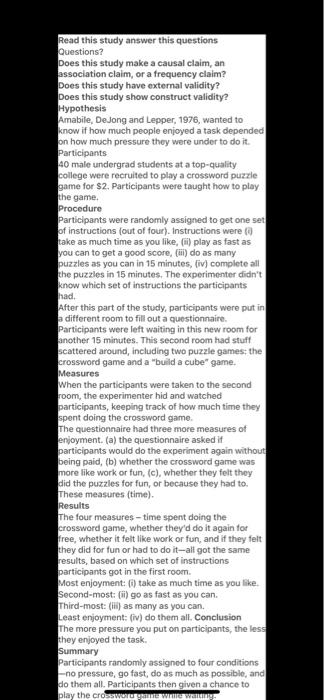
Read this study answer this questions Questions? Does this study make a causal claim, an association claim, or a frequency claim? Does this study have external validity? Does this study show construct validity? Hypothesis Amabile, Dejong and Lepper, 1976, wanted to know if how much people enjoyed a task depended on how much pressure they were under to do it Participants 40 male undergrad students at a top-quality college were recruited to play a crossword puzzle game for $2. Participants were taught how to play the game: Procedure Participants were randomly assigned to get one set of instructions (out of four). Instructions were take as much time as you like, (ii) play as fast as you can to get a good score, (i) do as many puzzles as you can in 15 minutes, (iv) complete all the puzzles in 15 minutes. The experimenter didn't know which set of instructions the participants had After this part of the study, participants were put in a different room to fill out a questionnaire Participants were left waiting in this new room for another 15 minutes. This second room had stuff scattered around, including two puzzle games: the crossword game and a "build a cube" game. Measures When the participants were taken to the second room, the experimenter hid and watched participants, keeping track of how much time they spent doing the crossword game. The questionnaire had three more measures of enjoyment. (a) the questionnaire asked it participants would do the experiment again without being paid, (b) whether the crossword game was more like work or fun, (c), whether they felt they did the puzzles for fun, or because they had to These measures (time). Results The four measures-time spent doing the crossword game, whether they'd do it again for free, whether it felt like work or fun, and if they felt they did for fun or had to do it-all got the same results, based on which set of instructions participants got in the first room. Most enjoyment: (i) take as much time as you like. Second-most: (ii) go as fast as you can Third-most: (i) as many as you can Least enjoyment: (iv) do them all. Conclusion The more pressure you put on participants, the less they enjoyed the task Summary Participants randomly assigned to four conditions no pressure, go fast, do as much as possible, and do them all. Participants then given a chance to play the crossword Read this study answer this questions Questions? Does this study make a causal claim, an association claim, or a frequency claim? Does this study have external validity? Does this study show construct validity? Hypothesis Amabile, Dejong and Lepper, 1976, wanted to know if how much people enjoyed a task depended on how much pressure they were under to do it Participants 40 male undergrad students at a top-quality college were recruited to play a crossword puzzle game for $2. Participants were taught how to play the game: Procedure Participants were randomly assigned to get one set of instructions (out of four). Instructions were take as much time as you like, (ii) play as fast as you can to get a good score, (i) do as many puzzles as you can in 15 minutes, (iv) complete all the puzzles in 15 minutes. The experimenter didn't know which set of instructions the participants had After this part of the study, participants were put in a different room to fill out a questionnaire Participants were left waiting in this new room for another 15 minutes. This second room had stuff scattered around, including two puzzle games: the crossword game and a "build a cube" game. Measures When the participants were taken to the second room, the experimenter hid and watched participants, keeping track of how much time they spent doing the crossword game. The questionnaire had three more measures of enjoyment. (a) the questionnaire asked it participants would do the experiment again without being paid, (b) whether the crossword game was more like work or fun, (c), whether they felt they did the puzzles for fun, or because they had to These measures (time). Results The four measures-time spent doing the crossword game, whether they'd do it again for free, whether it felt like work or fun, and if they felt they did for fun or had to do it-all got the same results, based on which set of instructions participants got in the first room. Most enjoyment: (i) take as much time as you like. Second-most: (ii) go as fast as you can Third-most: (i) as many as you can Least enjoyment: (iv) do them all. Conclusion The more pressure you put on participants, the less they enjoyed the task Summary Participants randomly assigned to four conditions no pressure, go fast, do as much as possible, and do them all. Participants then given a chance to play the crossword









 Study Help