







Question: Read through both problems completely before you start Problem 1. It may help to print the Excel worksheet linked at the bottom of the page,
Read through both problems completely before you start Problem 1. It may help to print the Excel worksheet linked at the bottom of the page, and refer to it as you read through the problem description.
Problem 1
Consider the completed MRP tables for the 32" Right Hand Pre-Hung Door and 32" Left Hand Pre-Hung Door from our earlier examples. The completed tables, (computed right at the start of week 11,covering weeks 11 through 18), are shown below:
Assignment 1 Figure 1. This figure shows completed MRP tables for items 32" RH Pre-Hung Door and 32" LH Pre-Hung door, using a planning horizon of weeks 11 to 18. The assignment, in contrast, asks you to fill out the table that would be used after week 11 is past, and we are planning weeks 12 to 19.
MRP applies a "rolling" planning horizon. In this example, we would develop a new 8-week plan every week. As we move through the rolling horizon, the MRP plans are continually being updated in response to the latest information.
Suppose it is now one week later, (so now we are just starting week 12) and we are currently planning weeks 12 through 19. In this case, we have new demand information (customer orders) for week 15, while the forecast (average weekly demand of 40 for each item) has been applied to week 19. Moreover, while we were "planning" to have 50 32" RH Pre-Hung doors in inventory at the beginning of week 12, we currently actually only have 45. (One of our customers called at the last minute and increased their order by 5.) Similarly, we actually have 54 32" left-hand doors in stock, vs. the 52 that was projected in last week's plan. Notice also, according to the tables developed last week, neither item has any scheduled receipts right now. The units that were previously showing up (in the tables above) as scheduled receipts in week 11 have been received, and some of them used, by the start of week 12.
Perform the calculations to fill out the week 12-19 MRP tables for both items. Use the blank tables with initial information provided in the spreadsheet linked below. Verify that the tables provided reflect the updated information described above. You do not need to enter Excel formulas into the tables, but you may do so if you wish. The alternative is to simply do the calculations with a calculator, and enter the resulting numbers into the table.
Problem 2
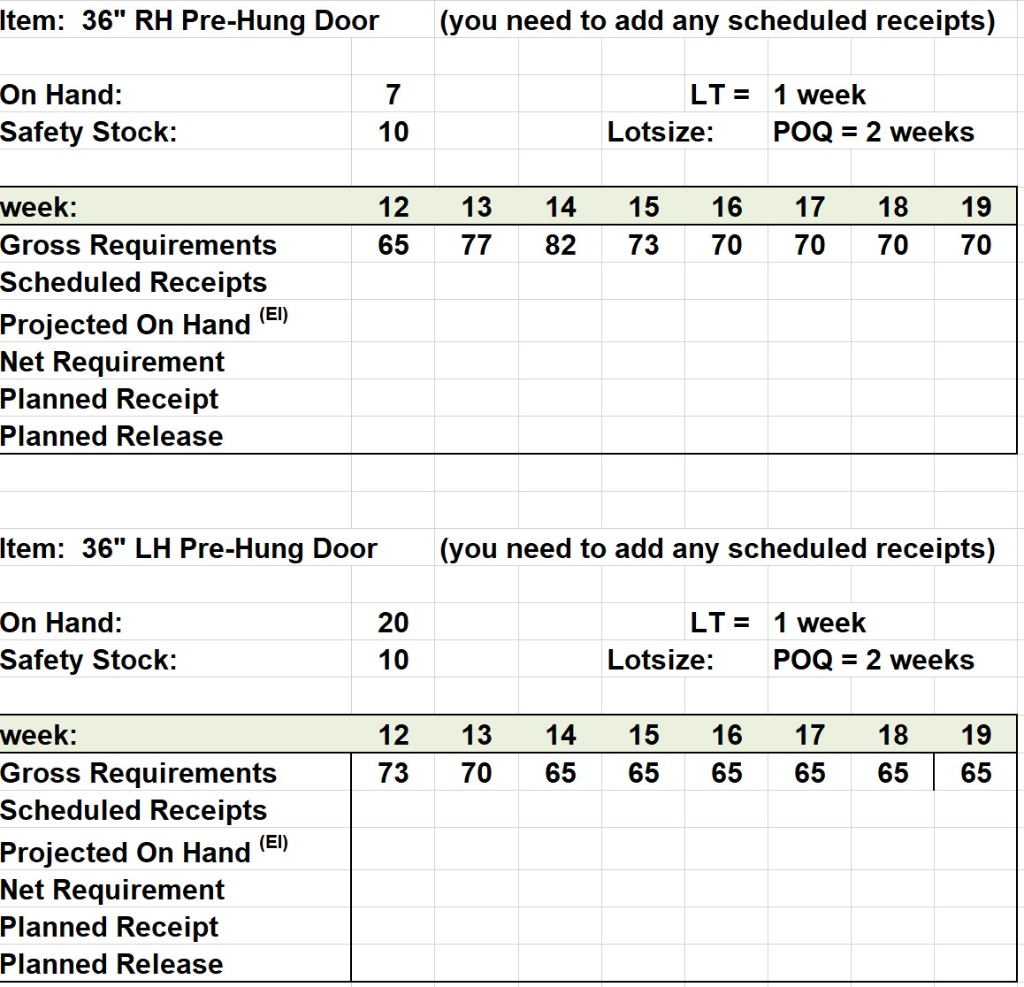
Last week's (week 11) completed MRP table for the 36" RH doors is shown below. Assuming we are now at the start of week 12, you are to develop the updated MRP plan for weeks 12-19. We actually have 7 of these doors in stock (vs. the value 10 that was projected in the tables computed back in week 11), with updated demand information as provided in the spreadsheet linked below. YOU need to enter any Scheduled Receipt information that belongs in the week 12-19 MRP table for 36" RH doors, based on what you see below in the week 11-18 MRP table. Notice the table below shows 142 of the 36" RH Pre-Hung Doors that should be ordered in week 11 (because the planned release is in week 11), to be received in week 12 (because the planned receipt is in week 12). Assuming we actually ordered those 142 doors in week 11 like we were supposed to, in week 12 they would be showing up as a scheduled receipt in week 12, rather than as a planned receipt in week 12.
As explained in the commentary, scheduled receipts are telling us when we will receive units that have already been ordered. The planned release row tells us when we should be ordering units that have not been ordered yet. (The planned receipt row shows us when we plan to be receiving orders that have not been ordered yet.) These "planned" quantities could still change when the MRP tables are recomputed using new information. Once an order is actually placed, (released for production or released to the supplier), the order quantity (now a scheduled receipt) typically does not change.
Assignment 1 Figure 2. This figure shows the completed MRP table for items 36" RH Pre-Hung Door, using a planning horizon of weeks 11 to 18.
Similarly, the weeks 11-18 MRP table for the 36"LH pre-hung door is shown below. Given this information, fill out the week 12-19 MRP table for this item, using the updated demand and inventory information provided in the spreadsheet linked below. You will need to update the Scheduled Receipt row for the 36"LH Pre-Hung door, based on what you see in the planned release and planned receipt for the week 11-18 MRP table shown below. (In the next lesson you will work with a real-life MRP system and see how this is implemented in practice.)
Assignment 1 Figure 3. This figure shows the completed MRP table for items 36" LH Pre-Hung Door, using a planning horizon of weeks 11 to 18.
Notice we are also producing the 32" and 36" versions in alternate weeks, and plan to stick to that schedule. (Notice all the scheduled and/or planned receipts for 32" doors are in odd-numbered weeks, while all the 36" versions have scheduled and/or planned receipts in even numbered weeks.) If a small net requirement to replenish safety stock appears to be prompting a planned receipt in an "off" week for the item in question, the net requirement will simply accumulate until the next "normal cycle" planned receipt period for that item. Your scheduled and planned receipts should stick to the "every other week" pattern established for each item, using the POQ = 2 weeks lot sizing rule. We will not expedite an order for the purpose of maintaining safety stock. To the contrary, we will remember that the purpose of safety stock is to help "stabilize" the production schedules and reduce the need for expediting.
Use the blank tables provided in the Excel workbook below for both problems. Be sure to enter your name in the indicated cell before you submit your solution.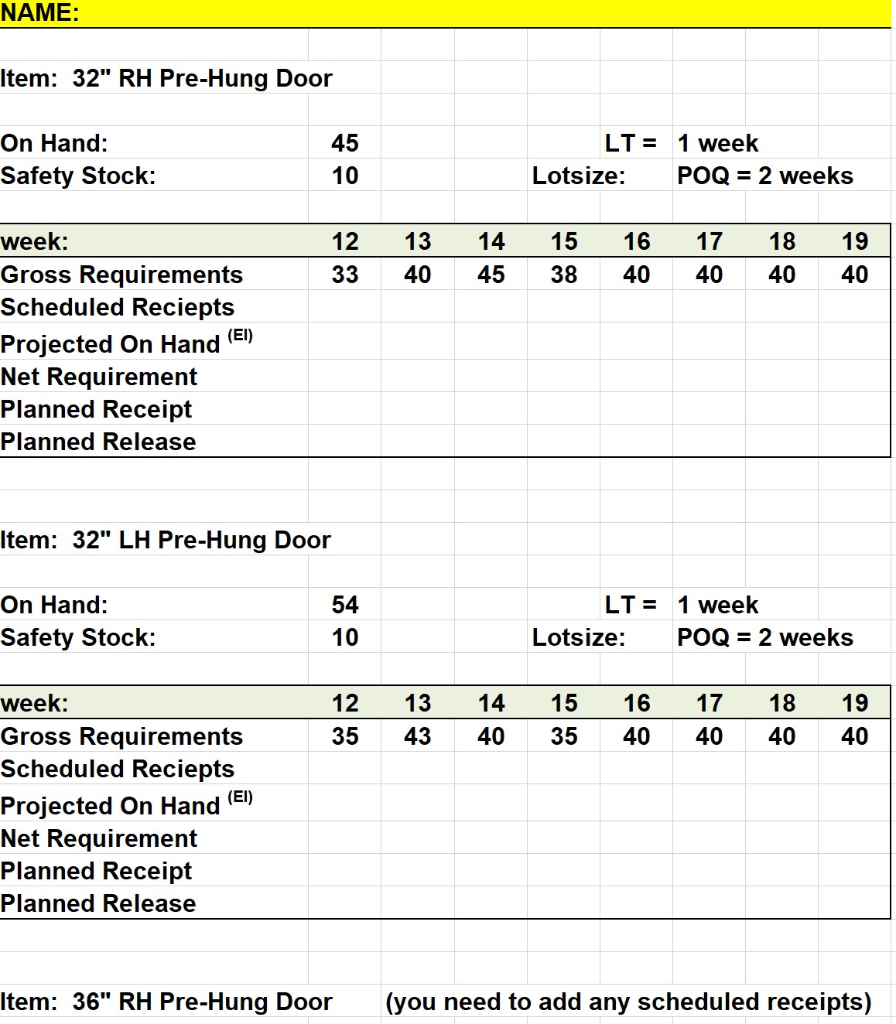
Step by Step Solution
There are 3 Steps involved in it

Get step-by-step solutions from verified subject matter experts
 Study Help