







Question: Read Timing is Everything: The Optimal Time To Learn From Crises and answer the following questions: What was new or surprised you? What you agree
Read Timing is Everything: The Optimal Time To Learn From Crises and answer the following questions:
What was new or surprised you?
What you agree or disagree?
What in your own experience corresponds to what you read?
What was the main 'takeaway'?
Should your peers read it or not? Why or why not?
 pg1
pg1
 pg2
pg2
 pg3
pg3
 pg4
pg4
 pg5
pg5
 pg6
pg6
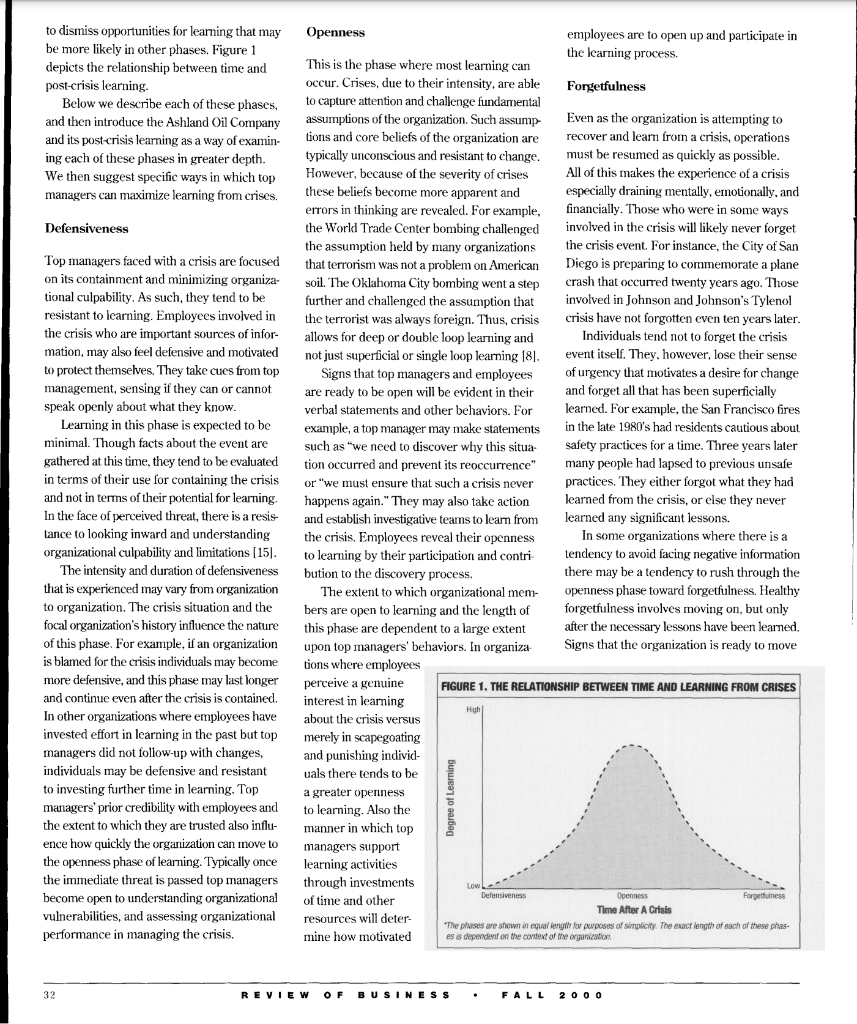
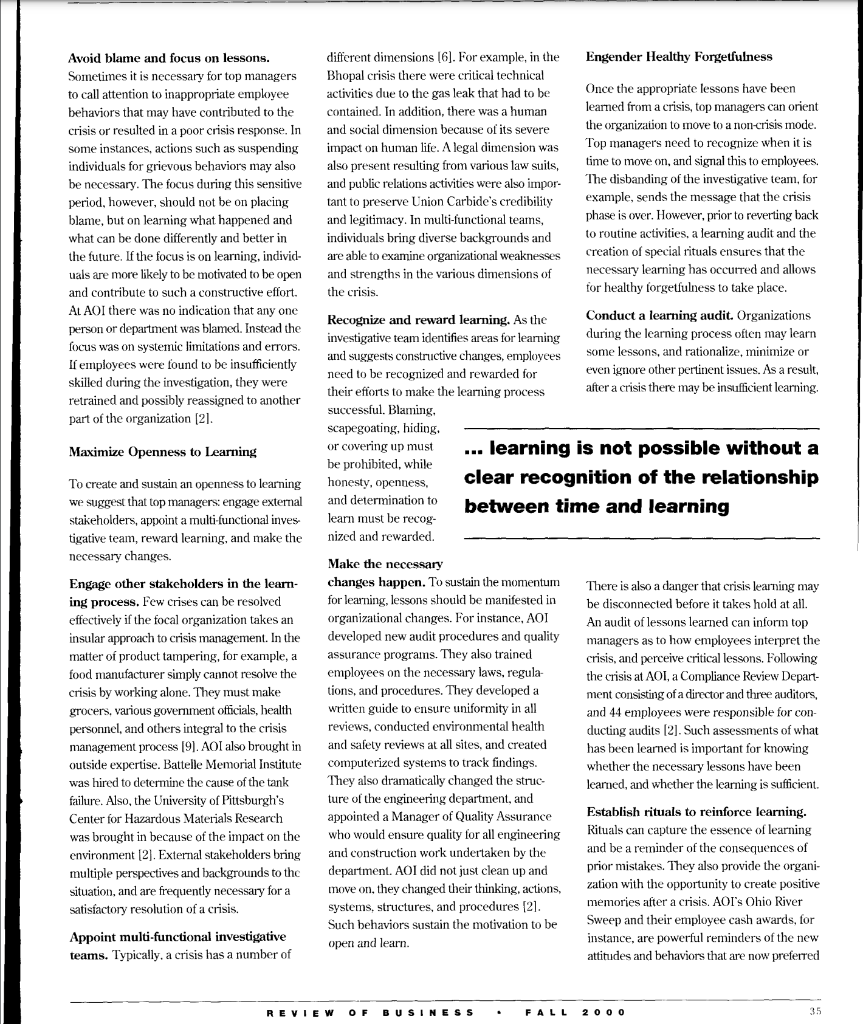
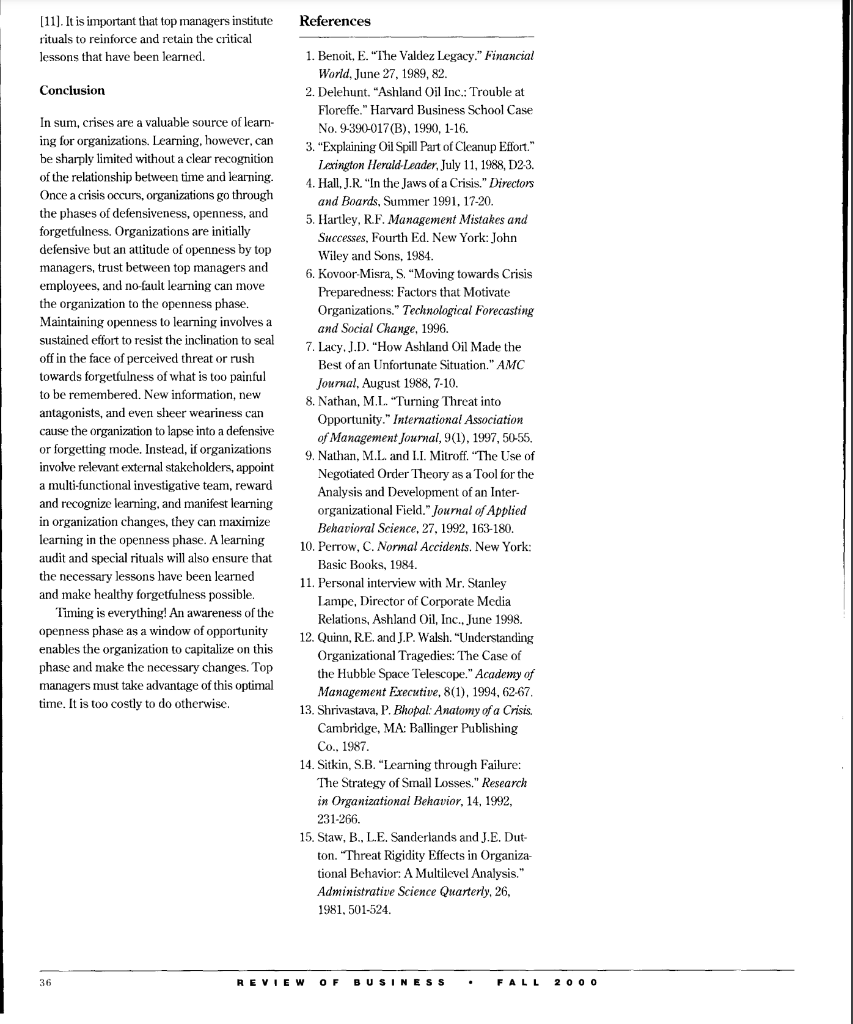
Timing Is Everything: The Optimal Time To Learn from Crises Sarah Kovoor-Misra, College of Business, University of Colorado at Denver Maria Nathan, School of Business and Economics, Lynchburg College in Virginia Crises are important opportunities for learn- Introduction are defensive, and learn little from it [14]. ness, then openness to leaming, and finally allegations as experienced by Mitsubishi, and and problems in communication. These were forgetfulness.Duringtheopennessphasenumerousdot.comcompaniesthatquicklyeconomicfailuressuchasthedemiseofbyexpertsafterthedisaster[12].Thegasleakonlythreeofthe42faultsthatwerediscovered most learning can occur. We use the case rose to prominence and then failed. Such in the Union Carbide plant in Bhopal, India, of Ashland Oil Company's Pittsburgh Oil crises have the potential to exact severe also highlighted problems in training, low Spilltodescribethesethreephasesandtohuman,economic,andreputationalcostsforworkermorale,andpoorcoordinationbetween suggeststrategiesthattopmanagerscantheycanpreventfutureoccurrenceifpossible,ofxon,theCoastGuard,andtheAlyeskathatorganizationslearnfromcrisessothattheExxonValdezOilSpilltheinadequacies use to optimize post-crisis learning. or at least manage them more effectively if Consortium in containing large oil spills were they do occur. Organizations simply cannot also revealed. In other cases organizational afford to do otherwise. strengths may be revealed. In the Johnson Crises create a critical period of learning and Johnson's Tylenol Tampering crisis, for readiness in organizations. Stakeholders both instance, the organization's good crisis coninside and outside the organization are aware tainment capabilities were highlighted, and that something must be done and motivated they became the benchmark for other orgato make changes. However, this does not nizations to imitate [5]. necessarily mean that organizations do learn Crises, thus, can be a valuable source of from crises. Sometimes they learn the wrong information and a motivator for change [6]. things as in superstitious learning. Sometimes However, an understanding of the crisis they learn nothing. For example, after a major management process is critical. We suggest crisis involving the explosion of a dam, one that there is a time-sensitive window of organization's official was asked "What have opportunity within which most learning is you learned?" to which he replied, "Nothing. possible. We propose that organizations go There was no lesson" [10]. Lack of learning through three successive post-crisis learning from a crisis is often attributed to the intense phases: defensiveness, openness, and then emotional responses that are evoked. The forgetfulness. It is in the openness phase that assumption is that top managers become too most learning can occur. To focus only on rigid when faced with the threat of a crisis, the threat rigidity effects of a crisis would be to dismiss opportunities for learning that may Openness employees are to open up and participate in be more likely in other phases. Figure 1 the learning process. depicts the relationship between time and This is the phase where most learning can post-crisis learning. occur. Crises, due to their intensity, are able Forgetfulness Below we describe each of these phases, to capture attention and challenge fundamental and then introduce the Ashland Oil Company assumptions of the organization. Such assump- Even as the organization is attempting to and its post-crisis learning as a way of examin- tions and core beliefs of the organization are recover and leam from a crisis, operations ing each of these phases in greater depth. typically unconscious and resistant to change. must be resumed as quickly as possible. We then suggest specific ways in which top However, because of the severity of crises All of this makes the experience of a crisis managers can maximize learning from crises. these beliefs become more apparent and especially draining mentally, emotionally, and errors in thinking are revealed. For example, financially. Those who were in some ways Defensiveness the World Trade Center bombing challenged involved in the crisis will likely never forget the assumption held by many organizations the crisis event. For instance, the City of San Top managers faced with a crisis are focused that terrorism was not a problem on American Diego is preparing to commemorate a plane on its containment and minimizing organiza- soil. The Oklahoma City bombing went a step crash that occurred twenty years ago. Those tional culpability. As such, they tend to be further and challenged the assumption that involved in Johnson and Johnson's Tylenol resistant to learning. Employees involved in the terrorist was always foreign. Thus, crisis crisis have not forgotten even ten years later. the crisis who are important sources of infor- allows for deep or double loop learning and Individuals tend not to forget the crisis mation, may also feel defensive and motivated not just superficial or single loop learning [8]. event itself. They, however, lose their sense to protect themselves. They take cues from top Signs that top managers and employees of urgency that motivates a desire for change management, sensing if they can or cannot_are ready to be open will be evident in their and forget all that has been superficially speak openly about what they know. verbal statements and other behaviors. For learned. For example, the San Francisco fires Learning in this phase is expected to be example, a top manager may make statements in the late 1980's had residents cautious about minimal. Though facts about the event are such as "we need to discover why this situa- safety practices for a time. Three years later gathered at this time, they tend to be evaluated tion occurred and prevent its reoccurrence" many people had lapsed to previous unsafe in terms of their use for containing the crisis or "we must ensure that such a crisis never practices. They either forgot what they had and not in terms of their potential for learning. happens again." They may also take action learned from the crisis, or else they never In the face of perceived threat, there is a resis- and establish investigative teams to leam from learned any significant lessons. tance to looking inward and understanding the crisis. Employees reveal their openness In some organizations where there is a organizational culpability and limitations [15]. to learning by their participation and contri- tendency to avoid facing negative information The intensity and duration of defensiveness bution to the discovery process. there may be a tendency to rush through the that is experienced may vary from organization The extent to which organizational mem- openness phase toward forgetfulness. Healthy to organization. The crisis situation and the bers are open to learning and the length of forgetfulness involves moving on, but only focal organization's history influence the nature this phase are dependent to a large extent after the necessary lessons have been learned. of this phase. For example, if an organization upon top managers' behaviors. In organiza- Signs that the organization is ready to move is blamed for the crisis individuals may become tions where employees more defensive, and this phase may last longer perceive a genuine and continue even after the crisis is contained. interest in learning In other organizations where employees have about the crisis versus invested effort in learning in the past but top merely in scapegoating managers did not follow-up with changes, and punishing individindividuals may be defensive and resistant uals there tends to be to investing further time in learning. Top a greater openness managers' prior credibility with employees and to learning. Also the the extent to which they are trusted also influ- manner in which top ence how quickly the organization can move to managers support the openness phase of learning. Typically once learning activities the immediate threat is passed top managers through investments become open to understanding organizational of time and other vulnerabilities, and assessing organizational resources will deterperformance in managing the crisis. mine how motivated 32 REVIEW OF BUSINESS. FALL 2000 as well as an inability to establish consistent although the proseculor sought to obtain and crisis teams took a decisive stand to standards [2]. Hall responded by conceding double the damages (\$8 million) allowed by remain open to learning. They themselves that the company had made mistakes. His the Clean Water Act, the judge levied a much took on the task of reducing defensiveness, openness, a highly atypical corporate response lower fine of $2.25 million against AOI[2]. maximizing openness to learning, and allowto a crisis, won the organization good marks This was because AOI had done everything ing for healthy forgetfulness to occur. In the with the news people and the public. For that it could to make restitution and correct next section we discuss some strategies that the situation. top managers could use to effectively manage The the phases of learning. However unique the event in the Forgetfulness Organization's history, crisis usually Once the crisis abated Minimize Defensiveness uncovers Iimitations that have been and the organization Defensiveness inhibits openness and neganeglected or unnoticed.... their routine business is gathered. To reduce the intensity and activities, AOI moved duration of the defensiveness phase, we to the forgetfulness suggest that top managers lead by example, phase. However, when establish a climate of trust, avoid blame, and example, WTAE television news director Joe Rovitto, said, "They were more forthcoming asked what is remembered 10 years after the focus on the lessons to be found in the crisis. than many companies have been" [3]. oil spill, one manager observed that many Lopad by example. Top managers need to AOI also conducted a terminal by terminal employees still have vivid recollections of the crisis. Even those who weren't with the exemplify what it means to be open, John Hall study, and dismantled tanks that did not the crisis. Even those who werent with the and his associates, for instance, went immedimeasure up to specifications. They formed a organization at the ime remember the crisis ately to the crisis site and started work. They Compliance Review Department that reported vicariously. Ihe memory is accompanied by apologized for the organization's role in the to the assistant vice president and general feelings of cmbarrassment for the mistakes crisis and made restitution. During a crisis counsel. The responsibility of the group was to and problens at AO1 that permitted the event there is confusion, and employees look to learn what could be done so that the situation to procedures that were put in place as a result of top managers specifically to understand how would never be repeated. Numerous structural the crisis signify the learning that has occurred. they should behave. changes were made including a change in the AOI has also instituted rituals as a reminder Build trust. For employees to move from the structure of the Engineering Department. Beyond the structural changes were profound of the lessons learned. It commemorates the defensiveness to openness they also need to cultural changes. Employees had to rethink event with constructive measures to show the feel that they can trust top management. It is, the way they conducted business. community that they care about the environ- therefore, critical that top managers actively As John Hall expressed it, "I think the ment, and that they have changed. Every build trust. Their ability to build trust during oil industry is on a learning curve about the third Saturday in June, they have an Ohio a crisis, however, is constrained by the extent environment. A lot of things that we did 20 River Sweep that attracts as many as 22,0000 to which they were trusted prior to the crisis. or 30 years ago that met all of the rules and volunteers who clean up over 2,100 miles of Ashland Oil was a cradle to grave type of were standard practice we now know create shoreline. Also, every year around the time employer, meaning employees had long problems for society" [1]. When asked what of the crisis (first week in January), 15 cash tenures there. There was mutual trust among lessons AOI learned from the crisis, Hall_awards are given to those employees who top management and employees [2]. The responded that the biggest lesson was the contributed that year to the organization's employees were known to feel comfortable experience itself. As a result of the crisis, AOI environmental consciousness [11]. Positive sharing the results of their mistakes, and this developed what they referred to as a crisis measures such as these allow those involved may be why examiners were able to uncover management "recipe." This recipe included: to engage in healthy forgetfulness and retain the mistakes and problems so rapidly. The visit the crisis site early, obtain firsthand_ what was learned. advantage in rapidly diminishing the defensiveinformation, contact political officials and other ness phase is that there is then more time durthird parties, offer restitution, meet the press, Strategies for Effective Crisis Learning ing which learning can occur. Defensiveness and become personally involved [4]. Top managers play a critical role in determin- can affect the quality of information gathered Because the Governor's Tank Collapse ing the extent to which their organizations and thwart learning. For employees to move Task Force found much more than a tank with- will learn from a crisis. As we saw in the case from defensiveness to openness they need to out a permit, the case was then pursued in the of Ashland Oil, John Hall and his executive feel that they can trust top management. It is Commonwealth of Pennsylvania. However. critical that top managers strive to build trust. Avoid blame and focus on lessons. different dimensions [6]. For example, in the Engender Healthy Forgetfulness Sometimes it is necessary for top managers Bhopal crisis there were critical technical to call attention to inappropriate employee activities due to the gas leak that had to be Once the appropriate lessons have been behaviors that may have contributed to the contained. In addition, there was a human learned from a crisis, top managers can orient crisis or resulted in a poor crisis response. In and social dimension because of its severe the organizaion to move to a non-crisis mode. some instances, actions such as suspending impact on human life. A legal dimension was Top managers need to recognize when it is individuals for grievous behaviors may also also present resulting from various law suits, time to move on, and signal this to employees. be necessary. The focus during this sensitive and public relations activities were also impor- The disbanding of the investigative team, for period, however, should not be on placing tant to preserve Lnion Carbide's credibility example, sends the message that the crisis blame, but on learning what happened and and legitimacy. In multi-functional teams, phase is over. However, prior to reverting back what can be done differently and better in individuals bring diverse backgrounds and to routine activities, a learning audit and the the future. If the focus is on learning, individ- are able to examine organizational weaknesses creation of special rituals ensures that the uals are more likely to be motivated to be open and strengths in the various dimensions of necessary learning has occurred and allows and contribute to such a constructive effort. the crisis. for healthy forgetfulness to take place. At AOI there was no indication that any one Recognize and reward learning. As the Conduct a learning audit. Organizations person or department was blamed. Instead the investigative team identifies areas for learning during the learning process often may learn focus was on systemic limitations and errors. and suggests constructive changes, employees some lessons, and rationalize, minimize or If employees were found to be insufficiently need to be recognized and rewarded for even ignore other pertinent issues. As a result, skilled during the investigation, they were their efiorts to make the learning process after a crisis there may be insufficient learning. retrained and possibly reassigned to another their eforts successful. Blaming, part of the organization [2]. scapegoating, hiding. MaximizeOpennesstoLearningbeprohibited,whileorcoveringupmust...Iearningisnotpossiblewithoutaclearrecognitionoftherelationship we suggest that top managers: engage external and determination to bebween time and learning stakeholders, appoint a multi-functional inves. learn must be recog- tigative team, reward learning, and make the nized and rewarded. necessary changes. Make the necessary Engage other stakeholders in the learn- changes happen. To sustain the momentum There is also a danger that crisis learning may ing process. Few crises can be resolved for learning, lessons should be manifested in be disconnected before it takes hold at all. effectively if the focal organization takes an organizational changes. For instance, AOI An audit of lessons learned can inform top insular approach to crisis management. In the developed new audit procedures and quality managers as to how employees interpret the matter of product tampering, for example, a assurance programs. They also trained crisis, and perceive critical lessons. Following food manufacturer simply cannot resolve the employees on the necessary laws, regula- the crisis at AOI, a Compliance Review Departcrisis by working alone. They must make tions, and procedures. They developed a ment consisting of a director and three auditors, grocers, various government officials, health written guide to ensure uniformity in all and 44 employees were responsible for conpersonnel, and others integral to the crisis reviews, conducted environmental health ducting audits [2]. Such assessments of what management process [9]. AOI also brought in and safety reviews at all sites, and created has been learned is important for knowing outside expertise. Battelle Memorial Institute computerized systems to track findings. whether the necessary lessons have been was hired to determine the cause of the tank They also dramatically changed the struc- learned, and whether the learning is sufficient. failure. Also, the University of Pittsburgh's ture of the engineering department, and Center for Hazardous Materials Research appointed a Manager of Quality Assurance Establish rituals to reinforce learning. was brought in because of the impact on the who would ensure quality for all engineering Rituals can capture the essence of learning environment [2]. External stakeholders bring and construction work undertaken by the and be a reminder of the consequences of multiple perspectives and backgrounds to the department. AOI did not just clean up and prior mistakes. They also provide the organisituation, and are frequently necessary for a move on, they changed their thinking, actions, zation with the opportunity to create positive satisfactory resolution of a crisis. systems, structures, and procedures [2]. memories after a crisis. AOI's Ohio River Such behaviors sustain the motivation to be Sweep and their employee cash awards, for Appoint multi-functional investigative open and learn. instance, are powerful reminders of the new teams. Typically, a crisis has a number of attitudes and behaviors that are now preferred rituals to reinforce and retain the critical lessons that have been learned. 1. Benoit, E. "The Valdez Legacy." Financial World, June 27, 1989, 82. Conclusion 2. Delehunt. "Ashland Oil Inc.: Trouble at Floreffe." Harvard Business School Case In sum, crises are a valuable source of learnNo. 9-390-017(B), 1990, 1-16. ing for organizations. Learning, however, can 3. "Explaining Oil Spill Part of Cleanup Effort." be sharply limited without a clear recognition Lexington Herald-Leader, July 11, 1988, D23. of the relationship between time and learning. 4. Hall, J.R. "In the Jaws of a Crisis," Directors Once a crisis occurs, organizations go through and Boards, Summer 1991, 17-20. the phases of defensiveness, openness, and 5. Hartley, R.F. Management Mistakes and forgetfulness. Organizations are initially Successes, Fourth Ed. New York: John defensive but an attitude of openness by top Wiley and Sons, 1984. managers, trust between top managers and 6. Kovoor-Misra, S. "Moving towards Crisis employees, and no-fault learning can move Preparedness: Factors that Motivate the organization to the openness phase. Organizations." Technological Forecasting Maintaining openness to learning involves a and Social Change, 1996. sustained effort to resist the inclination to seal 7. Lacy, J.D. "How Ashland Oil Made the off in the face of perceived threat or rush Best of an Unfortunate Situation." AMC towards forgetfulness of what is too painful Journal, August 1988, 7-10. to be remembered. New information, new 8. Nathan, M.I. "Turning Threat into antagonists, and even sheer weariness can Opportunity." International Association cause the organization to lapse into a defensive of Management Journal, 9(1),1997,5055. or forgetting mode. Instead, if organizations 9. Nathan, M.L. and I.I. Mitroff. "The Use of involve relevant external stakeholders, appoint Negotiated Order Theory as a Tool for the a multi-functional investigative team, reward Analysis and Development of an Interand recognize learning, and manifest learning organizational Field." Journal of Applied in organization changes, they can maximize Behavioral Science, 27, 1992, 163-180. learning in the openness phase. A learning 10. Perrow, C. Normal Accidents. New York: audit and special rituals will also ensure that Basic Books, 1984. the necessary lessons have been learned 11. Personal interview with Mr. Stanley and make healthy forgetfulness possible. Lampe, Director of Corporate Media Timing is everything! An awareness of the Relations, Ashland Oil, Inc.. June 1998. openness phase as a window of opportunity 12. Quinn, R.E. and J.P. Walsh. "Understanding enables the organization to capitalize on this Organizational Tragedies: The Case of phase and make the necessary changes. Top the Hubble Space Telescope." Academy of managers must take advantage of this optimal Management Executive, 8(1), 1994, 62-67. time. It is too costly to do otherwise. 13. Shrivastava, P. Bhopal: Anatomy of a Crisis. Cambridge, MA: Ballinger Publishing Co., 1987. 14. Sitkin, S.B. "Learning through Failure: The Strategy of Small Losses," Research in Organizational Behavior, 14, 1992, 231-266. 15. Staw, B., L.E. Sanderlands and J.E. Dutton. "Threat Rigidity Effects in Organizational Behavior: A Multilevel Analysis," Administrative Science Quarterly, 26 , 1981,501524
Step by Step Solution
There are 3 Steps involved in it

Get step-by-step solutions from verified subject matter experts
 Study Help