







Question: READING AND ANALYZING make personal connections between what you learned from the reading and how it manifests in real life. How would you use what
READING AND ANALYZING
make personal connections between what you learned from the reading and how it manifests in real life. How would you use what you learned in your area of professional interest (marketing...etc.)? avoidparaphrasing or summarizing. Use a reflective writing style with the first singular pronounce "I".
put the answer in copy paste format for easy modification.
thank you
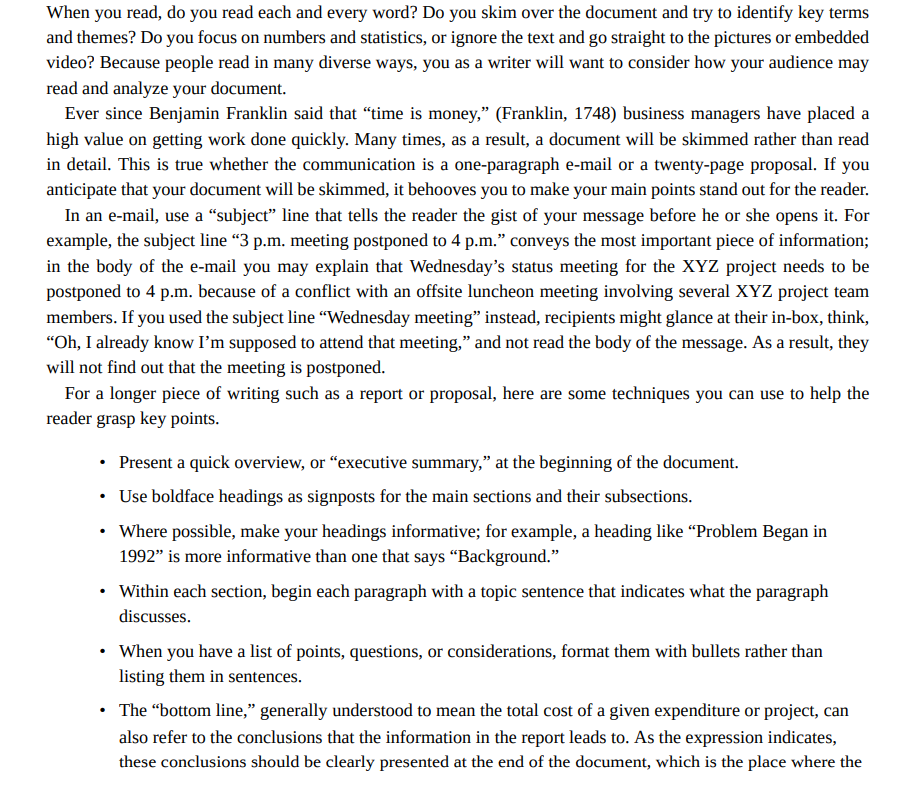
When you read, do you read each and every word? Do you skim over the document and try to identify key terms and themes? Do you focus on numbers and statistics, or ignore the text and go straight to the pictures or embedded video? Because people read in many diverse ways, you as a writer will want to consider how your audience may read and analyze your document. Ever since Benjamin Franklin said that "time is money," (Franklin, 1748) business managers have placed a high value on getting work done quickly. Many times, as a result, a document will be skimmed rather than read in detail. This is true whether the communication is a one-paragraph e-mail or a twenty-page proposal. If you anticipate that your document will be skimmed, it behooves you to make your main points stand out for the reader. In an e-mail, use a "subject" line that tells the reader the gist of your message before he or she opens it. For example, the subject line " 3 p.m. meeting postponed to 4 p.m." conveys the most important piece of information; in the body of the e-mail you may explain that Wednesday's status meeting for the XYZ project needs to be postponed to 4 p.m. because of a conflict with an offsite luncheon meeting involving several XYZ project team members. If you used the subject line "Wednesday meeting" instead, recipients might glance at their in-box, think, "Oh, I already know I'm supposed to attend that meeting," and not read the body of the message. As a result, they will not find out that the meeting is postponed. For a longer piece of writing such as a report or proposal, here are some techniques you can use to help the reader grasp key points. - Present a quick overview, or "executive summary," at the beginning of the document. - Use boldface headings as signposts for the main sections and their subsections. - Where possible, make your headings informative; for example, a heading like "Problem Began in 1992" is more informative than one that says "Background. - Within each section, begin each paragraph with a topic sentence that indicates what the paragraph discusses. - When you have a list of points, questions, or considerations, format them with bullets rather than listing them in sentences. - The "bottom line," generally understood to mean the total cost of a given expenditure or project, can also refer to the conclusions that the information in the report leads to. As the expression indicates, these conclusions should be clearly presented at the end of the document, which is the place where theStep by Step Solution
There are 3 Steps involved in it
1 Expert Approved Answer
Step: 1 Unlock

Question Has Been Solved by an Expert!
Get step-by-step solutions from verified subject matter experts
Step: 2 Unlock
Step: 3 Unlock
 Study Help