







Question: Real Estate Compared to Bonds - Simplified Examples You have a $1000 to invest with a 10-year horizon and are comparing investing in a
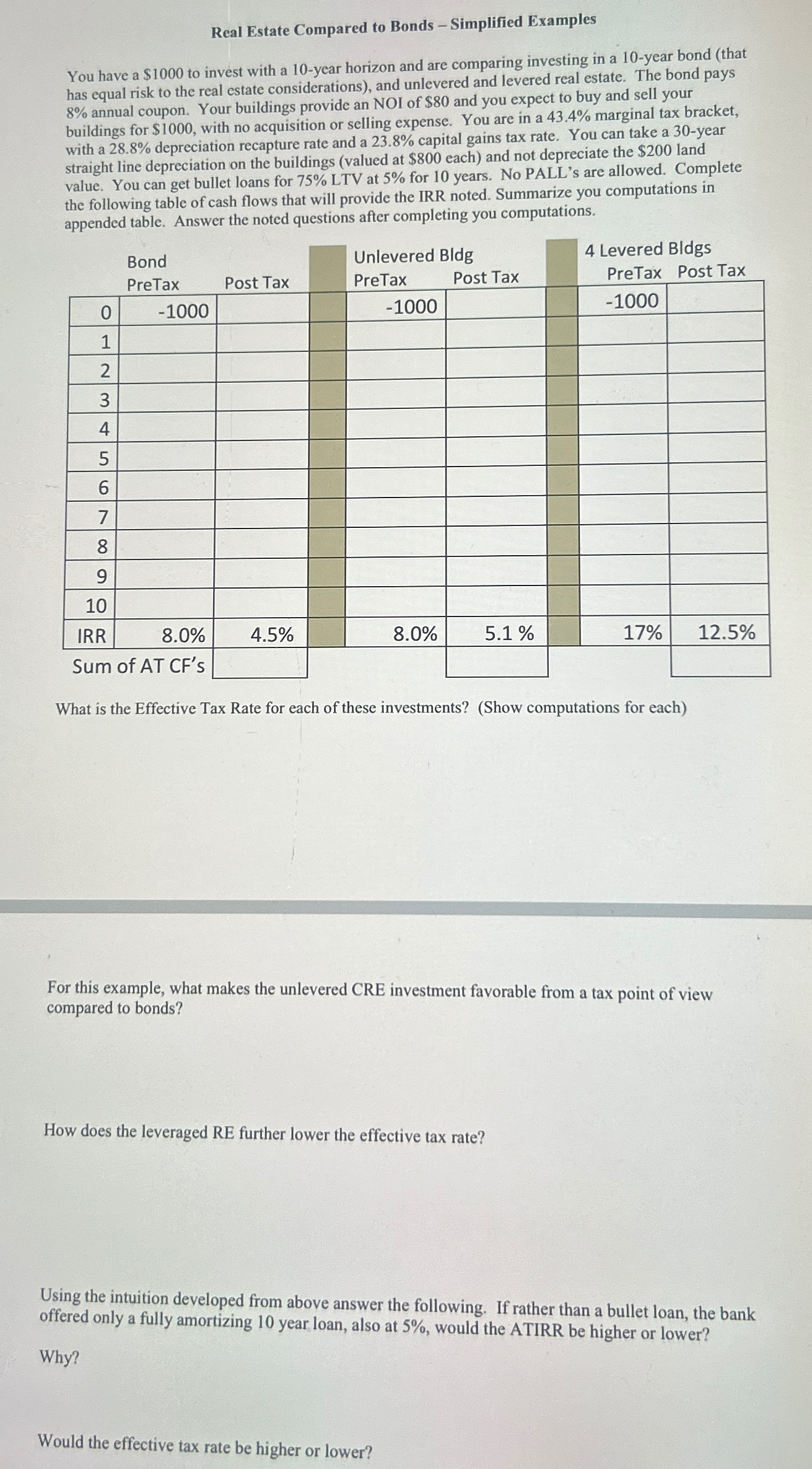
Real Estate Compared to Bonds - Simplified Examples You have a $1000 to invest with a 10-year horizon and are comparing investing in a 10-year bond (that has equal risk to the real estate considerations), and unlevered and levered real estate. The bond pays 8% annual coupon. Your buildings provide an NOI of $80 and you expect to buy and sell your buildings for $1000, with no acquisition or selling expense. You are in a 43.4% marginal tax bracket, with a 28.8% depreciation recapture rate and a 23.8% capital gains tax rate. You can take a 30-year straight line depreciation on the buildings (valued at $800 each) and not depreciate the $200 land value. You can get bullet loans for 75% LTV at 5% for 10 years. No PALL's are allowed. Complete the following table of cash flows that will provide the IRR noted. Summarize you computations in appended table. Answer the noted questions after completing you computations. Bond PreTax Unlevered Bldg 4 Levered Bldgs Post Tax PreTax Post Tax 0 -1000 -1000 PreTax Post Tax -1000 1 2 3 4 5 6 7 8 9 10 IRR 8.0% 4.5% 8.0% 5.1% 17% 12.5% Sum of AT CF's What is the Effective Tax Rate for each of these investments? (Show computations for each) For this example, what makes the unlevered CRE investment favorable from a tax point of view compared to bonds? How does the leveraged RE further lower the effective tax rate? Using the intuition developed from above answer the following. If rather than a bullet loan, the bank offered only a fully amortizing 10 year loan, also at 5%, would the ATIRR be higher or lower? Why? Would the effective tax rate be higher or lower?
Step by Step Solution
There are 3 Steps involved in it

Get step-by-step solutions from verified subject matter experts
 Study Help