







Question: RECALL THE FOLLOWING QUESTION FROM ASSIGNMENT #1: An exponentially distributed random variable, call it X, has the following probability density function: f(x) ex, o. Note
RECALL THE FOLLOWING QUESTION FROM ASSIGNMENT #1: An exponentially distributed random variable, call it X, has the following probability density function: f(x) ex, o. Note that EX- and VX] = 1. For the rest of this question, assume that you have a data set {X"}N1 consisting of a random sample of N observations of X (a) In the previous assignment you derived the Maximum Likelihood (ML) estimator for the distribution parameter. Recall that you found that it was Is the ML estimator for ? consistent? If so, explain why: if not, explain why not HINT What 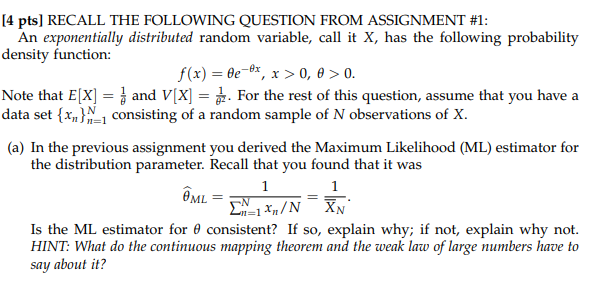
[4 pts] RECALL THE FOLLOWING QUESTION FROM ASSIGNMENT #1: density function: An exponentially distributed random variable, call it X, has the following probability f(x) = 0e ex ", x > 0, 0 > 0. Note that E X] = - and V[X] = a. For the rest of this question, assume that you have a data set {x, }_, consisting of a random sample of N observations of X. (a) In the previous assignment you derived the Maximum Likelihood (ML) estimator for the distribution parameter. Recall that you found that it was H OML = En=1XH / N XN Is the ML estimator for 0 consistent? If so, explain why; if not, explain why not. HINT: What do the continuous mapping theorem and the weak law of large numbers have to say about it
Step by Step Solution
There are 3 Steps involved in it

Get step-by-step solutions from verified subject matter experts
 Study Help