







Question: Recall the ideas explored in Homework Problems - I and its solution. In Problem 8 ( Homework Problems - I ) , we recognized the
Recall the ideas explored in Homework ProblemsI and its solution.
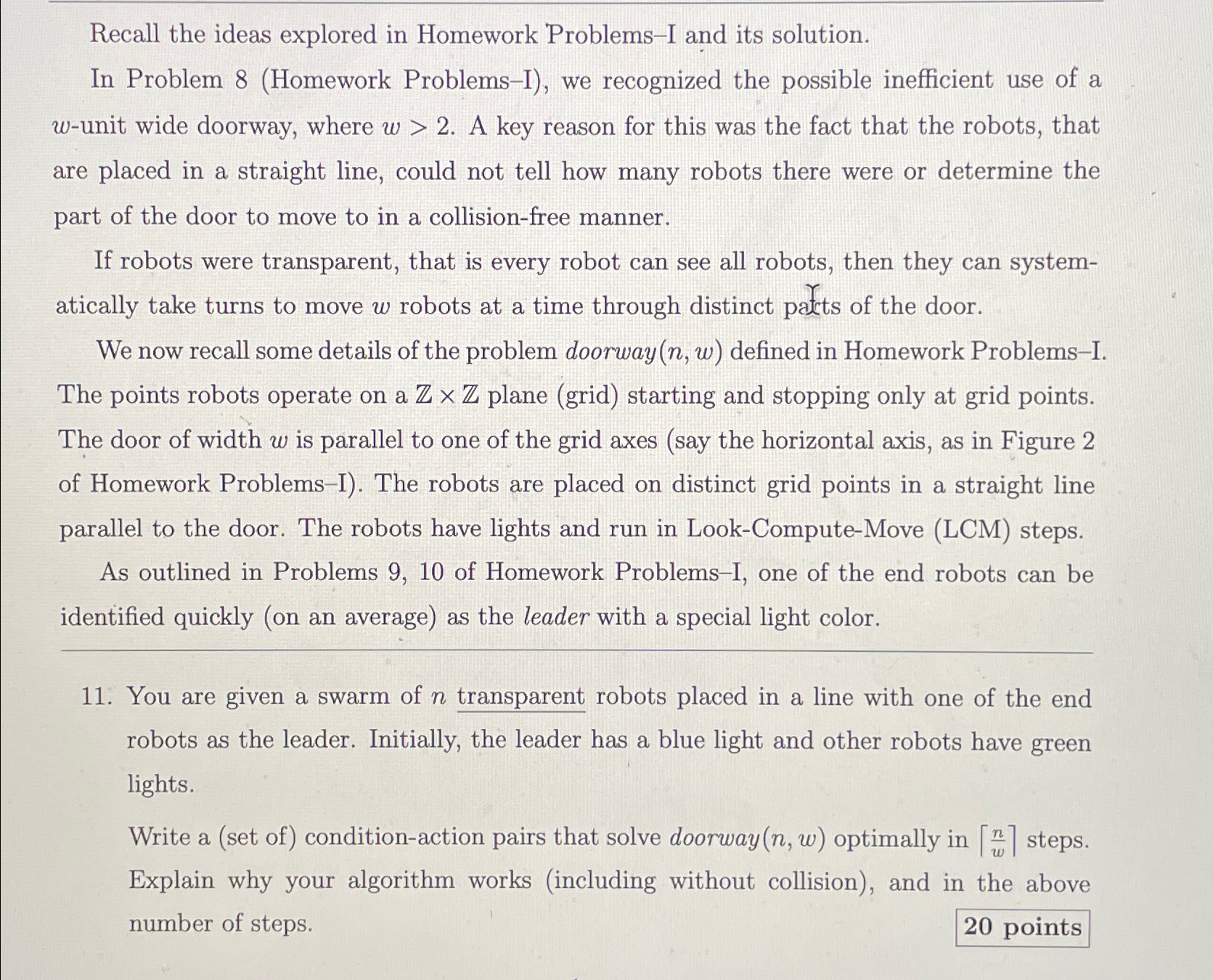
In Problem Homework ProblemsI we recognized the possible inefficient use of a unit wide doorway, where A key reason for this was the fact that the robots, that are placed in a straight line, could not tell how many robots there were or determine the part of the door to move to in a collisionfree manner.
If robots were transparent, that is every robot can see all robots, then they can systematically take turns to move robots at a time through distinct parts of the door.
We now recall some details of the problem doorway defined in Homework ProblemsI. The points robots operate on a plane grid starting and stopping only at grid points. The door of width is parallel to one of the grid axes say the horizontal axis, as in Figure of Homework ProblemsI The robots are placed on distinct grid points in a straight line parallel to the door. The robots have lights and run in LookComputeMove LCM steps.
As outlined in Problems of Homework ProblemsI, one of the end robots can be identified quickly on an average as the leader with a special light color.
You are given a swarm of transparent robots placed in a line with one of the end robots as the leader. Initially, the leader has a blue light and other robots have green lights.
Write a set of conditionaction pairs that solve optimally in ~~ steps. Explain why your algorithm works including without collision and in the above number of steps.
Step by Step Solution
There are 3 Steps involved in it
1 Expert Approved Answer
Step: 1 Unlock

Question Has Been Solved by an Expert!
Get step-by-step solutions from verified subject matter experts
Step: 2 Unlock
Step: 3 Unlock
 Study Help