







Question: Reccomdation and action plan for the case study above, only 1.5-2.5 pages needed please. (if you zoom in the images becomes clear) It was an
Reccomdation and action plan for the case study above, only 1.5-2.5 pages needed please.
(if you zoom in the images becomes clear)
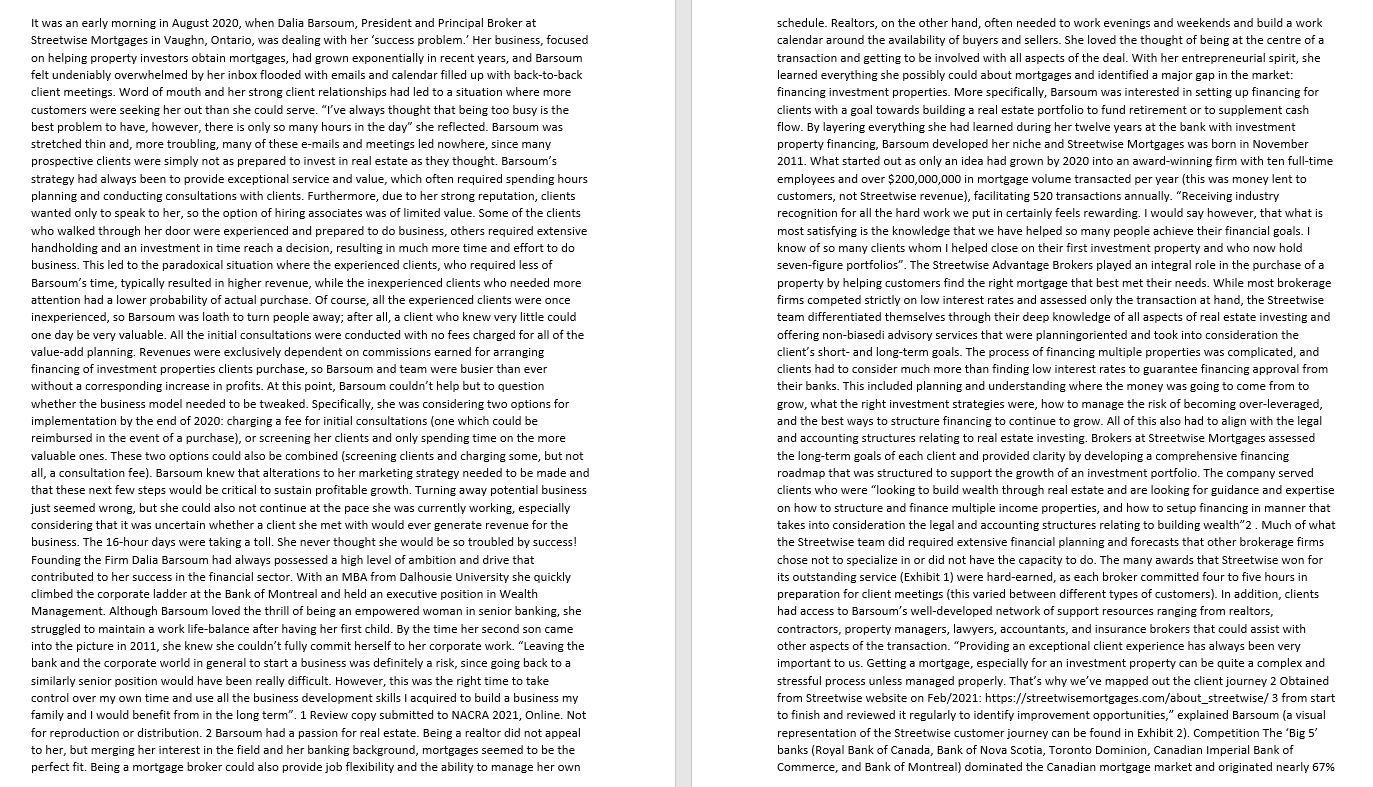
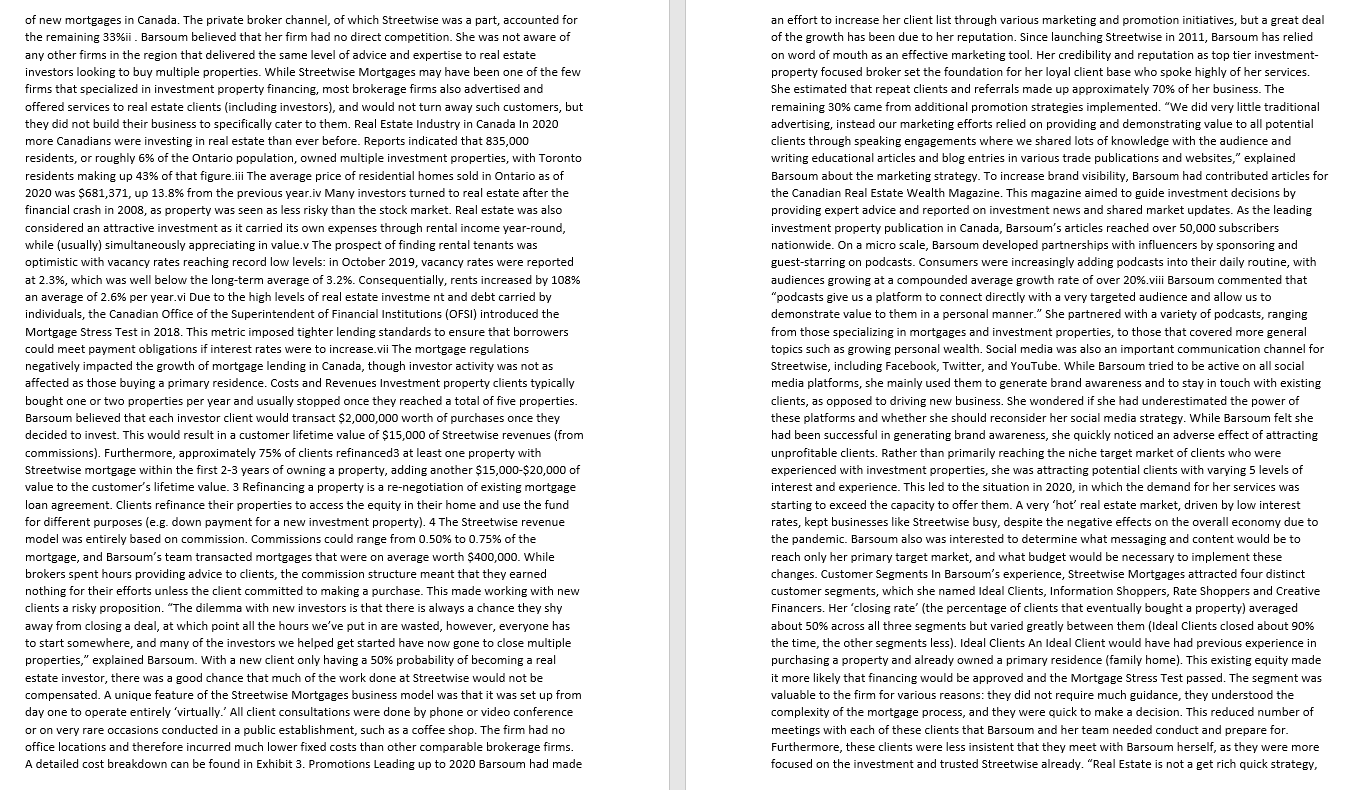
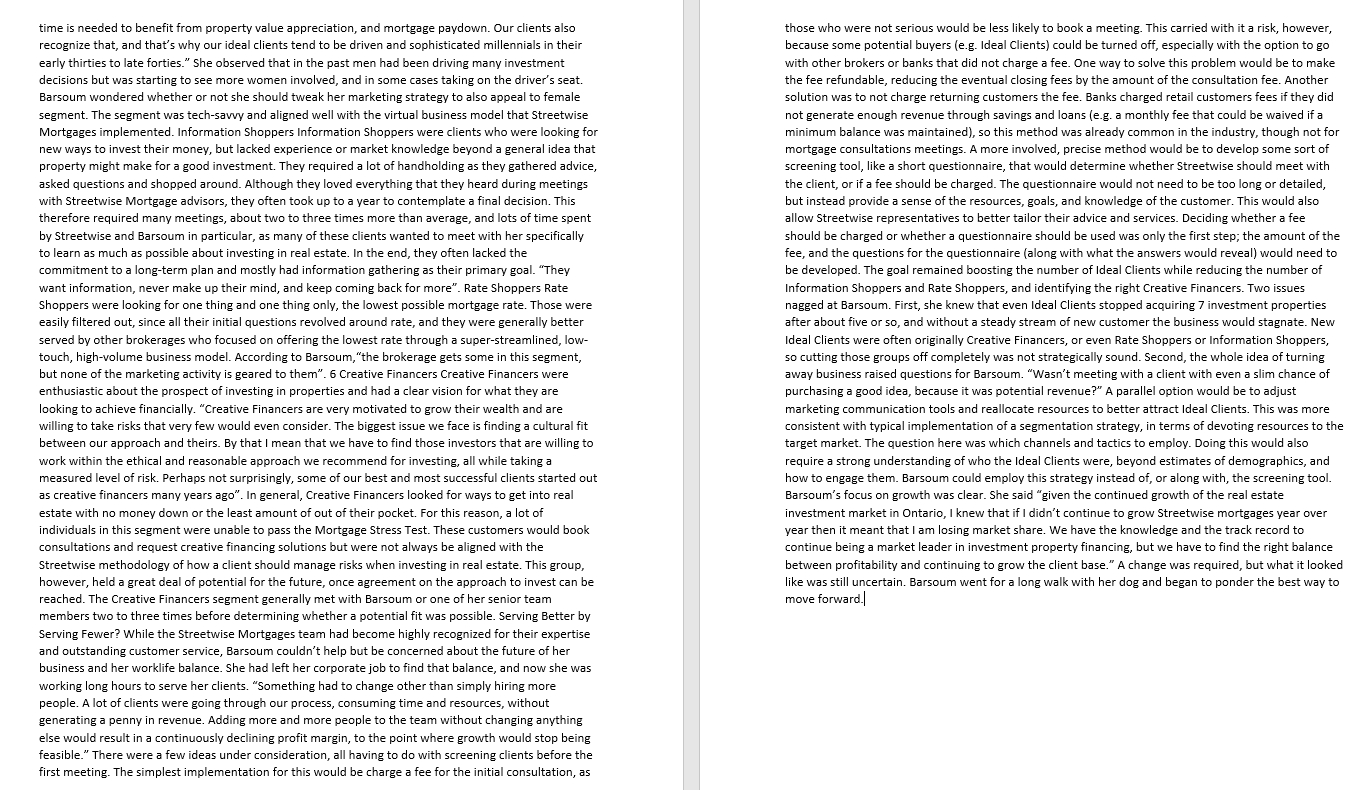
It was an early morning in August 2020, when Dalia Barsoum, President and Principal Broker at Streetwise Mortgages in Vaughn, Ontario, was dealing with her 'success problem.' Her business, focused on helping property investors obtain mortgages, had grown exponentially in recent years, and Barsoum felt undeniably overwhelmed by her inbox flooded with emails and calendar filled up with back-to-back client meetings. Word of mouth and her strong client relationships had led to a situation where more customers were seeking her out than she could serve. "I've always thought that being too busy is the best problem to have, however, there is only so many hours in the day" she reflected. Barsoum was stretched thin and, more troubling, many of these e-mails and meetings led nowhere, since many prospective clients were simply not as prepared to invest in real estate as they thought. Barsoum's strategy had always been to provide exceptional service and value, which often required spending hours planning and conducting consultations with clients. Furthermore, due to her strong reputation, clients wanted only to speak to her, so the option of hiring associates was of limited value. Some of the clients who walked through her door were experienced and prepared to do business, others required extensive handholding and an investment in time reach a decision, resulting in much more time and effort to do business. This led to the paradoxical situation where the experienced clients, who required less of Barsoum's time, typically resulted in higher revenue, while the inexperienced clients who needed more attention had a lower probability of actual purchase. Of course, all the experienced clients were once inexperienced, so Barsoum was loath to turn people away; after all, a client who knew very little could one day be very valuable. All the initial consultations were conducted with no fees charged for all of the value-add planning. Revenues were exclusively dependent on commissions earned for arranging financing of investment properties clients purchase, so Barsoum and team were busier than ever without a corresponding increase in profits. At this point, Barsoum couldn't help but to question whether the business model needed to be tweaked. Specifically, she was considering two options for implementation by the end of 2020: charging a fee for initial consultations (one which could be reimbursed in the event of a purchase), or screening her clients and only spending time on the more valuable ones. These two options could also be combined (screening clients and charging some, but not all, a consultation fee). Barsoum knew that alterations to her marketing strategy needed to be made and that these next few steps would be critical to sustain profitable growth. Turning away potential business just seemed wrong, but she could also not continue at the pace she was currently working, especially considering that it was uncertain whether a client she met with would ever generate revenue for the business. The 16-hour days were taking a toll. She never thought she would be so troubled by success! Founding the Firm Dalia Barsoum had always possessed a high level of ambition and drive that contributed to her success in the financial sector. With an MBA from Dalhousie University she quickly climbed the corporate ladder at the Bank of Montreal and held an executive position in Wealth Management. Although Barsoum loved the thrill of being an empowered woman in senior banking, she struggled to maintain a work life-balance after having her first child. By the time her second son came into the picture in 2011, she knew she couldn't fully commit herself to her corporate work. "Leaving the bank and the corporate world in general to start a business was definitely a risk, since going back to a similarly senior position would have been really difficult. However, this was the right time to take control over my own time and use all the business development skills I acquired to build a business my family and I would benefit from in the long term". 1 Review copy submitted to NACRA 2021, Online. Not for reproduction or distribution. 2 Barsoum had a passion for real estate. Being a realtor did not appeal to her, but merging her interest in the field and her banking background, mortgages seemed to be the perfect fit. Being a mortgage broker could also provide job flexibility and the ability to manage her own schedule. Realtors, on the other hand, often needed to work evenings and weekends and build a work calendar around the availability of buyers and sellers. She loved the thought of being at the centre of a transaction and getting to be involved with all aspects of the deal. With her entrepreneurial spirit, she learned everything she possibly could about mortgages and identified a major gap in the market: financing investment properties. More specifically, Barsoum was interested in setting up financing for clients with a goal towards building a real estate portfolio to fund retirement or to supplement cash flow. By layering everything she had learned during her twelve years at the bank with investment property financing, Barsoum developed her niche and Streetwise Mortgages was born in November 2011. What started out as only an idea had grown by 2020 into an award-winning firm with ten full-time employees and over $200,000,000 in mortgage volume transacted per year (this was money lent to customers, not Streetwise revenue), facilitating 520 transactions annually. "Receiving industry recognition for all the hard work we put in certainly feels rewarding. I would say however, that what is most satisfying is the knowledge that we have helped so many people achieve their financial goals. I know of so many clients whom I helped close on their first investment property and who now hold seven-figure portfolios". The Streetwise Advantage Brokers played an integral role in the purchase of a property by helping customers find the right mortgage that best met their needs. While most brokerage firms competed strictly on low interest rates and assessed only the transaction at hand, the Streetwise team differentiated themselves through their deep knowledge of all aspects of real estate investing and offering non-biasedi advisory services that were planningoriented and took into consideration the client's short- and long-term goals. The process of financing multiple properties was complicated, and clients had to consider much more than finding low interest rates to guarantee financing approval from their banks. This included planning and understanding where the money was going to come from to grow, what the right investment strategies were, how to manage the risk of becoming over-leveraged, and the best ways to structure financing to continue to grow. All of this also had to align with the legal and accounting structures relating to real estate investing. Brokers at Streetwise Mortgages assessed the long-term goals of each client and provided clarity by developing a comprehensive financing roadmap that was structured to support the growth of an investment portfolio. The company served clients who were "looking to build wealth through real estate and are looking for guidance and expertise on how to structure and finance multiple income properties, and how to setup financing in manner that takes into consideration the legal and accounting structures relating to building wealth"2. Much of what the Streetwise team did required extensive financial planning and forecasts that other brokerage firms chose not to specialize in or did not have the capacity to do. The many awards that Streetwise won for its outstanding service (Exhibit 1) were hard-earned, as each broker committed four to five hours in preparation for client meetings (this varied between different types of customers). In addition, clients had access to Barsoum's well-developed network of support resources ranging from realtors, contractors, property managers, lawyers, accountants, and insurance brokers that could assist with other aspects of the transaction. "Providing an exceptional client experience has always been very important to us. Getting a mortgage, especially for an investment property can be quite a complex and stressful process unless managed properly. That's why we've mapped out the client journey Obtained from Streetwise website on Feb/2021: https://streetwisemortgages.com/about_streetwise/ 3 from start to finish and reviewed it regularly to identify improvement opportunities," explained Barsoum (a visual representation of the Streetwise customer journey can be found in Exhibit 2). Competition The 'Big 5' banks (Royal Bank of Canada, Bank of Nova Scotia, Toronto Dominion, Canadian Imperial Bank of Commerce, and Bank of Montreal) dominated the Canadian mortgage market and originated nearly 67% of new mortgages in Canada. The private broker channel, of which Streetwise was a part, accounted for the remaining 33%ii. Barsoum believed that her firm had no direct competition. She was not aware of any other firms in the region that delivered the same level of advice and expertise to real estate investors looking to buy multiple properties. While Streetwise Mortgages may have been one of the few firms that specialized in investment property financing, most brokerage firms also advertised and offered services to real estate clients (including investors), and would not turn away such customers, but they did not build their business to specifically cater to them. Real Estate Industry in Canada In 2020 more Canadians were investing in real estate than ever before. Reports indicated that 835,000 residents, or roughly 6% of the Ontario population, owned multiple investment properties, with Toronto residents making up 43% of that figure.iii The average price of residential homes sold in Ontario as of 2020 was $681,371, up 13.8% from the previous year.iv Many investors turned to real estate after the financial crash in 2008, as property was seen as less risky than the stock market. Real estate was also considered an attractive investment as it carried its own expenses through rental income year-round, while (usually) simultaneously appreciating in value. The prospect of finding rental tenants was optimistic with vacancy rates reaching record low levels: in October 2019, vacancy rates were reported at 2.3%, which was well below the long-term average of 3.2%. Consequentially, rents increased by 108% an average of 2.6% per year.vi Due to the high levels of real estate investment and debt carried by individuals, the Canadian Office of the Superintendent of Financial Institutions (OFSI) introduced the Mortgage Stress Test in 2018. This metric imposed tighter lending standards to ensure that borrowers could meet payment obligations if interest rates were to increase.vii The mortgage regulations negatively impacted the growth of mortgage lending in Canada, though investor activity was not as affected as those buying a primary residence. Costs and Revenues Investment property clients typically bought one or two properties per year and usually stopped once they reached a total of five properties. Barsoum believed that each investor client would transact $2,000,000 worth of purchases once they decided to invest. This would result in a customer lifetime value of $15,000 of Streetwise revenues (from commissions). Furthermore, approximately 75% of clients refinanced3 at least one property with Streetwise mortgage within the first 2-3 years of owning a property, adding another $15,000-$20,000 of value to the customer's lifetime value. 3 Refinancing a property is a re-negotiation of existing mortgage loan agreement. Clients refinance their properties to access the equity their home and use the fund for different purposes (e.g. down payment for a new investment property). 4 The Streetwise revenue model was entirely based on commission. Commissions could range from 0.50% to 0.75% of the mortgage, and Barsoum's team transacted mortgages that were on average worth $400,000. While brokers spent hours providing advice to clients, the commission structure meant that they earned nothing for their efforts unless the client committed to making a purchase. This made working with new clients a risky proposition. "The dilemma with new investors is that there is always a chance they shy away from closing a deal, at which point all the hours we've put in are wasted, however, everyone has to start somewhere, and many of the investors we helped get started have now gone to close multiple properties," explained Barsoum. With a new client only having a 50% probability of becoming a real estate investor, there was a good chance that much of the work done at Streetwise would not be compensated. A unique feature of the Streetwise Mortgages business model was that it was set up from day one to operate entirely 'virtually.' All client consultations were done by phone or video conference or on very rare occasions conducted in a public establishment, such as a coffee shop. The firm had no office locations and therefore incurred much lower fixed costs than other comparable brokerage firms. A detailed cost breakdown can be found in Exhibit 3. Promotions Leading up to 2020 Barsoum had made an effort to increase her client list through various marketing and promotion initiatives, but a great deal of the growth has been due to her reputation. Since launching Streetwise in 2011, Barsoum has relied on word of mouth as an effective marketing tool. Her credibility and reputation as top tier investment- property focused broker set the foundation for her loyal client base who spoke highly of her services. She estimated that repeat clients and referrals made up approximately 70% of her business. The remaining 30% came from additional promotion strategies implemented. "We did very little traditional advertising, instead our marketing efforts relied on providing and demonstrating value to all potential clients through speaking engagements where we shared lots of knowledge with the audience and writing educational articles and blog entries in various trade publications and websites," explained Barsoum about the marketing strategy. To increase brand visibility, Barsoum had contributed articles for the Canadian Real Estate Wealth Magazine. This magazine aimed to guide investment decisions by providing expert advice and reported on investment news and shared market updates. As the leading investment property publication in Canada, Barsoum's articles reached over 50,000 subscribers nationwide. On a micro scale, Barsoum developed partnerships with influencers by sponsoring and guest starring on podcasts. Consumers were increasingly adding podcasts into their daily routine, with audiences growing at a compounded average growth rate of over 20%.viii Barsoum commented that "podcasts give us a platform to connect directly with a very targeted audience and allow us to demonstrate value to them in a personal manner." She partnered with a variety of podcasts, ranging from those specializing in mortgages and investment properties, to those that covered more general topics such as growing personal wealth. Social media was also an important communication channel for Streetwise, including Facebook, Twitter, and YouTube. While Barsoum tried to be active on all social media platforms, mainly used them to generate brand awareness and to stay in touch with existing clients, as opposed to driving new business. She wondered if she had underestimated the power of these platforms and whether she should reconsider her social media strategy. While Barsoum felt she had been successful in generating brand awareness, she quickly noticed an adverse effect of attracting unprofitable clients. Rather than primarily reaching the niche target market of clients who were experienced with investment properties, she was attracting potential clients with varying 5 levels of interest and experience. This led to the situation in 2020, in which the demand for her services was starting to exceed the capacity to offer them. A very 'hot' real estate market, driven by low interest rates, kept businesses like Streetwise busy, despite the negative effects on the overall economy due to the pandemic. Barsoum also was interested to determine what messaging and content would be to reach only her primary target market, and what budget would necessary to implement these changes. Customer Segments in Barsoum's experience, Streetwise Mortgages attracted four distinct customer segments, which she named Ideal Clients, Information Shoppers, Rate Shoppers and Creative Financers. Her 'closing rate (the percentage of clients that eventually bought a property) averaged about 50% across all three segments but varied greatly between them (Ideal Clients closed about 90% the time, the other segments less). Ideal Clients An Ideal Client would have had previous experience in purchasing a property and already owned a primary residence (family home). This existing equity made it more likely that financing would be approved and the Mortgage Stress Test passed. The segment was valuable to the firm for various reasons: they did not require much guidance, they understood the complexity of the mortgage process, and they were quick to make a decision. This reduced number of meetings with each of these clients that Barsoum and her team needed conduct and prepare for. Furthermore, these clients were less insistent that they meet with Barsoum herself, as they were more focused on the investment and trusted Streetwise already. "Real Estate is not a get rich quick strategy, time is needed to benefit from property value appreciation, and mortgage paydown. Our clients also recognize that, and that's why our ideal clients tend to be driven and sophisticated millennials in their early thirties to late forties." She observed that in the past men had been driving many investment decisions but was starting to see more women involved, and in some cases taking on the driver's seat. Barsoum wondered whether or not she should tweak her marketing strategy to also appeal to female segment. The segment was tech-savvy and aligned well with the virtual business model that Streetwise Mortgages implemented. Information Shoppers Information Shoppers were clients who were looking for new ways to invest their money, but lacked experience or market knowledge beyond a general idea that property might make for a good investment. They required a lot of handholding as they gathered advice, asked questions and shopped around. Although they loved everything that they heard during meetings with Streetwise Mortgage advisors, they often took up to a year to contemplate a final decision. This therefore required many meetings, about two to three times more than average, and lots of time spent by Streetwise and Barsoum in particular, as many of these clients wanted to meet with her specifically to learn as much as possible about investing in real estate. In the end, they often lacked the commitment to a long-term plan and mostly had information gathering as their primary goal. "They want information, never make up their mind, and keep coming back for more". Rate Shoppers Rate Shoppers were looking for one thing and one thing only, the lowest possible mortgage rate. Those were easily filtered out, since all their initial questions revolved around rate, and they were generally better served by other brokerages who focused on offering the lowest rate through a super-streamlined, low- touch, high-volume business model. According to Barsoum,"the brokerage gets some in this segment, but none of the marketing activity is geared to them". 6 Creative Financers Creative Financers were enthusiastic about the prospect of investing in properties and had a clear vision for what they are looking to achieve financially. "Creative Financers are very motivated to grow their wealth and are willing to take risks that very few would even consider. The biggest issue we face is finding a cultural fit between our approach and theirs. By that I mean that we have to find those investors that are willing to work within the ethical and reasonable approach we recommend for investing, all while taking a measured level of risk. Perhaps not surprisingly, some of our best and most successful clients started out as creative financers many years ago". In general, Creative Financers looked for ways to get into real estate with no money down or the least amount of out of their pocket. For this reason, a lot of individuals in this segment were unable to pass the Mortgage Stress Test. These customers would book consultations and request creative financing solutions but were not always be aligned with the Streetwise methodology of how a client should manage risks when investing in real estate. This group, however, held a great deal of potential for the future, once agreement on the approach to invest can be reached. The Creative Financers segment generally met with Barsoum or one of her senior team members two to three times before determining whether a potential fit was possible. Serving Better by Serving Fewer? While the Streetwise Mortgages team had become highly recognized for their expertise and outstanding customer service, Barsoum couldn't help but be concerned about the future of her business and her worklife balance. She had left her corporate job to find that balance, and now she was working long hours to serve her clients. "Something had to change other than simply hiring more people. A lot of clients were going through our process, consuming time and resources, without generating a penny in revenue. Adding more and more people to the team without changing anything else would result in a continuously declining profit margin, to the point where growth would stop being feasible." There were few ideas under consideration, all having to do with screening clients before the first meeting. The simplest implementation for this would be charge a fee for the initial consultation, as those who were not serious would be less likely to book a meeting. This carried with it a risk, however, because some potential buyers (e.g. Ideal Clients) could be turned off, especially with the option to go with other brokers or banks that did not charge a fee. One way to solve this problem would be to make the fee refundable, reducing the eventual closing fees by the amount of the consultation fee. Another solution was to not charge returning customers the fee. Banks charged retail customers fees if they did not generate enough revenue through savings and loans (e.g. a monthly fee that could be waived if a minimum balance was maintained), so this method was already common in the industry, though not for mortgage consultations meetings. A more involved, precise method would be to develop some sort of screening tool, like a short questionnaire, that would determine whether Streetwise should meet with the client, or if a fee should be charged. The questionnaire would not need to be too long or detailed, but instead provide a sense of the resources, goals, and knowledge of the customer. This would also allow Streetwise representatives to better tailor their advice and services. Deciding whether a fee should be charged or whether a questionnaire should be used was only the first step; the amount of the fee, and the questions for the questionnaire (along with what the answers would reveal) would need to be developed. The goal remained boosting the number of Ideal Clients while reducing the number of Information Shoppers and Rate Shoppers, and identifying the right Creative Financers. Two issues nagged at Barsoum. First, she knew that even Ideal Clients stopped acquiring 7 investment properties after about five or so, and without a steady stream of new customer the business would stagnate. New Ideal Clients were often originally Creative Financers, or even Rate Shoppers or Information Shoppers, so cutting those groups off completely was not strategically sound. Second, the whole idea of turning away business raised questions for Barsoum. "Wasn't meeting with a client with even a slim chance of purchasing a good idea, because it was potential revenue?" A parallel option would be to adjust marketing communication tools and reallocate resources to better attract Ideal Clients. This was more consistent with typical implementation of a segmentation strategy, in terms of devoting resources to the target market. The question here was which channels and tactics to employ. Doing this would also equire a strong understanding of who the Ideal Clients were, beyond estimates of demographics, and how to engage them. Barsou could employ this strategy instead of, or along with, the screening tool. Barsoum's focus on growth was clear. She said "given the continued growth of the real estate investment market in Ontario, I knew that if I didn't continue to grow Streetwise mortgages year over year then it meant that I am losing market share. We have the knowledge and the track record to continue being a market leader in investment property financing, but we have to find the right balance between profitability and continuing to grow the client base." A change was required, but what it looked like was still uncertain. Barsoum went for a long walk with her dog and began to ponder the best way to move forwardStep by Step Solution
There are 3 Steps involved in it
1 Expert Approved Answer
Step: 1 Unlock

Question Has Been Solved by an Expert!
Get step-by-step solutions from verified subject matter experts
Step: 2 Unlock
Step: 3 Unlock
 Study Help