Question: reead this chapter and wryyte a 2 to 3 pg summary on the chapter > play.google.com (105) The... Dashboard Pic - Goo... BUS_192_... eB Strategy
reead this chapter and wryyte a 2 to 3 pg summary on the chapter
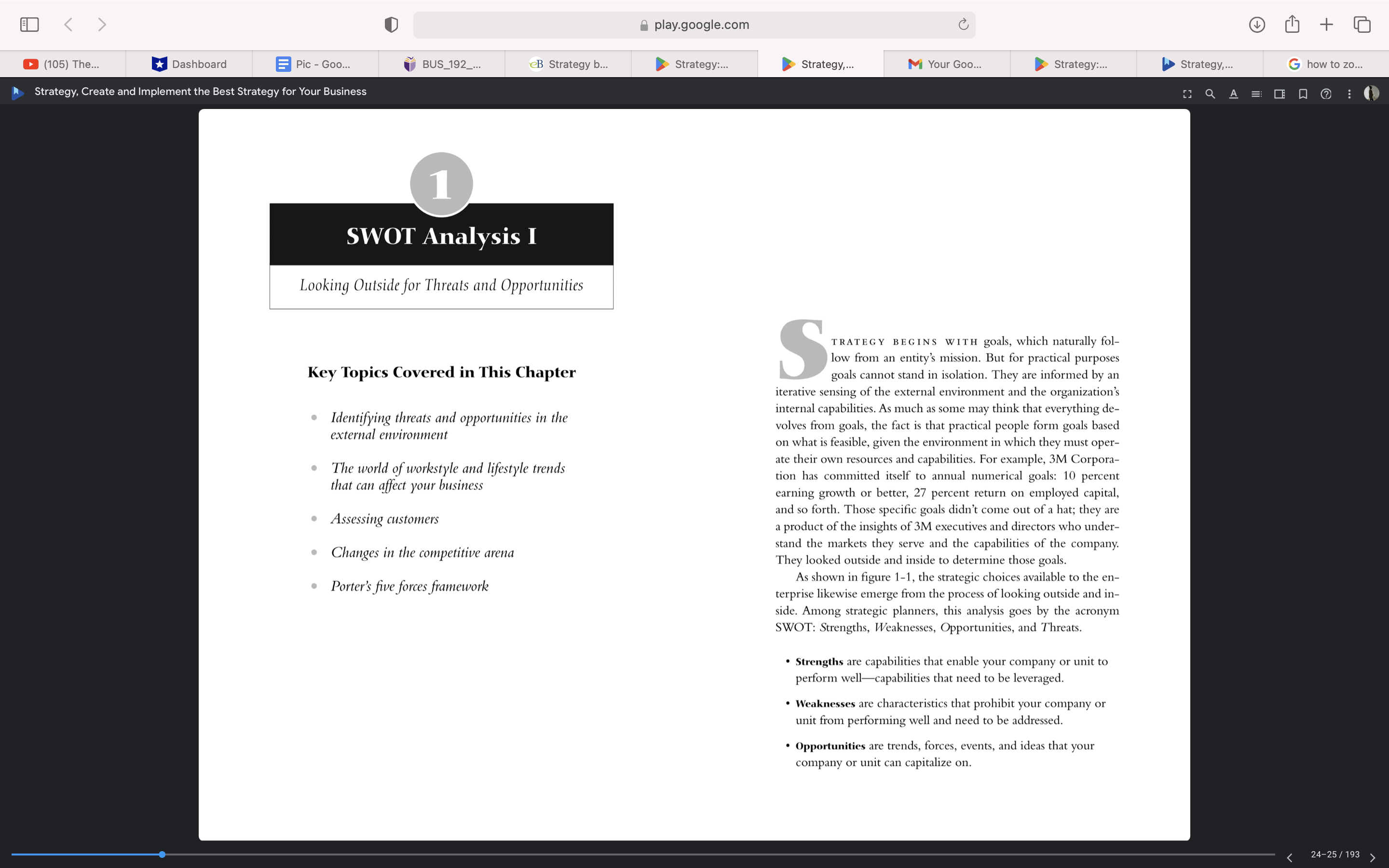
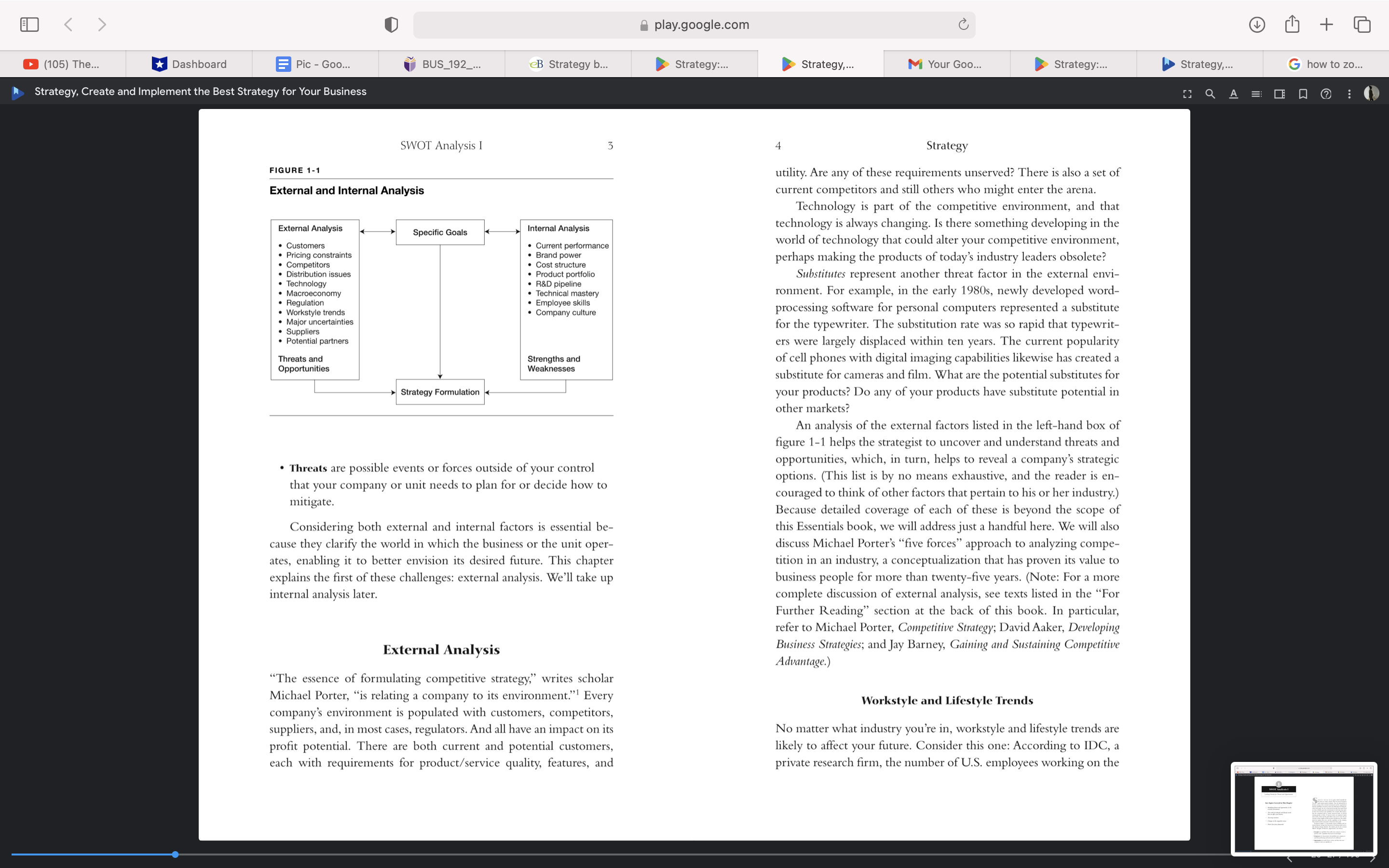
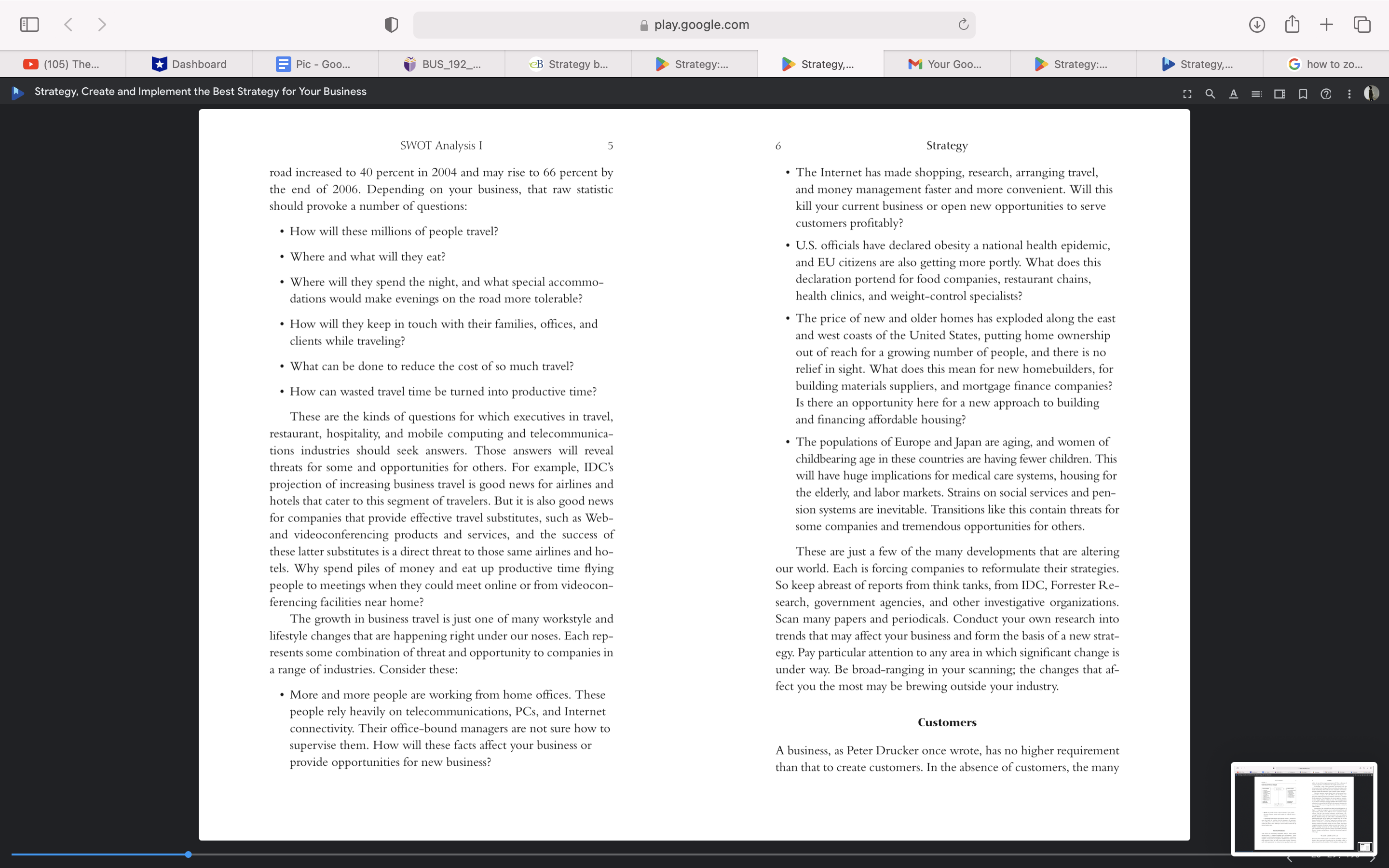
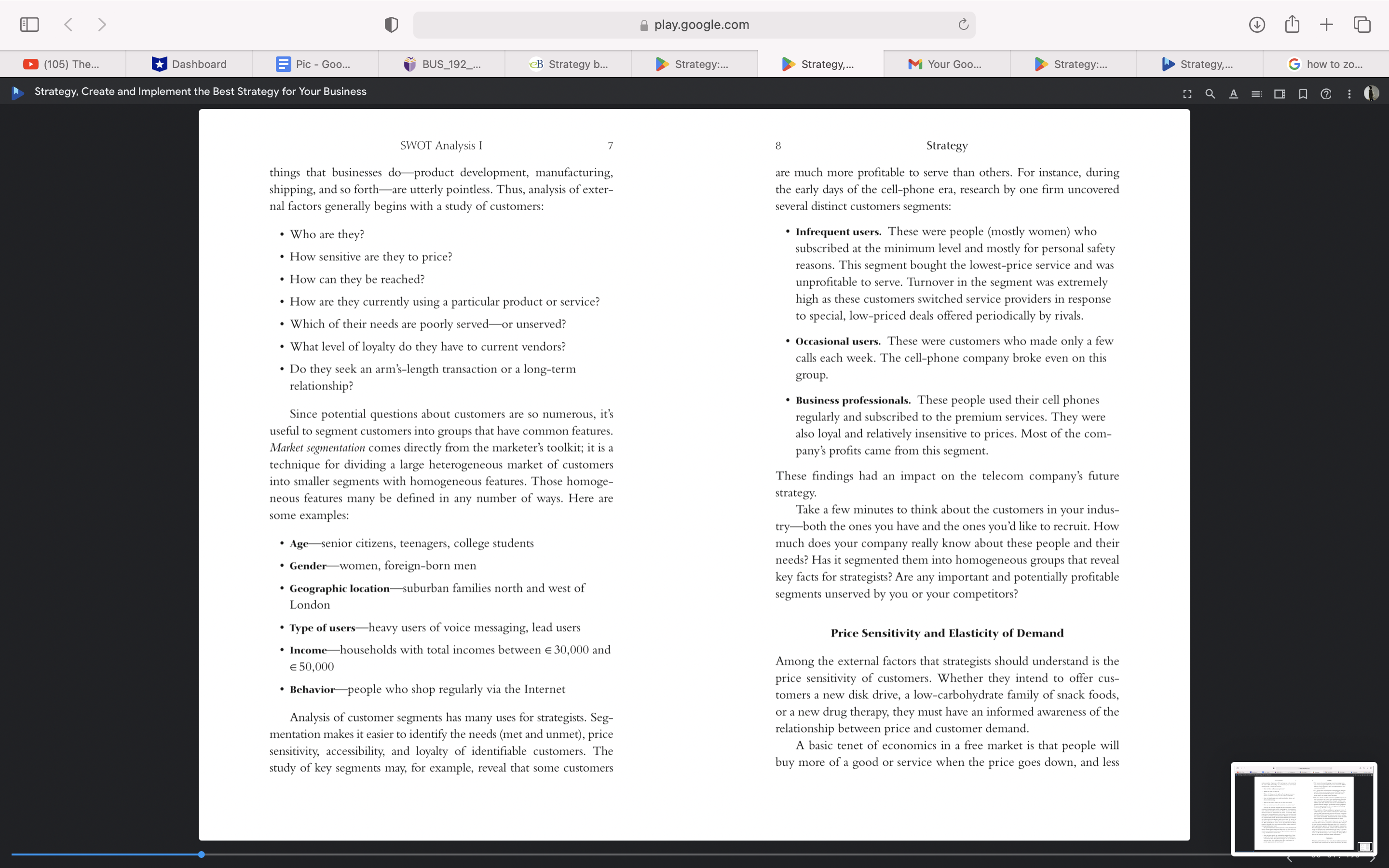
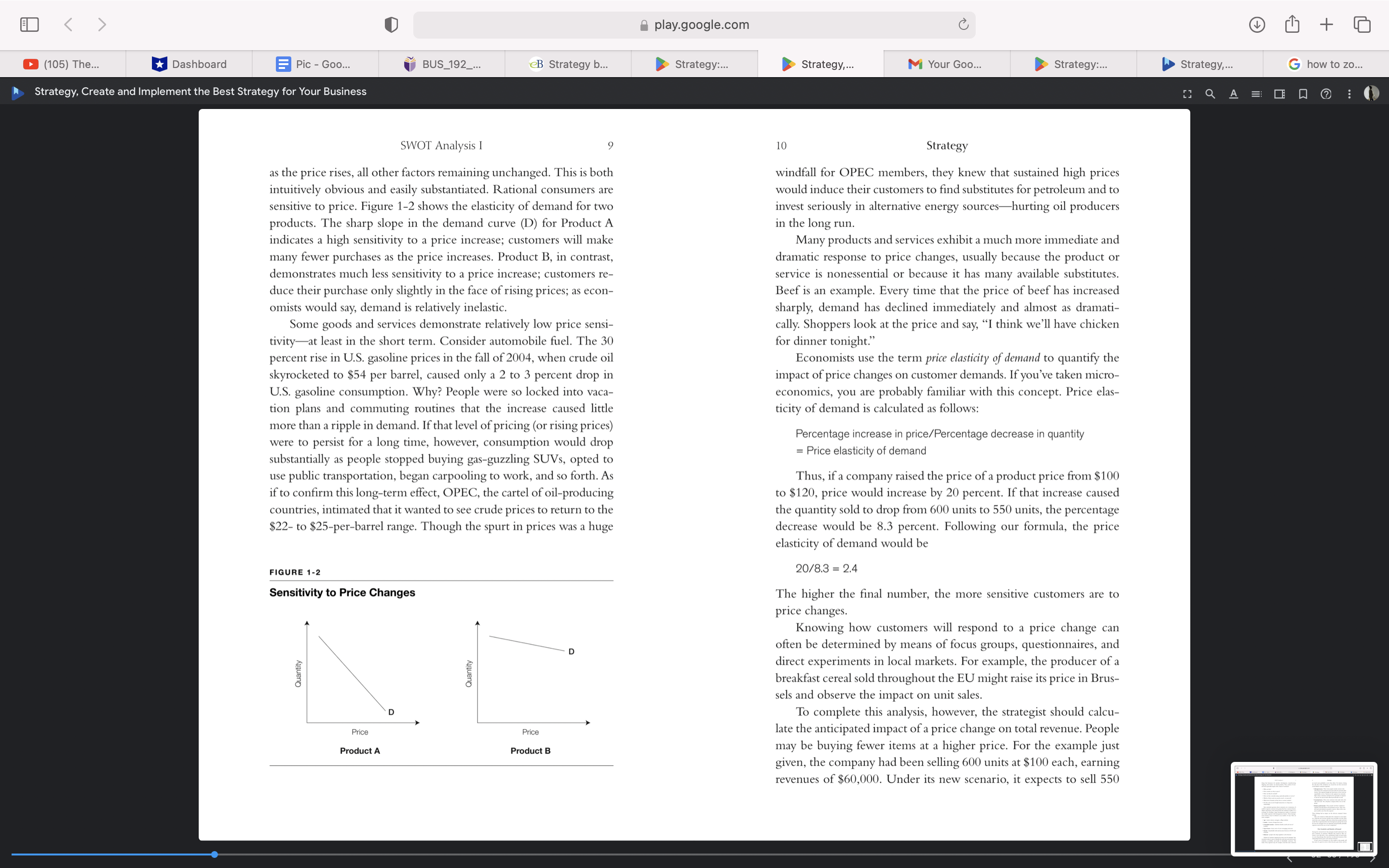
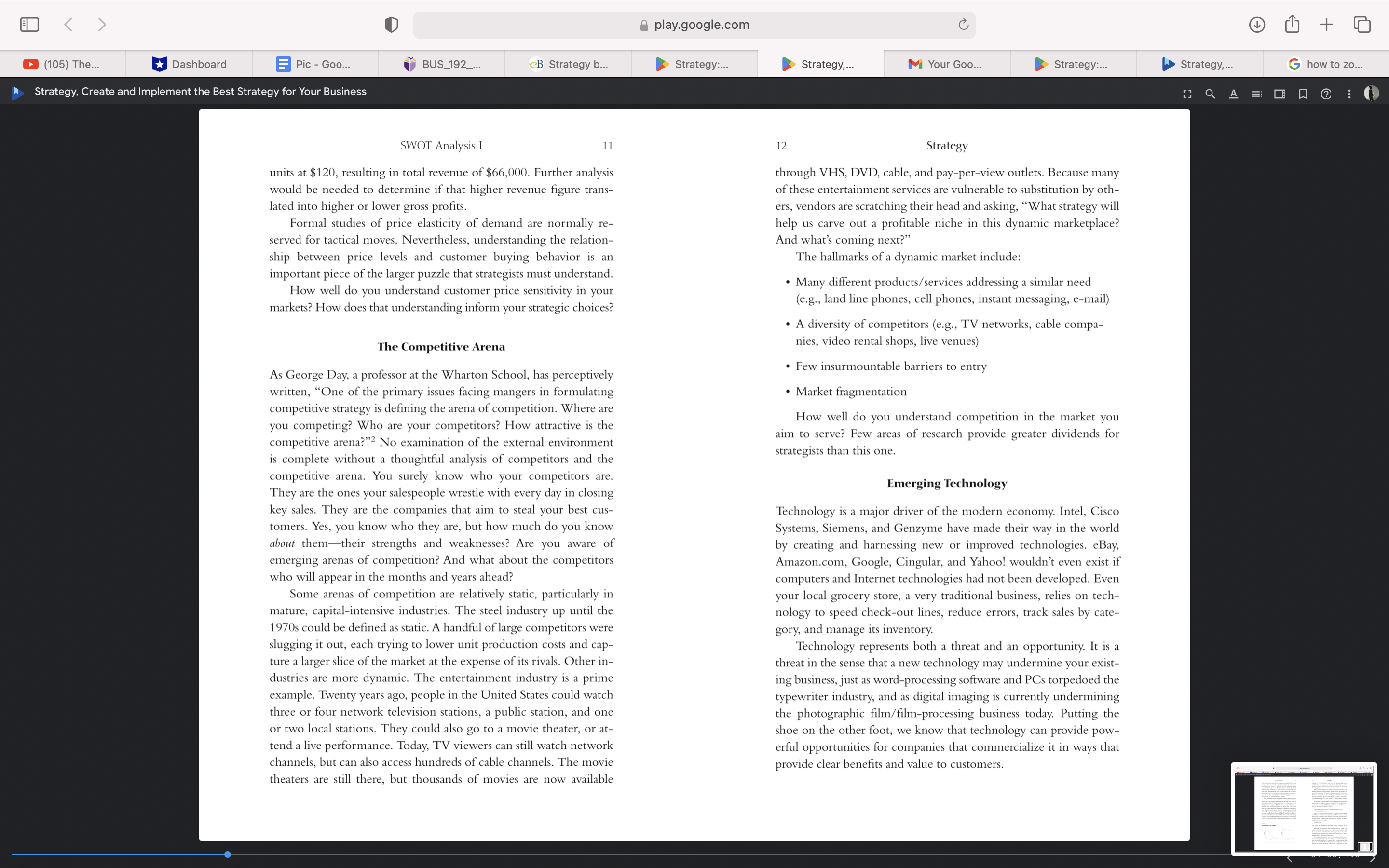
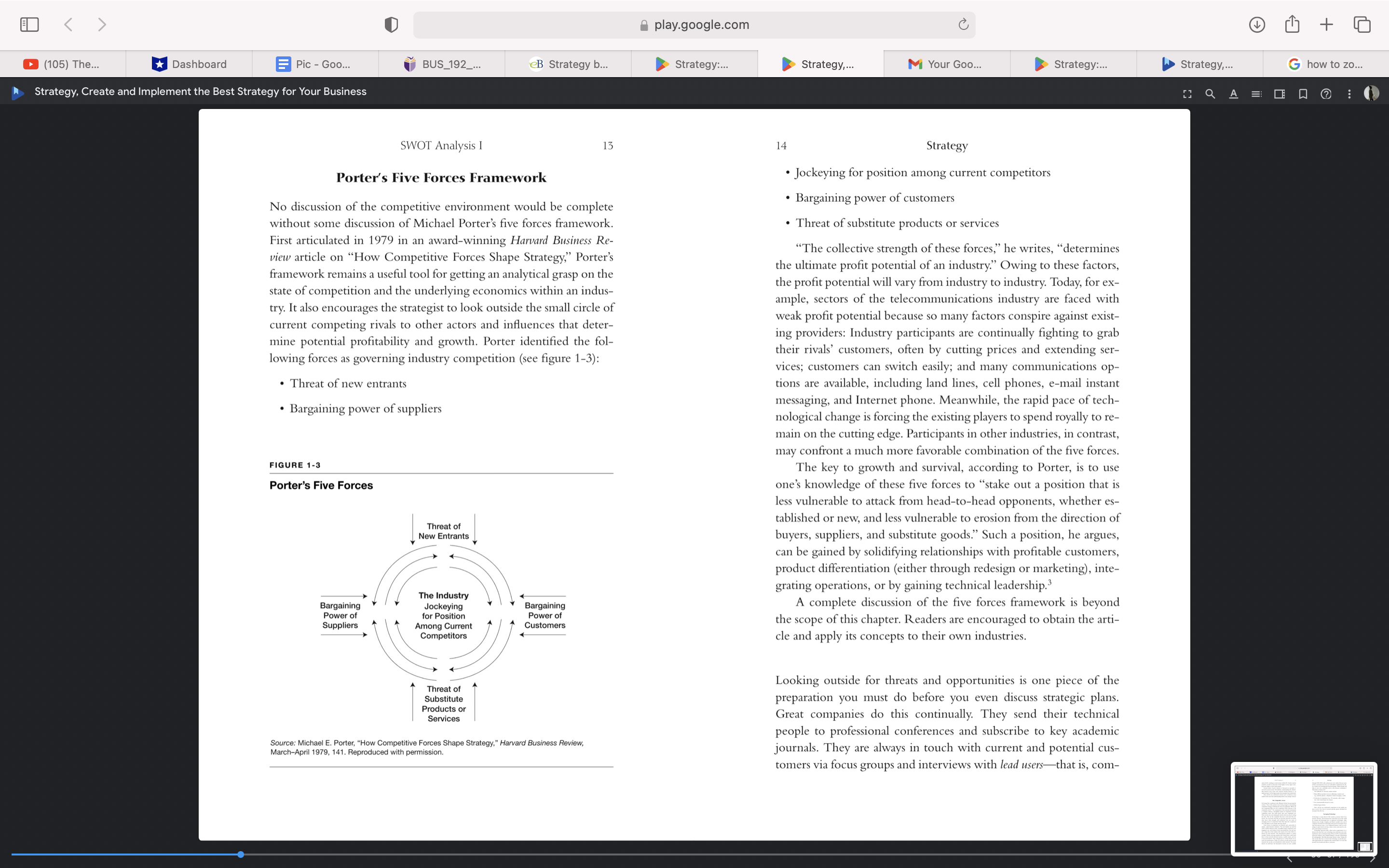
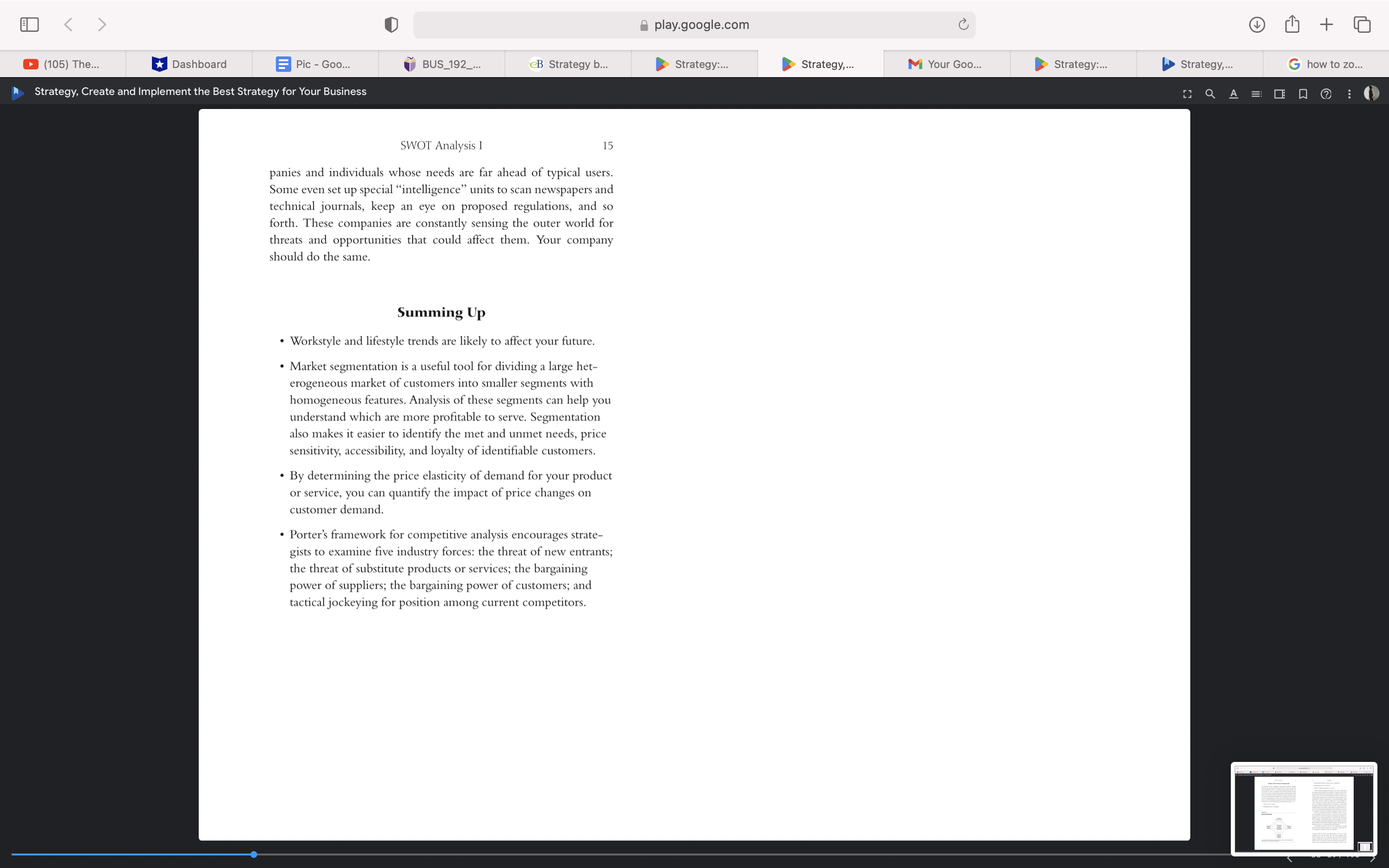
> play.google.com (105) The... Dashboard Pic - Goo... BUS_192_... eB Strategy b... Strategy:... Strategy, ... M Your Goo... Strategy:... Strategy, ... G how to zo... Strategy, Create and Implement the Best Strategy for Your Business [ Q A = DO @: 1 SWOT Analysis I Looking Outside for Threats and Opportunities ow from an entity's mission. But for practical purposes Key Topics Covered in This Chapter S TRATEGY BEGINS WITH goals, which naturally fol- goals cannot stand in isolation. They are informed by an iterative sensing of the external environment and the organization's Identifying threats and opportunities in the internal capabilities. As much as some may think that everything de- volves from goals, the fact is that practical people form goals based external environment on what is feasible, given the environment in which they must oper- The world of workstyle and lifestyle trends ate their own resources and capabilities. For example, 3M Corpora- that can affect your business ion has committed itself to annual numerical goals: 10 percent earning growth or better, 27 percent return on employed capital, and so forth. Those specific goals didn't come out of a hat; they are Assessing customers a product of the insights of 3M executives and directors who under- Changes in the competitive arena stand the markets they serve and the capabilities of the company. They looked outside and inside to determine those goals. Porter's five forces framework As shown in figure 1-1, the strategic choices available to the en- terprise likewise emerge from the process of looking outside and in- side. Among strategic planners, this analysis goes by the acronym SWOT: Strengths, Weaknesses, Opportunities, and Threats. . Strengths are capabilities that enable your company or unit to perform well-capabilities that need to be leveraged Weaknesses are characteristics that prohibit your company or unit from performing well and need to be addressed. . Opportunities are trends, forces, events, and ideas that your company or unit can capitalize on. 24-25 / 193 >> play.google.com (105) The... Dashboard Pic - Goo... BUS_192_... eB Strategy b... Strategy:... Strategy, ... M Your Goo... Strategy:... Strategy,... G how to zo... Strategy, Create and Implement the Best Strategy for Your Business [ Q A = DQ @ : SWOT Analysis I Strategy FIGURE 1-1 utility. Are any of these requirements unserved? There is also a set of External and Internal Analysis current competitors and still others who might enter the arena Technology is part of the competitive environment, and that External Analysis technology is always changing. Is there something developing in the Specific Goals Internal Analysis . Customers . Current performance world of technology that could alter your competitive environment, . Pricing constraints . Brand power . Cost structure perhaps making the products of today's industry leaders obsolete? . Competitors . Distribution issues . Product portfolio Substitutes represent another threat factor in the external envi- . Technology . R&D pipeline . Macroeconomy . Technical mastery ronment. For example, in the early 1980s, newly developed word- . Regulation . Employee skills . Workstyle trends any culture processing software for personal computers represented a substitute . Major uncertainties for the typewriter. The substitution rate was so rapid that typewrit- Suppliers Potential partners ers were largely displaced within ten years. The current popularity Threats and Strengths and of cell phones with digital imaging capabilities likewise has created a Opportunities Weaknesses substitute for cameras and film. What are the potential substitutes for Strategy Formulation your products? Do any of your products have substitute potential in other markets? An analysis of the external factors listed in the left-hand box of figure 1-1 helps the strategist to uncover and understand threats and . Threats are possible events or forces outside of your control opportunities, which, in turn, helps to reveal a company's strategic that your company or unit needs to plan for or decide how to options. (This list is by no means exhaustive, and the reader is en- mitigate. couraged to think of other factors that pertain to his or her industry.) Because detailed coverage of each of these is beyond the scope of Considering both external and internal factors is essential be- this Essentials book, we will address just a handful here. We will also cause they clarify the world in which the business or the unit oper- discuss Michael Porter's "five forces" approach to analyzing compe- ates, enabling it to better envision its desired future. This chapter tition in an industry, a conceptualization that has proven its value to explains the first of these challenges: external analysis. We'll take up business people for more than twenty-five years. (Note: For a more internal analysis later. complete discussion of external analysis, see texts listed in the "For Further Reading" section at the back of this book. In particular, refer to Michael Porter, Competitive Strategy; David Aaker, Developing External Analysis Business Strategies; and Jay Barney, Gaining and Sustaining Competitive Advantage.) "The essence of formulating competitive strategy," writes scholar Michael Porter, "is relating a company to its environment." Every Workstyle and Lifestyle Trends company's environment is populated with customers, competitors, suppliers, and, in most cases, regulators. And all have an impact on its No matter what industry you're in, workstyle and lifestyle trends are profit potential. There are both current and potential customers, likely to affect your future. Consider this one: According to IDC, a each with requirements for product/service quality, features, and private research firm, the number of U.S. employees working on the> play.google.com (105) The... Dashboard Pic - Goo... BUS_192_... eB Strategy b... Strategy:... Strategy,... M Your Goo... Strategy:... Strategy,... G how to zo... Strategy, Create and Implement the Best Strategy for Your Business [ Q A = OD@ : SWOT Analysis I 6 Strategy road increased to 40 percent in 2004 and may rise to 66 percent by . The Internet has made shopping, research, arranging travel, the end of 2006. Depending on your business, that raw statistic and money management faster and more convenient. Will this should provoke a number of questions: kill your current business or open new opportunities to serve . How will these millions of people travel? customers profitably? U.S. officials have declared obesity a national health epidemic, . Where and what will they eat? and EU citizens are also getting more portly. What does this . Where will they spend the night, and what special accommo- declaration portend for food companies, restaurant chains, dations would make evenings on the road more tolerable? health clinics, and weight-control specialists? . How will they keep in touch with their families, offices, and . The price of new and older homes has exploded along the east clients while traveling? and west coasts of the United States, putting home ownership out of reach for a growing number of people, and there is no . What can be done to reduce the cost of so much travel? relief in sight. What does this mean for new homebuilders, for . How can wasted travel time be turned into productive time? building materials suppliers, and mortgage finance companies? Is there an opportunity here for a new approach to building These are the kinds of questions for which executives in travel, and financing affordable housing? restaurant, hospitality, and mobile computing and telecommunica tions industries should seek answers. Those answers will reveal The populations of Europe and Japan are aging, and women of threats for some and opportunities for others. For example, IDC's childbearing age in these countries are having fewer children. This projection of increasing business travel is good news for airlines and will have huge implications for medical care systems, housing for hotels that cater to this segment of travelers. But it is also good news the elderly, and labor markets. Strains on social services and pen- for companies that provide effective travel substitutes, such as Web- sion systems are inevitable. Transitions like this contain threats for and videoconferencing products and services, and the success of some companies and tremendous opportunities for others. these latter substitutes is a direct threat to those same airlines and ho- These are just a few of the many developments that are altering tels. Why spend piles of money and eat up productive time flying our world. Each is forcing companies to reformulate their strategies. people to meetings when they could meet online or from videocon- So keep abreast of reports from think tanks, from IDC, Forrester Re- ferencing facilities near home? search, government agencies, and other investigative organizations. The growth in business travel is just one of many workstyle and Scan many papers and periodicals. Conduct your own research into lifestyle changes that are happening right under our noses. Each rep- trends that may affect your business and form the basis of a new strat- resents some combination of threat and opportunity to companies in egy. Pay particular attention to any area in which significant change is a range of industries. Consider these: under way. Be broad-ranging in your scanning; the changes that af- . More and more people are working from home offices. These fect you the most may be brewing outside your industry. people rely heavily on telecommunications, PCs, and Internet connectivity. Their office-bound managers are not sure how to Customers supervise them. How will these facts affect your business or A business, as Peter Drucker once wrote, has no higher requirement provide opportunities for new business? than that to create customers. In the absence of customers, the many> play.google.com (105) The... Dashboard Pic - Goo... BUS_192_... eB Strategy b... Strategy:... Strategy,... M Your Goo... Strategy:... Strategy, ... G how to zo... Strategy, Create and Implement the Best Strategy for Your Business [ Q A = DO @ : SWOT Analysis I 8 Strategy things that businesses do-product development, manufacturing, are much more profitable to serve than others. For instance, during shipping, and so forth-are utterly pointless. Thus, analysis of exter- the early days of the cell-phone era, research by one firm uncovered nal factors generally begins with a study of customers: several distinct customers segments: . Who are they? Infrequent users. These were people (mostly women) who . How sensitive are they to price? subscribed at the minimum level and mostly for personal safety reasons. This segment bought the lowest-price service and was How can they be reached? unprofitable to serve. Turnover in the segment was extremely How are they currently using a particular product or service? high as these customers switched service providers in response . Which of their needs are poorly served-or unserved? to special, low-priced deals offered periodically by rivals. . What level of loyalty do they have to current vendors? Occasional users. These were customers who made only a few calls each week. The cell-phone company broke even on this . Do they seek an arm's-length transaction or a long-term group. relationship? Business professionals. These people used their cell phones Since potential questions about customers are so numerous, it's regularly and subscribed to the premium services. They were useful to segment customers into groups that have common features. also loyal and relatively insensitive to prices. Most of the com- Market segmentation comes directly from the marketer's toolkit; it is a pany's profits came from this segment. technique for dividing a large heterogeneous market of customers into smaller segments with homogeneous features. Those homoge- These findings had an impact on the telecom company's future neous features many be defined in any number of ways. Here are strategy. some examples: Take a few minutes to think about the customers in your indus- try-both the ones you have and the ones you'd like to recruit. How . Age senior citizens, teenagers, college students much does your company really know about these people and their Gender-women, foreign-born men needs? Has it segmented them into homogeneous groups that reveal key facts for strategists? Are any important and potentially profitable . Geographic location-suburban families north and west of segments unserved by you or your competitors? London Type of users-heavy users of voice messaging, lead users Price Sensitivity and Elasticity of Demand Income-households with total incomes between E 30,000 and E 50,000 Among the external factors that strategists should understand is the price sensitivity of customers. Whether they intend to offer cus- . Behavior-people who shop regularly via the Internet tomers a new disk drive, a low-carbohydrate family of snack foods, Analysis of customer segments has many uses for strategists. Seg- or a new drug therapy, they must have an informed awareness of the mentation makes it easier to identify the needs (met and unmet), price relationship between price and customer demand. sensitivity, accessibility, and loyalty of identifiable customers. The A basic tenet of economics in a free market is that people will study of key segments may, for example, reveal that some customers buy more of a good or service when the price goes down, and less> play.google.com (105) The... Dashboard Pic - Goo... BUS_192_... eB Strategy b... Strategy:... Strategy, ... M Your Goo... Strategy:... Strategy,... G how to zo... Strategy, Create and Implement the Best Strategy for Your Business [ Q A = Q @ : SWOT Analysis I 10 Strategy as the price rises, all other factors remaining unchanged. This is both windfall for OPEC members, they knew that sustained high prices intuitively obvious and easily substantiated. Rational consumers are would induce their customers to find substitutes for petroleum and to sensitive to price. Figure 1-2 shows the elasticity of demand for two invest seriously in alternative energy sources-hurting oil producers products. The sharp slope in the demand curve (D) for Product A in the long run. indicates a high sensitivity to a price increase; customers will make Many products and services exhibit a much more immediate and many fewer purchases as the price increases. Product B, in contrast, dramatic response to price changes, usually because the product or demonstrates much less sensitivity to a price increase; customers re- service is nonessential or because it has many available substitutes. duce their purchase only slightly in the face of rising prices; as econ- Beef is an example. Every time that the price of beef has increased omists would say, demand is relatively inelastic. sharply, demand has declined immediately and almost as dramati- Some goods and services demonstrate relatively low price sensi- cally. Shoppers look at the price and say, "I think we'll have chicken tivity-at least in the short term. Consider automobile fuel. The 30 for dinner tonight." percent rise in U.S. gasoline prices in the fall of 2004, when crude oil Economists use the term price elasticity of demand to quantify the skyrocketed to $54 per barrel, caused only a 2 to 3 percent drop in impact of price changes on customer demands. If you've taken micro- U.S. gasoline consumption. Why? People were so locked into vaca- economics, you are probably familiar with this concept. Price elas- tion plans and commuting routines that the increase caused little ticity of demand is calculated as follows: more than a ripple in demand. If that level of pricing (or rising prices) were to persist for a long time, however, consumption would drop Percentage increase in price/Percentage decrease in quantity = Price elasticity of demand substantially as people stopped buying gas-guzzling SUVs, opted to use public transportation, began carpooling to work, and so forth. As Thus, if a company raised the price of a product price from $100 if to confirm this long-term effect, OPEC, the cartel of oil-producing to $120, price would increase by 20 percent. If that increase caused countries, intimated that it wanted to see crude prices to return to the the quantity sold to drop from 600 units to 550 units, the percentage $22- to $25-per-barrel range. Though the spurt in prices was a huge decrease would be 8.3 percent. Following our formula, the price elasticity of demand would be FIGURE 1-2 20/8.3 = 2.4 Sensitivity to Price Changes The higher the final number, the more sensitive customers are to price changes. Knowing how customers will respond to a price change can often be determined by means of focus groups, questionnaires, and direct experiments in local markets. For example, the producer of a Quantity Quantit breakfast cereal sold throughout the EU might raise its price in Brus- sels and observe the impact on unit sales. To complete this analysis, however, the strategist should calcu- Price Price late the anticipated impact of a price change on total revenue. People Product A Product B may be buying fewer items at a higher price. For the example just given, the company had been selling 600 units at $100 each, earning revenues of $60,000. Under its new scenario, it expects to sell 550> play.google.com (105) The... Dashboard Pic - Goo... BUS_192_... eB Strategy b... Strategy:... Strategy, ... M Your Goo... Strategy:... Strategy,... G how to zo... Strategy, Create and Implement the Best Strategy for Your Business [ Q A = DQ@ : SWOT Analysis I 12 Strategy units at $120, resulting in total revenue of $66,000. Further analysis through VHS, DVD, cable, and pay-per-view outlets. Because many would be needed to determine if that higher revenue figure trans- of these entertainment services are vulnerable to substitution by oth- lated into higher or lower gross profits. ers, vendors are scratching their head and asking, "What strategy will Formal studies of price elasticity of demand are normally re- help us carve out a profitable niche in this dynamic marketplace? served for tactical moves. Nevertheless, understanding the relation- And what's coming next?" ship between price levels and customer buying behavior is an The hallmarks of a dynamic market include: important piece of the larger puzzle that strategists must understand. How well do you understand customer price sensitivity in your Many different products/services addressing a similar need markets? How does that understanding inform your strategic choices? (e.g., land line phones, cell phones, instant messaging, e-mail) . A diversity of competitors (e.g., TV networks, cable compa- The Competitive Arena nies, video rental shops, live venues) As George Day, a professor at the Wharton School, has perceptively . Few insurmountable barriers to entry written, "One of the primary issues facing mangers in formulating . Market fragmentation competitive strategy is defining the arena of competition. Where are you competing? Who are your competitors? How attractive is the How well do you understand competition in the market you competitive arena?"? No examination of the external environment aim to serve? Few areas of research provide greater dividends for is complete without a thoughtful analysis of competitors and the strategists than this one. competitive arena. You surely know who your competitors are. Emerging Technology They are the ones your salespeople wrestle with every day in closing key sales. They are the companies that aim to steal your best cus- Technology is a major driver of the modern economy. Intel, Cisco tomers. Yes, you know who they are, but how much do you know Systems, Siemens, and Genzyme have made their way in the world about them-their strengths and weaknesses? Are you aware of by creating and harnessing new or improved technologies. eBay, emerging arenas of competition? And what about the competitors Amazon.com, Google, Cingular, and Yahoo! wouldn't even exist if who will appear in the months and years ahead? computers and Internet technologies had not been developed. Even Some arenas of competition are relatively static, particularly in your local grocery store, a very traditional business, relies on tech- mature, capital-intensive industries. The steel industry up until the nology to speed check-out lines, reduce errors, track sales by cate- 1970s could be defined as static. A handful of large competitors were gory, and manage its inventory. slugging it out, each trying to lower unit production costs and cap- Technology represents both a threat and an opportunity. It is a ture a larger slice of the market at the expense of its rivals. Other in- threat in the sense that a new technology may undermine your exist- dustries are more dynamic. The entertainment industry is a prime ing business, just as word-processing software and PCs torpedoed the example. Twenty years ago, people in the United States could watch typewriter industry, and as digital imaging is currently undermining three or four network television stations, a public station, and one the photographic film/film-processing business today. Putting the or two local stations. They could also go to a movie theater, or at- shoe on the other foot, we know that technology can provide pow- tend a live performance. Today, TV viewers can still watch network erful opportunities for companies that commercialize it in ways that channels, but can also access hundreds of cable channels. The movie provide clear benefits and value to customers. theaters are still there, but thousands of movies are now available> play.google.com (105) The... Dashboard Pic - Goo... BUS_192_... eB Strategy b... Strategy:... Strategy,... M Your Goo... Strategy:... Strategy,... G how to zo... Strategy, Create and Implement the Best Strategy for Your Business [ Q A = DQ @ : SWOT Analysis I 13 14 Strategy Porter's Five Forces Framework . Jockeying for position among current competitors No discussion of the competitive environment would be complete . Bargaining power of customers without some discussion of Michael Porter's five forces framework. . Threat of substitute products or services First articulated in 1979 in an award-winning Harvard Business Re- view article on "How Competitive Forces Shape Strategy," Porter's "The collective strength of these forces," he writes, "determines framework remains a useful tool for getting an analytical grasp on the the ultimate profit potential of an industry." Owing to these factors, state of competition and the underlying economics within an indus- the profit potential will vary from industry to industry. Today, for ex- try. It also encourages the strategist to look outside the small circle of ample, sectors of the telecommunications industry are faced with current competing rivals to other actors and influences that deter- weak profit potential because so many factors conspire against exist- mine potential profitability and growth. Porter identified the fol- ing providers: Industry participants are continually fighting to grab lowing forces as governing industry competition (see figure 1-3): heir rivals' customers, often by cutting prices and extending ser- vices; customers can switch easily; and many communications op- . Threat of new entrants ions are available, including land lines, cell phones, e-mail instant . Bargaining power of suppliers messaging, and Internet phone. Meanwhile, the rapid pace of tech- nological change is forcing the existing players to spend royally to re- main on the cutting edge. Participants in other industries, in contrast, may confront a much more favorable combination of the five forces. FIGURE 1-3 The key to growth and survival, according to Porter, is to use Porter's Five Forces one's knowledge of these five forces to "stake out a position that is less vulnerable to attack from head-to-head opponents, whether es- Threat of tablished or new, and less vulnerable to erosion from the direction of New Entrants buyers, suppliers, and substitute goods." Such a position, he argues, can be gained by solidifying relationships with profitable customers, product differentiation (either through redesign or marketing), inte- grating operations, or by gaining technical leadership.' The Industry Bargaining Jockeying Bargaining A complete discussion of the five forces framework is beyond Power of for Position Power of Suppliers Among Curren Customers the scope of this chapter. Readers are encouraged to obtain the arti- Competitors cle and apply its concepts to their own industries. Threat of Looking outside for threats and opportunities is one piece of the Substitute preparation you must do before you even discuss strategic plans. Products or Services Great companies do this continually. They send their technical people to professional conferences and subscribe to key academic Source: Michael E. Porter, "How Competitive Forces Shape Strategy," Harvard Business Review, March-April 1979, 141. Reproduced with permission. journals. They are always in touch with current and potential cus- tomers via focus groups and interviews with lead users-that is, com-> play.google.com (105) The... Dashboard Pic - Goo... BUS_192_... eB Strategy b... Strategy:... Strategy, ... M Your Goo... Strategy:... Strategy,... G how to zo... Strategy, Create and Implement the Best Strategy for Your Business [ Q A = DQ @ : SWOT Analysis I 15 panies and individuals whose needs are far ahead of typical users. Some even set up special "intelligence" units to scan newspapers and technical journals, keep an eye on proposed regulations, and so forth. These companies are constantly sensing the outer world for threats and opportunities that could affect them. Your company should do the same. Summing Up . Workstyle and lifestyle trends are likely to affect your future. . Market segmentation is a useful tool for dividing a large het- erogenous market of customers into smaller segments with homogeneous features. Analysis of these segments can help you understand which are more profitable to serve. Segmentation also makes it easier to identify the met and unmet needs, price sensitivity, accessibility, and loyalty of identifiable customers. . By determining the price elasticity of demand for your product or service, you can quantify the impact of price changes on customer demand. . Porter's framework for competitive analysis encourages strate- gists to examine five industry forces: the threat of new entrants; the threat of substitute products or services; the bargaining power of suppliers; the bargaining power of customers; and tactical jockeying for position among current competitors
Step by Step Solution
There are 3 Steps involved in it
1 Expert Approved Answer
Step: 1 Unlock
Question Has Been Solved by an Expert!
Get step-by-step solutions from verified subject matter experts
Step: 2 Unlock
Step: 3 Unlock
Students Have Also Explored These Related General Management Questions!