







Question: Refer to the generation groups and social classes in Chapter 4 and the ethnic subcultures in Chapter 5. With all of these concepts in mind,
Refer to the generation groups and social classes in Chapter 4 and the ethnic subcultures in Chapter 5. With all of these concepts in mind, describe an ideal target market segment for Beats Music.
Hopefully, someone can use the summaries of these 2 chapters to answer this question, it would be greatly appreciated.
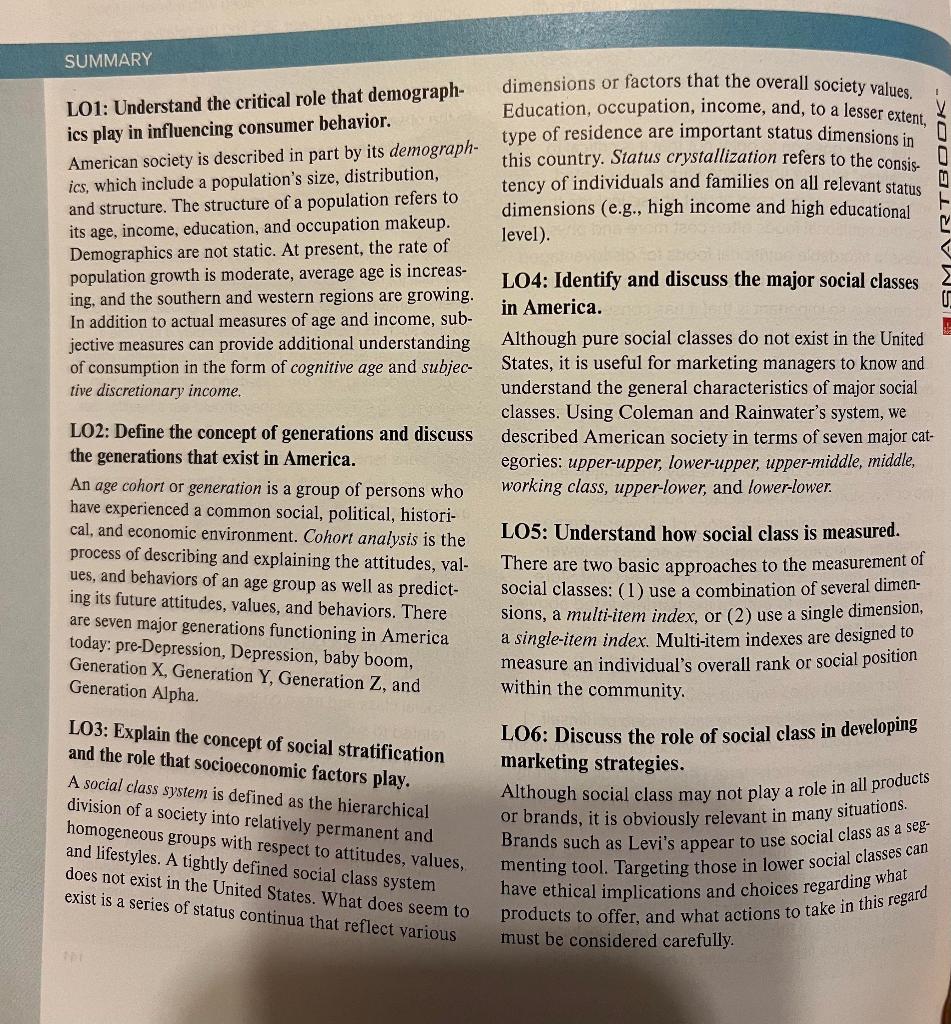
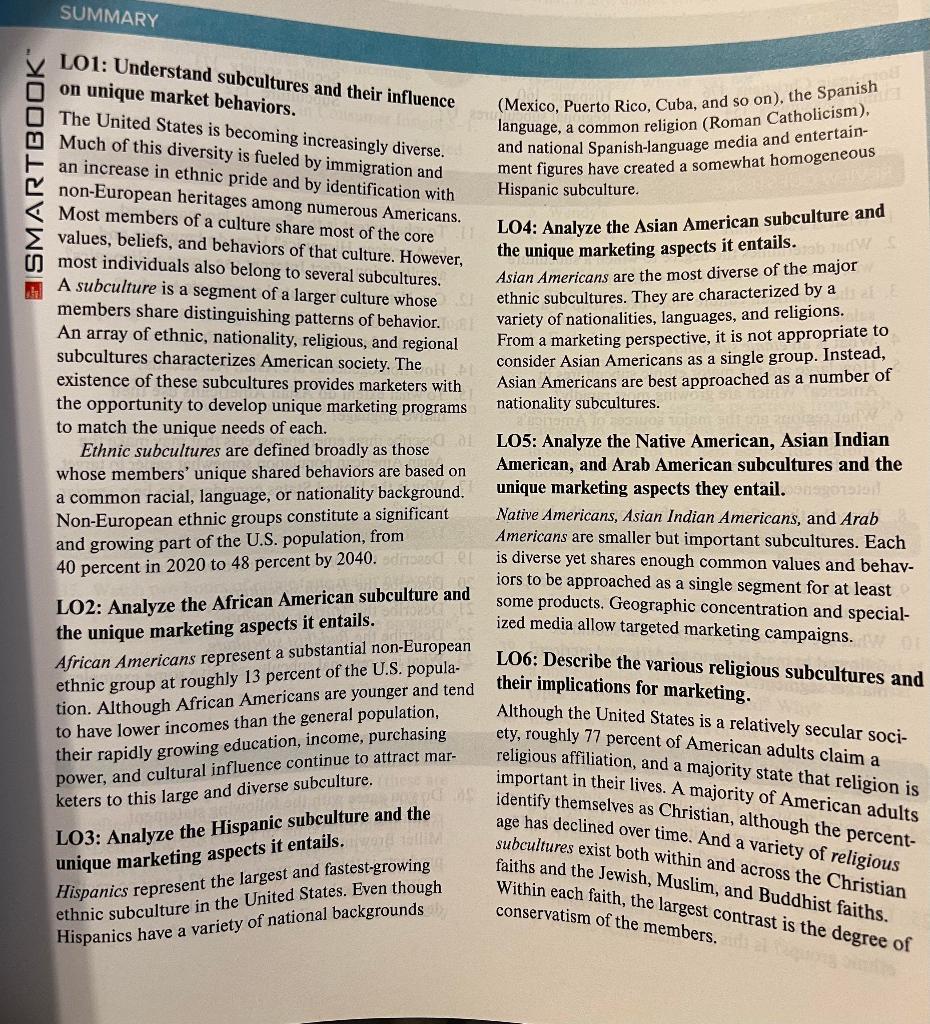
ODELUVWS SUMMARY dimensions or factors that the overall society values. LO1: Understand the critical role that demograph- Education, occupation, income, and, to a lesser extent ics play in influencing consumer behavior. American society is described in part by its demograph type of residence are important status dimensions in this country. Status crystallization refers to the consis- ics, which include a population's size, distribution, tency of individuals and families on all relevant status and structure. The structure of a population refers to dimensions (e.g., high income and high educational its age, income, education, and occupation makeup. level). Demographics are not static. At present, the rate of population growth is moderate, average age is increas- LO4: Identify and discuss the major social classes ing, and the southern and western regions are growing. in America. In addition to actual measures of age and income, sub- jective measures can provide additional understanding Although pure social classes do not exist in the United of consumption in the form of cognitive age and subjec- States, it is useful for marketing managers to know and tive discretionary income. understand the general characteristics of major social classes. Using Coleman and Rainwater's system, we LO2: Define the concept of generations and discuss described American society in terms of seven major cat- the generations that exist in America. egories: upper-upper, lower-upper, upper-middle, middle, An age cohort or generation is a group of persons who working class, upper-lower, and lower-lower. have experienced a common social, political, histori- cal, and economic environment. Cohort analysis is the LO5: Understand how social class is measured. process of describing and explaining the attitudes, val- ues, and behaviors of an age group as well as predict- There are two basic approaches to the measurement of ing its future attitudes, values, and behaviors. There social classes: (1) use a combination of several dimen- are seven major generations functioning in America sions, a multi-item index, or (2) use a single dimension, a single-item index. Multi-item indexes are designed to measure an individual's overall rank or social position within the community. LO6: Discuss the role of social class in developing marketing strategies. Although social class may not play a role in all products or brands, it is obviously relevant in many situations. Brands such as Levi's appear to use social class as a seg- menting tool. Targeting those in lower social classes can have ethical implications and choices regarding what products to offer, and what actions to take in this regard must be considered carefully. today: pre-Depression, Depression, baby boom, Generation X, Generation Y, Generation Z, and Generation Alpha. LO3: Explain the concept of social stratification and the role that socioeconomic factors play. A social class system is defined as the hierarchical division of a society into relatively permanent and homogeneous groups with respect to attitudes, values, and lifestyles. A tightly defined social class system does not exist in the United States. What does seem to exist is a series of status continua that reflect various SUMMARY LO1: Understand subcultures and their influence on unique market behaviors. The United States is becoming increasingly diverse. Much of this diversity is fueled by immigration and an increase in ethnic pride and by identification with non-European heritages among numerous Americans. Most members of a culture share most of the core values, beliefs, and behaviors of that culture. However, most individuals also belong to several subcultures. A subculture is a segment of a larger culture whose (Mexico, Puerto Rico, Cuba, and so on), the Spanish language, a common religion (Roman Catholicism), and national Spanish-language media and entertain- ment figures have created a somewhat homogeneous Hispanic subculture. LO4: Analyze the Asian American subculture and the unique marketing aspects it entails. Asian Americans are the most diverse of the major members share distinguishing patterns of behavior variety of nationalities, languages , and religions: ethnic subcultures. They are characterized by a An array of ethnic, nationality, religious, and regional subcultures characterizes American society. The From a marketing perspective, it is not appropriate to consider Asian Americans as a single group. Instead, existence of these subcultures provides marketers with Asian Americans are best approached as a number of the opportunity to develop unique marketing programs nationality subcultures. to match the unique needs of each. Ethnic subcultures are defined broadly as those LO5: Analyze the Native American, Asian Indian whose members' unique shared behaviors are based on American, and Arab American subcultures and the a common racial, language, or nationality background. unique marketing aspects they entail. otola Non-European ethnic groups constitute a significant Native Americans, Asian Indian Americans, and Arab and growing part of the U.S. population, from Americans are smaller but important subcultures. Each 40 percent in 2020 to 48 percent by 2040. Header is diverse yet shares enough common values and behav- iors to be approached as a single segment for at least LO2: Analyze the African American subculture and some products. Geographic concentration and special- the unique marketing aspects it entails. African Americans represent a substantial non-European ethnic group at roughly 13 percent of the U.S. popula- tion. Although African Americans are younger and tend to have lower incomes than the general population, their rapidly growing education, income, purchasing power, and cultural influence continue to attract mar- ized media allow targeted marketing campaigns. L06: Describe the various religious subcultures and their implications for marketing. Although the United States is a relatively secular soci- ety, roughly 77 percent of American adults claim a religious affiliation, and a majority state that religion is important in their lives. A majority of American adults identify themselves as Christian, although the percent- age has declined over time. And a variety of religious subcultures exist both within and across the Christian faiths and the Jewish, Muslim, and Buddhist faiths. conservatism of the members. keters to this large and diverse subculture. LO3: Analyze the Hispanic subculture and the unique marketing aspects it entails. Hispanics represent the largest and fastest-growing ethnic subculture in the United States. Even though Hispanics have a variety of national backgrounds Within each faith, the largest contrast is the degree ofStep by Step Solution
There are 3 Steps involved in it
1 Expert Approved Answer
Step: 1 Unlock

Question Has Been Solved by an Expert!
Get step-by-step solutions from verified subject matter experts
Step: 2 Unlock
Step: 3 Unlock
 Study Help