Question: referable to Mr. Eu will not change. Which CASE STUDIES Dynamic Pricing Introduced in Indian Railways Indian Railways runs around 12500 passenger trains. Daily more
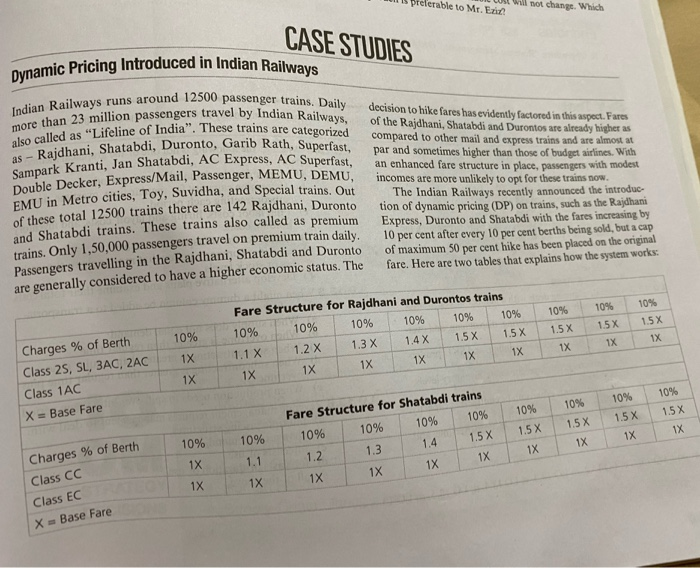
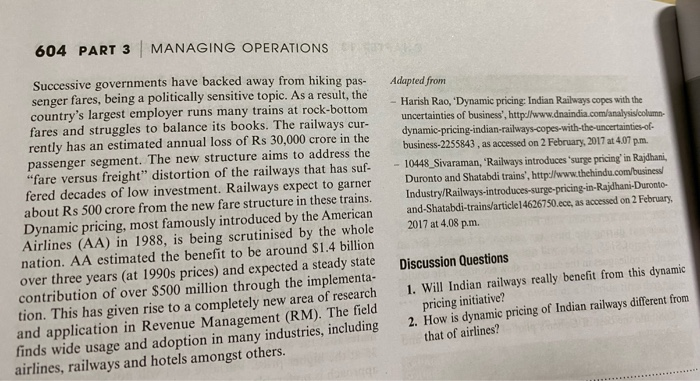
referable to Mr. Eu will not change. Which CASE STUDIES Dynamic Pricing Introduced in Indian Railways Indian Railways runs around 12500 passenger trains. Daily more than 23 million passengers travel by Indian Railways, also called as Lifeline of India". These trains are categorized as - Rajdhani, Shatabdi, Duronto, Garib Rath, Superfast, Sampark Kranti, Jan Shatabdi, AC Express, AC Superfast, Double Decker, Express/Mail, Passenger, MEMU, DEMU, EMU in Metro cities, Toy, Suvidha, and Special trains. Out of these total 12500 trains there are 142 Rajdhani, Duronto and Shatabdi trains. These trains also called as premium trains. Only 1,50,000 passengers travel on premium train daily. Passengers travelling in the Rajdhani, Shatabdi and Duronto are generally considered to have a higher economic status. The decision to hike fares has evidently factored in this aspect. Fares of the Rajdhani, Shatabdi and Durontos are already higher as compared to other mail and express trains and are almost at par and sometimes higher than those of budget airlines. With an enhanced fare structure in place, passengers with modest incomes are more unlikely to opt for these trains now. The Indian Railways recently announced the introduc- tion of dynamic pricing (DP) on trains, such as the Rajdhani Express, Duronto and Shatabdi with the fares increasing by 10 per cent after every 10 per cent berths being sold, but a cap of maximum 50 per cent hike has been placed on the original fare. Here are two tables that explains how the system works. 10% Fare Structure for Rajdhani and Durontos trains 10% 10% 10% 10% 10% 10% 1.1 x 1.2 X 1.3 X 1.4 X 1.5 X 1.5 X 1X 1X 1X 1X 1X 1x 10% 1.5 X 1x 10% 1.5 X 1X 10% 1.5 X 1X 1X Charges % of Berth Class 2S, SL, 3AC, 2AC Class 1AC X =Base Fare 1X 10% 10% 10% 10% 1.5 X Fare Structure for Shatabdi trains 10% 10% 10% 10% 1.5 X 1X 1.5 X 1.5 X 1X 10% 10% 1X 1.4 1.5 X 1X 1.3 1X 1.2 1X 1.1 IX 1X 1X 1X Charges % of Berth Class CC Class EC XBase Fare 1X 604 PART 3 MANAGING OPERATIONS Successive governments have backed away from hiking pas- senger fares, being a politically sensitive topic. As a result, the country's largest employer runs many trains at rock-bottom fares and struggles to balance its books. The railways cur- rently has an estimated annual loss of Rs 30,000 crore in the passenger segment. The new structure aims to address the "fare versus freight" distortion of the railways that has suf- fered decades of low investment. Railways expect to garner about Rs 500 crore from the new fare structure in these trains. Dynamic pricing, most famously introduced by the American Airlines (AA) in 1988, is being scrutinised by the whole nation. AA estimated the benefit to be around $1.4 billion over three years (at 1990s prices) and expected a steady state contribution of over $500 million through the implementa- tion. This has given rise to a completely new area of research and application in Revenue Management (RM). The field finds wide usage and adoption in many industries, including airlines, railways and hotels amongst others. Adapted from Harish Rao, 'Dynamic pricing: Indian Railways copes with the uncertainties of business', http://www.dnaindia.com/analysis column- dynamic-pricing-indian-railways-copes-with-the-uncertainties-of- business-2255843, as accessed on 2 February, 2017 at 4.07p.m. - 10448_Sivaraman, 'Railways introduces 'surge pricing' in Rajdhani, Duronto and Shatabdi trains', http://www.thehindu.com/business Industry/Railways-introduces-surge-pricing-in-Rajdhani-Duronto- and-Shatabdi-trains/article14626750.ece, as accessed on 2 February 2017 at 4.08 p.m. Discussion Questions 1. Will Indian railways really benefit from this dynamic pricing initiative? 2. How is dynamic pricing of Indian railways different from that of airlines









 Study Help