







Question: Reference: Calculus and Its Applications, 12th, by Marvin L. Bittinger andDavid Ellenbogen Book Elementary Applied Calculus I need help with questions These are practice questions
Reference: Calculus and Its Applications, 12th, by Marvin L. Bittinger andDavid Ellenbogen Book
Elementary Applied Calculus
I need help with questions
These are practice questions
Links to Book Below:
1. Calculus And Its Applications, Brief Version 12th edition | Print ISBN - 9780135164884, eText ISBN - 9780135225103 | VitalSource
2. Bittinger, Ellenbogen, Surgent & Kramer, Calculus and Its Applications: Brief Version, 12th Edition | Pearson
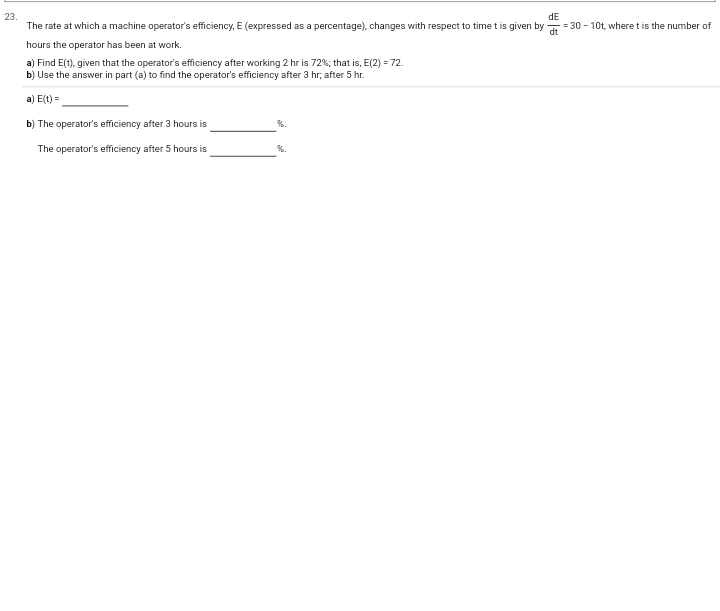
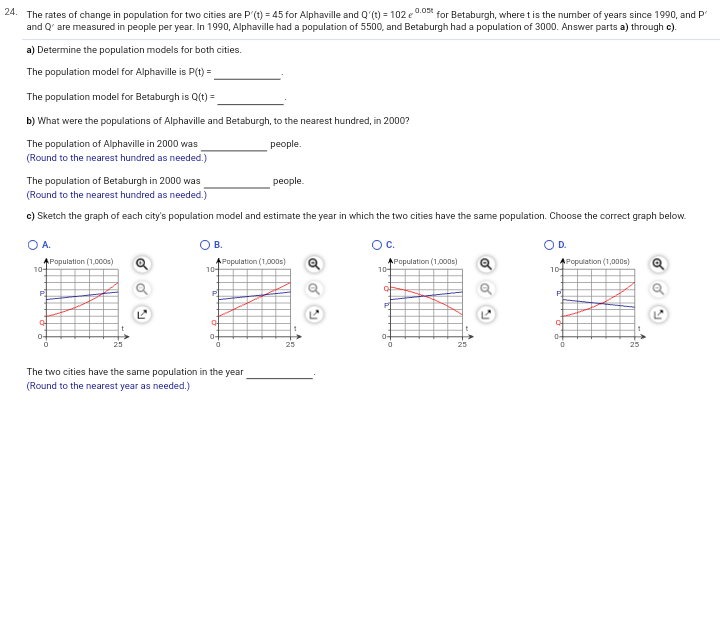
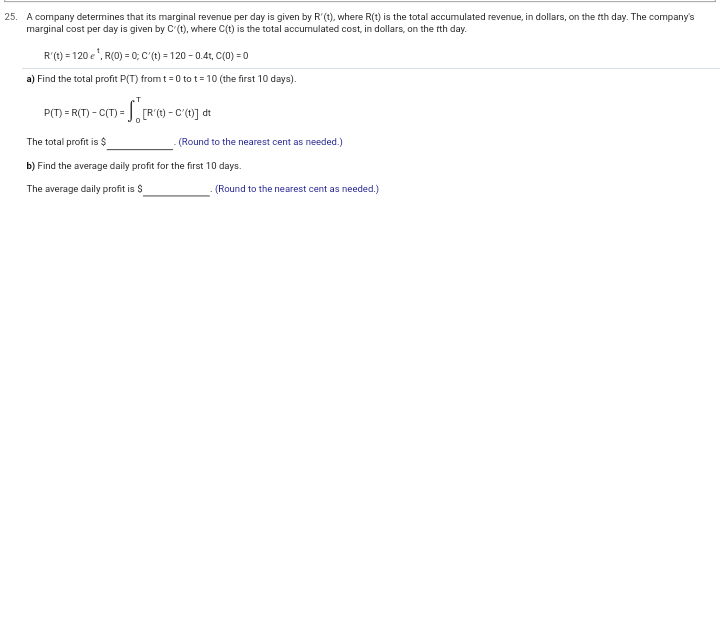
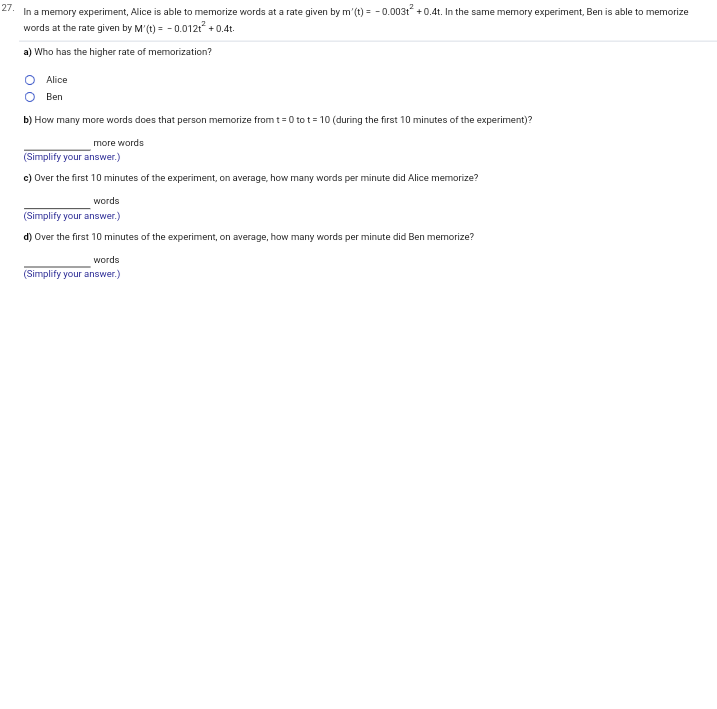
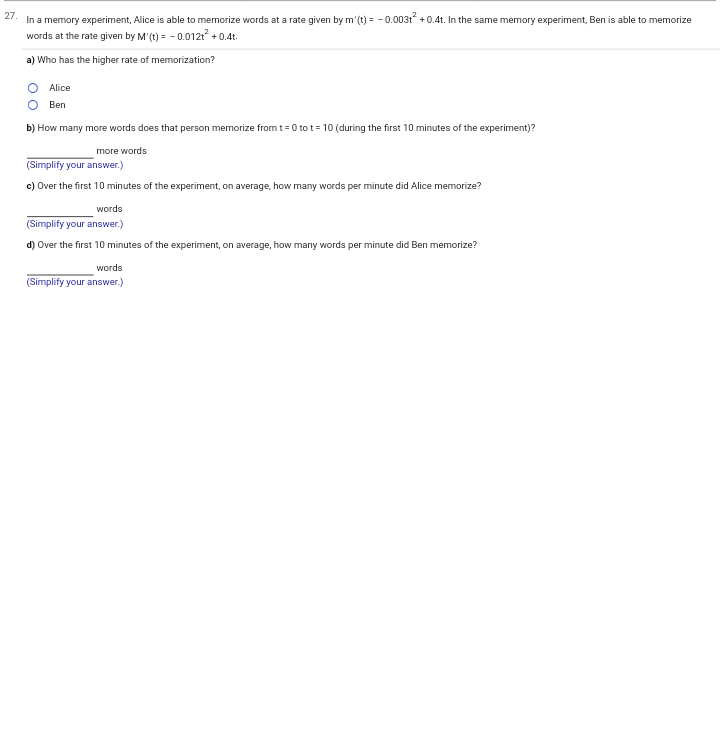
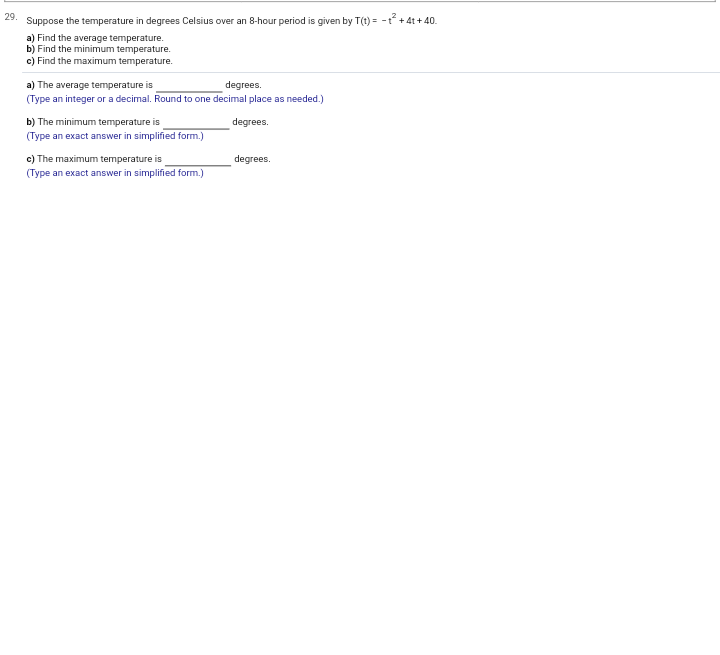
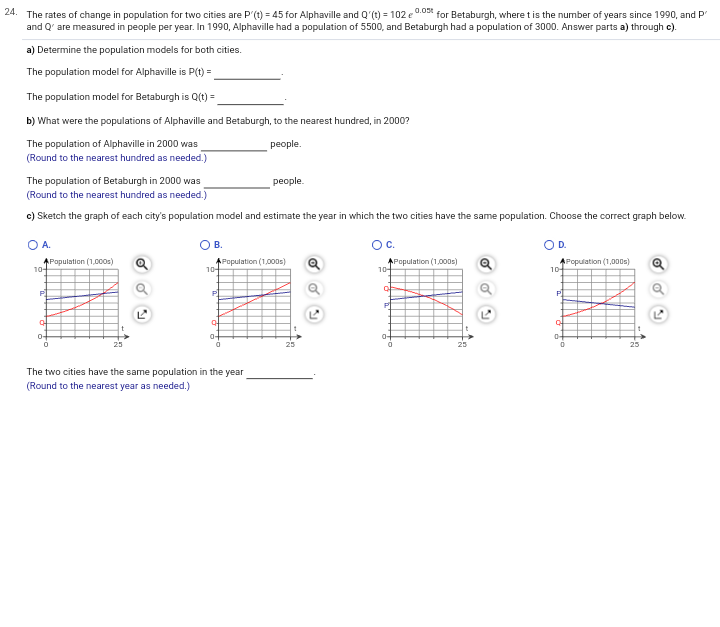
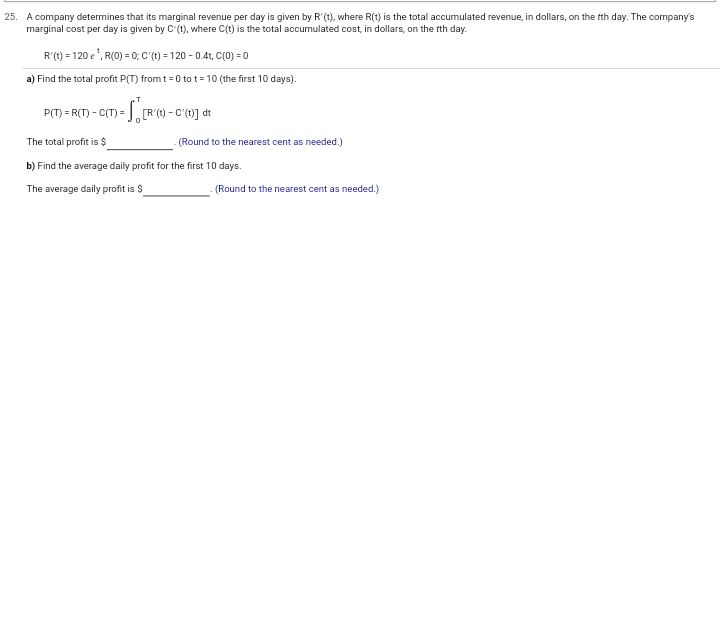
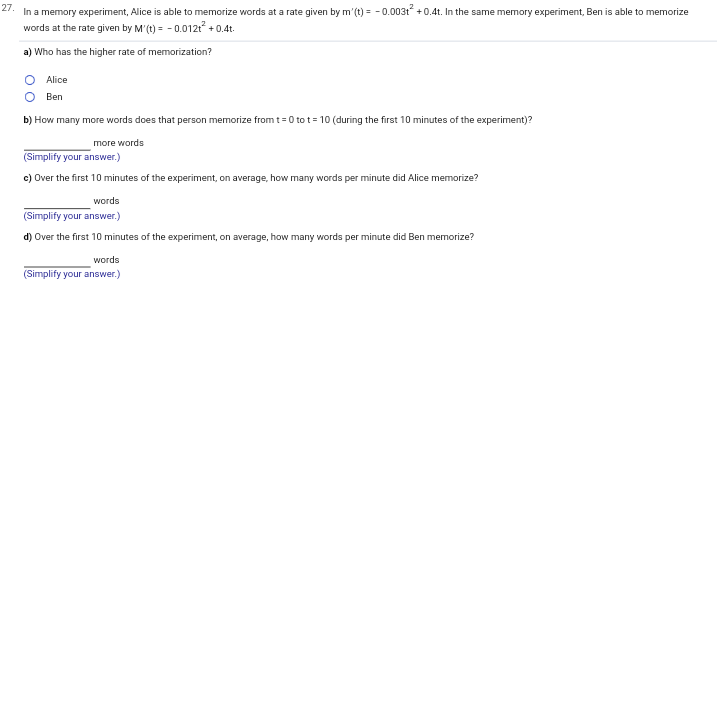
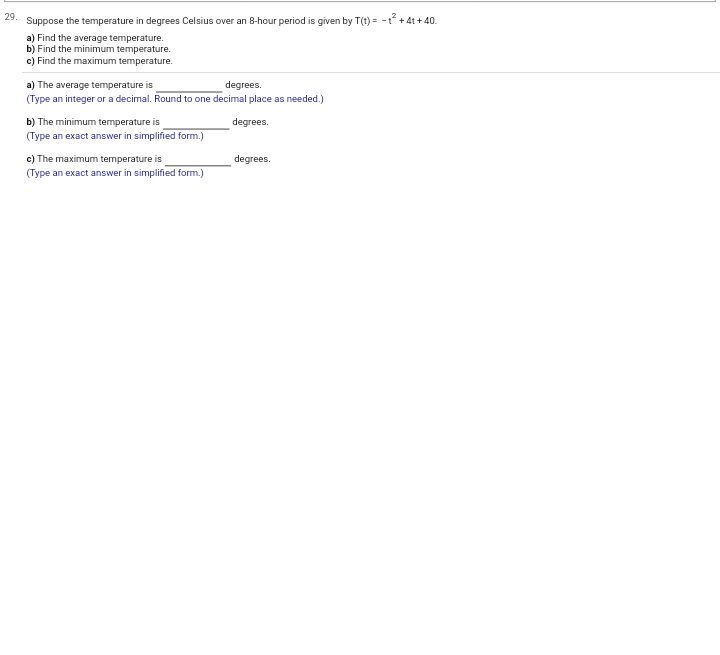
23 dE The rate at which a machine operator's efficiency, E (expressed as a percentage). changes with respect to time t is given by - =30 - 10t, where t is the number of hours the operator has been at work. ) Find E(t), given that the operator's efficiency after working 2 hr is 72%; that is, E(2) = 72. b) Use the answer in part (a) to find the operator's efficiency after 3 hr, after 5 hr. a) E(t) = b) The operator's efficiency after 3 hours is The operator's efficiency after 5 hours is24. The rates of change in population for two cities are P'(t) = 45 for Alphaville and Q'(t) = 102 ed." for Betaburgh, where t is the number of years since 1990, and P' and Q' are measured in people per year. In 1990, Alphaville had a population of 5500, and Betaburgh had a population of 3000. Answer parts a) through c). a) Determine the population models for both cities. The population model for Alphaville is P(t) = The population model for Betaburgh is Q(t) = b) What were the populations of Alphaville and Betaburgh, to the nearest hundred, in 2000? The population of Alphaville in 2000 was people. (Round to the nearest hundred as needed.) The population of Betaburgh in 2000 was people. (Round to the nearest hundred as needed.) c) Sketch the graph of each city's population model and estimate the year in which the two cities have the same population. Choose the correct graph below. O A. O B. O C. O D. *Population (1,000s) * Population (1,0009) Population (1,000s) Population (1,000s) 10- 10- Q 10 a a a LA LA 25 25 The two cities have the same population in the year (Round to the nearest year as needed.)25. A company determines that its marginal revenue per day is given by R'(t), where R(t) is the total accumulated revenue, in dollars, on the tth day. The company's marginal cost per day is given by C'(t), where C(t) is the total accumulated cost, in dollars, on the tth day. R'(t) = 120 e , R(0) = 0; C'(t) = 120 - 0.4t, C(0) = 0 a) Find the total profit P(T) from t = 0 to t = 10 (the first 10 days). P(T) = R() - C() = [ [RC) - city] dt The total profit is $ (Round to the nearest cent as needed.) b) Find the average daily profit for the first 10 days. The average daily profit is $ (Round to the nearest cent as needed.)27. In a memory experiment, Alice is able to memorize words at a rate given by m'(t) = -0.0031 +0.4t. In the same memory experiment, Ben is able to memorize words at the rate given by M'(t) = - 0.012t* + 0.4t. a) Who has the higher rate of memorization? Alice Ben b) How many more words does that person memorize from t= 0 to t = 10 (during the first 10 minutes of the experiment)? more words (Simplify your answer.) c) Over the first 10 minutes of the experiment, on average, how many words per minute did Alice memorize? words (Simplify your answer.) d) Over the first 10 minutes of the experiment, on average, how many words per minute did Ben memorize? words Simplify your answer.)27. In a memory experiment, Alice is able to memorize words at a rate given by m'(t) = -0.0031 +0.4t. In the same memory experiment, Ben is able to memorize words at the rate given by M'(t) = - 0.012t* + 0.4t. a) Who has the higher rate of memorization? Alice Ben b) How many more words does that person memorize from t = 0 to t = 10 (during the first 10 minutes of the experiment)? more words (Simplify your answer.) c) Over the first 10 minutes of the experiment, on average, how many words per minute did Alice memorize? words Simplify your answer.] d) Over the first 10 minutes of the experiment, on average, how many words per minute did Ben memorize? words (Simplify your answer.)29. Suppose the temperature in degrees Celsius over an 8-hour period is given by T(t) = -* + 41 + 40. a) Find the average temperature. b) Find the minimum temperature. c) Find the maximum temperature. ) The average temperature is degrees. (Type an integer or a decimal. Round to one decimal place as needed.) b) The minimum temperature is degrees. (Type an exact answer in simplified form.) c) The maximum temperature is degrees. (Type an exact answer in simplified form.)
Step by Step Solution
There are 3 Steps involved in it

Get step-by-step solutions from verified subject matter experts
 Study Help