







Question: reference: https://drive.google.com/file/d/1CKgK_0A_jH1kSdAdJz1Bglf4OjLDS-dp/view?usp=sharing please answer thank you so much. i will give a high rate. with solution/explanation What's More NOW IT'S YOUR TURN! Exercise 1.2 Comprehension
reference: https://drive.google.com/file/d/1CKgK_0A_jH1kSdAdJz1Bglf4OjLDS-dp/view?usp=sharing
please answer thank you so much. i will give a high rate. with solution/explanation
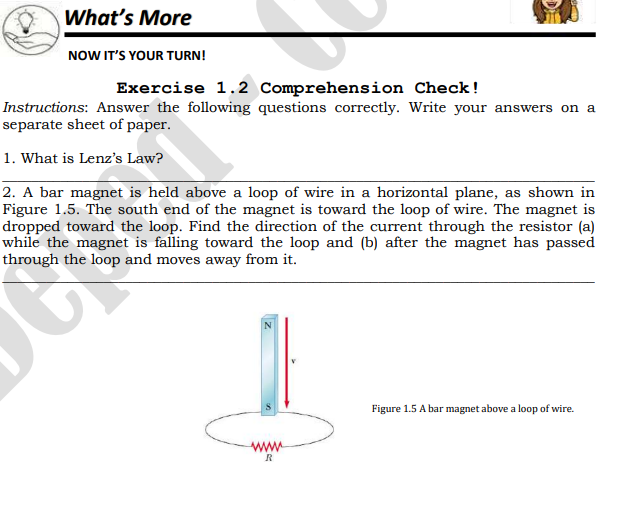
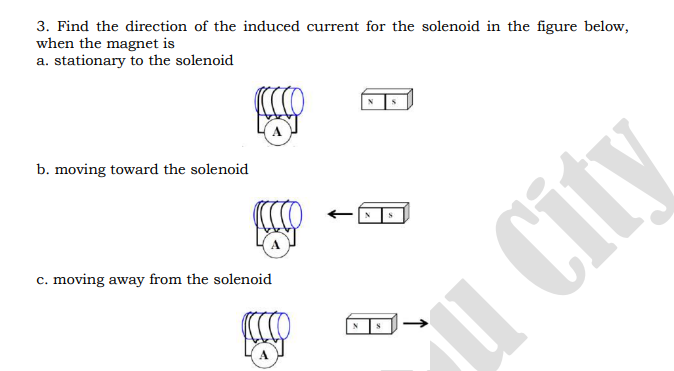
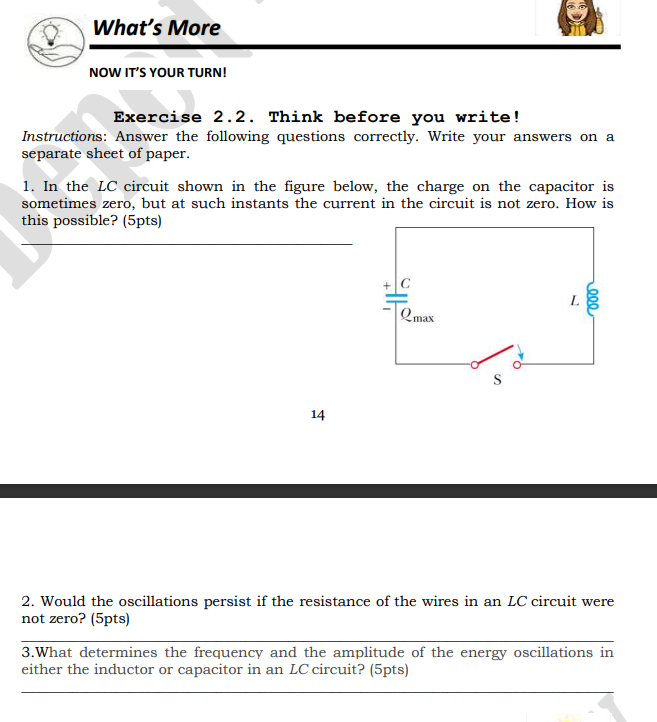
What's More NOW IT'S YOUR TURN! Exercise 1.2 Comprehension Check! Instructions: Answer the following questions correctly. Write your answers on a separate sheet of paper. 1. What is Lenz's Law? 2. A bar magnet is held above a loop of wire in a horizontal plane, as shown in Figure 1.5. The south end of the magnet is toward the loop of wire. The magnet is dropped toward the loop. Find the direction of the current through the resistor (a) while the magnet is falling toward the loop and (b) after the magnet has passed through the loop and moves away from it. Figure 1.5 A bar magnet above a loop of wire. R3. Find the direction of the induced current for the solenoid in the figure below, when the magnet is a. stationary to the solenoid N b. moving toward the solenoid N S C. moving away from the solenoid C N AWhat's More NOW IT'S YOUR TURN! Exercise 2.2. Think before you write! Instructions: Answer the following questions correctly. Write your answers on a separate sheet of paper. 1. In the LC circuit shown in the figure below, the charge on the capacitor is sometimes zero, but at such instants the current in the circuit is not zero. How is this possible? (5pts) + C 000 2max S 14 2. Would the oscillations persist if the resistance of the wires in an LC circuit were not zero? (5pts) 3.What determines the frequency and the amplitude of the energy oscillations in either the inductor or capacitor in an LC circuit? (5pts)
Step by Step Solution
There are 3 Steps involved in it

Get step-by-step solutions from verified subject matter experts
 Study Help