







Question: References: http://scikit-learn.org/stable/auto_examples/svm/plot_iris.html#sphx-glr-auto-examples-svm-plot-iris-py http://scikit-learn.org/stable/modules/model_evaluation.html Devlop a python program and include output. 1, Compare different algorithms of Sklearn (svm, DecisionTree, Naive Bayes, Stochastic Gradient Descent, Multi-layer Perceptron)
References:
http://scikit-learn.org/stable/auto_examples/svm/plot_iris.html#sphx-glr-auto-examples-svm-plot-iris-py
http://scikit-learn.org/stable/modules/model_evaluation.html
Devlop a python program and include output.
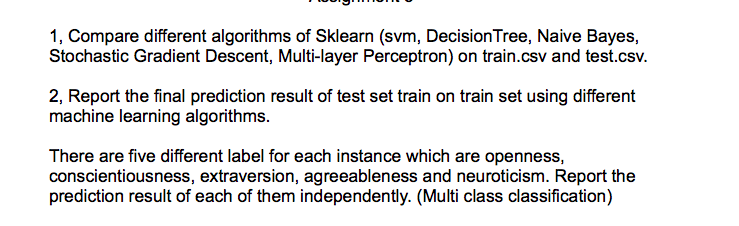
1, Compare different algorithms of Sklearn (svm, DecisionTree, Naive Bayes, Stochastic Gradient Descent, Multi-layer Perceptron) on train.csv and test.csv. 2, Report the final prediction result of test set train on train set using different machine learning algorithms. There are five different label for each instance which are openness, conscientiousness, extraversion, agreeableness and neuroticism. Report the prediction result of each of them independently. (Multi class classification) 1, Compare different algorithms of Sklearn (svm, DecisionTree, Naive Bayes, Stochastic Gradient Descent, Multi-layer Perceptron) on train.csv and test.csv. 2, Report the final prediction result of test set train on train set using different machine learning algorithms. There are five different label for each instance which are openness, conscientiousness, extraversion, agreeableness and neuroticism. Report the prediction result of each of them independently. (Multi class classification)
Step by Step Solution
There are 3 Steps involved in it

Get step-by-step solutions from verified subject matter experts
 Study Help